Care-home catering managers
Decide which products belong in standard recipes and which are needed for breakfast or snack service. Check that those choices can be used alongside residents’ individual menu requirements and preferences.


For care-home toast and sandwich service, consider a spreadable blend when spreading straight from chilled storage matters; for recipes where the kitchen needs to add salt separately, consider unsalted block butter. Compare the exact product’s salt and saturates per 100g, then check individual menu requirements, milk allergen information and storage instructions before serving.
The useful format depends on whether butter is going into recipes, being served at the table, or both.
Decide which products belong in standard recipes and which are needed for breakfast or snack service. Check that those choices can be used alongside residents’ individual menu requirements and preferences.
Compare the salt and saturates declared for each product, and decide whether a recipe needs unsalted butter so seasoning can be added separately. An individual plan may call for a different choice from the standard menu.
Consider how readily a chilled product can be spread on toast or sandwiches, while checking the exact pack’s milk allergen information and instructions for storage during service.
Start with how the product will be used, then compare its label with the menu and the way it will be stored and served.
| Priority | What to check | Your needs |
|---|---|---|
| Kitchen or table use | Check whether a recipe calls for block butter or whether staff need a product that spreads when chilled. Tesco Groceries describes Kerrygold Spreadable Butter 400g as spreadable straight from the fridge. | For toast service, I need a product staff can spread at the point of serving; for baking, I need to follow the recipe’s specified ingredient. |
| Salt and saturates | Compare both values per 100g on the exact pack. Tesco Groceries lists 0.9g salt per 100g for Lurpak Spreadable Slightly Salted 500g and 1.8g for Kerrygold Pure Irish Salted Butter 200g; their formulations also differ. | I want menu calculations to reflect the product actually used, rather than treating a salted block and a spreadable blend as interchangeable. |
| Individual menus | Check the resident’s diet plan and food preferences against the intended recipe or serving. If salt needs to be added separately during preparation, check whether unsalted block butter fits that recipe. | One standard product may work for the main menu, but I need to check whether it also fits an individual resident’s meal. |
| Milk allergen | Check the current ingredient and allergen declaration for every product and the record for the recipe in which it is used. The Food Standards Agency identifies milk as a common ingredient in butter. | Before service, I need the allergen record to match the product that reached the kitchen. |
| Chilled storage | Read the exact pack’s storage instructions and check how it will be held during preparation and service. Tesco Groceries lists refrigeration instructions for the checked Lurpak spreadable and Kerrygold salted block products. | A breakfast product needs to fit both our chilled storage and the way staff serve it. |
The checked Lurpak and Kerrygold products have different formulations and declared salt and saturates per 100g, according to their Tesco Groceries listings. Substituting one for another changes the figures used in menu planning.
Compare the current nutrition panel for the exact product before using it in a recipe or menu calculation.
Salted butter adds salt as part of the ingredient, before the kitchen seasons the rest of the dish. That distinction matters when a recipe or individual menu calls for control over added salt.
Check whether unsalted block butter fits the recipe, then account for any salt added elsewhere in the dish.
Spreadability does not establish allergen suitability. The Food Standards Agency identifies milk as a common ingredient in butter, and the checked Lurpak and Kerrygold products declare milk.
Check the delivered pack and the care home’s recipe and allergen records before service; follow its allergen-control procedure for the resident concerned.
These examples show why the format and exact product label matter more than a brand name alone.
Lurpak lists both unsalted butter and spreadable slightly salted products in its UK range. The checked spreadable product is a butter-and-rapeseed-oil blend, not plain block butter.
The checked Kerrygold products illustrate two distinct formats: a salted block butter and a spreadable blend.
Tesco Groceries’ category listings include own-label salted and unsalted block butter and a salted spreadable option.
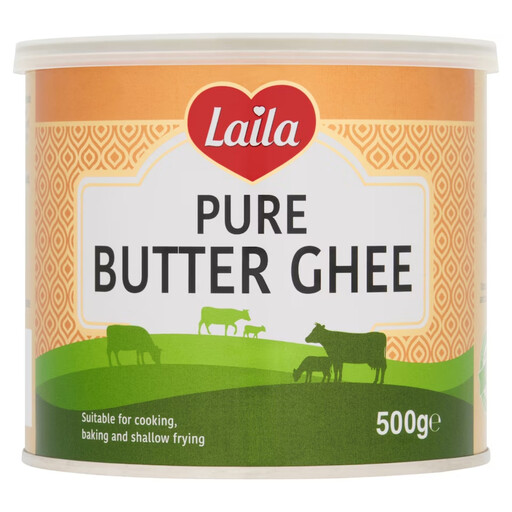
This selection is butter ghee for kitchen preparation. Assess it as a different format from the block butter and spreadable blends considered for other care-home uses.
 No image available
Consider this ghee for kitchen cooking rather than assuming it will work as a chilled table spread. Check the current pack’s nutrition declaration, milk allergen information and storage directions against the recipe and residents’ individual plans.
Not necessarily. Check the intended product against each resident’s diet plan, food preferences and any support needed at mealtimes; a standard menu choice need not suit every individual serving.
No. The checked Lurpak Spreadable Slightly Salted 500g and Kerrygold Spreadable Butter 400g are butter-and-rapeseed-oil blends, according to Tesco Groceries, rather than plain block butter. Compare the exact ingredients and nutrition declarations before substituting one format in a menu.
No. The Food Standards Agency identifies milk as a common ingredient in butter, and the checked Lurpak and Kerrygold products declare milk. Follow the care home’s allergen-control procedure and check the delivered product and recipe record before serving.
Follow the instructions on the specific pack. Tesco Groceries lists refrigeration instructions for the checked Lurpak spreadable and Kerrygold salted block products; check the delivered label and plan how the product will be held during service.