Care-home caterers serving dairy-free residents
A long-life coconut drink may be considered for cereal or drinks once the resident’s dietary needs, allergies and preferences have been checked.


Choose a long-life coconut drink only when its ingredients, declared nutrients and storage instructions fit the resident’s care plan; do not assume it can replace cows’ milk or a planned nutrition-support product. A fortified drink may suit a menu requiring its declared nutrients, while organic or no-added-sugar options address different preferences. “Filtered” does not mean UHT or establish how long a coconut drink will keep.
A long-life coconut drink may be considered for cereal or drinks once the resident’s dietary needs, allergies and preferences have been checked.
Norfolk and Waveney Integrated Care System’s 2026 care-home guidance calls for residents’ nutritional needs to be assessed and reviewed. Use that assessment and the resident’s care plan when considering a drink substitution.
Ingredients and precautionary allergen statements differ between coconut drinks, including variants from the same brand. Check the exact product before adding it to an allergy-managed menu.
Start with the resident’s care plan, then compare the exact carton’s nutrient declaration, ingredients and storage instructions.
| Priority | What to check | Your needs |
|---|---|---|
| Resident’s care plan | Confirm whether a coconut drink fits the resident’s assessed requirements. Compare its declared protein and other nutrients with the planned menu rather than treating dairy-free status as nutritional equivalence. | “I’m serving someone whose drink choice must fit an individual nutrition or hydration plan.” Norfolk and Waveney Integrated Care System’s 2026 guidance calls for care-home residents’ needs to be assessed and reviewed. |
| Fortification | Check the label separately for calcium, iodine, vitamin B12 and vitamin D if the menu calls for them. Tesco Groceries lists all four for Tesco Long Life Coconut Original; its Alpro Coconut Long Life listing names calcium and vitamins B2, B12 and D. | “The menu calls for particular declared nutrients, so I need to compare the exact product labels.” The UK government’s 2025 SACN/COT summary notes that nutrient content varies considerably between plant-based drinks. |
| Ingredients and allergens | Read the current pack and supplier information for ingredients and precautionary statements. Tesco’s drink carries a peanut-and-nut precaution; Plenish lists possible nut and soya cross-contact, while Alpro’s coconut barista variant contains soya. | “Before serving a resident with an allergy, I need the allergen information for this variant—not just the brand name or a vegan description.” |
| Sugar and formulation | Distinguish a sweetened drink from one labelled no added sugars, and check any other required nutrients separately. A barista variant may have different ingredients from the brand’s regular coconut drink. | “I want the carton to match the menu specification without assuming that ‘no added sugars’ answers every dietary requirement.” |
| Storage and processing | Look for UHT or long-life wording and follow the exact pack’s instructions after opening. Arla UK describes filtered cows’ milk as milk that undergoes an additional filtration process; that description does not establish a coconut drink’s storage life. | “I need an opened-carton routine that staff can follow, rather than applying an unopened-carton rule once the drink is in the fridge.” |
The UK government’s SACN/COT summary says plant-based drinks vary considerably in nutrient content. Tesco’s standard long-life coconut drink declares 0.5g protein per 100ml, while Plenish declares less than 0.5g per 100ml; neither figure establishes suitability for a resident’s nutrition-support plan.
For a resident at risk of malnutrition or with another clinical dietary requirement, use the assessed care plan and relevant dietetic advice before changing the drink served.
Arla UK uses “filtered” for an additional process applied to cows’ milk. A long-life coconut drink’s UHT description and its own storage instructions are separate information.
Specify a UHT or long-life coconut drink when that is what the menu requires, and check the chosen carton’s instructions after opening.
Those descriptions do not tell you whether the carton declares the calcium, iodine or vitamins required by a particular menu plan.
Write the required nutrients into the menu specification, then check each one on the exact product label.
Tesco lists a peanut-and-nut precaution, Plenish lists possible nut and soya cross-contact, and Alpro’s coconut barista variant contains soya. Substituting one carton for another can therefore change the information needed for service.
Keep records at product and variant level, and check the current pack against each resident’s allergy information before serving.
These product lines illustrate different label information to compare; a brand name alone does not establish suitability for a resident.
Tesco Long Life Coconut Original is a 1L UHT sweetened coconut drink with declared added nutrients.
Alpro Coconut Long Life Drink and Alpro Barista Coconut are distinct variants.
Plenish Organic Unsweetened Long Life Coconut Drink is a 1L UHT coconut-and-rice drink.
Rude Health Organic Long Life Unsweetened Coconut Drink is an organic coconut-and-rice product.
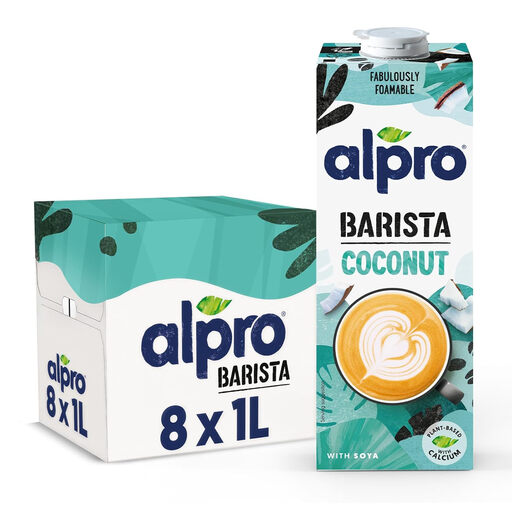
This barista-style long-life coconut drink may be considered for drinks service where its soya ingredient and declared nutrients fit the resident’s menu requirements.
 No image available
For a care-home drinks menu, check this barista variant against the resident’s care plan and allergy record before serving.
No. Arla UK describes filtered cows’ milk as undergoing an additional filtration process, whereas the coconut drinks discussed here are identified as UHT or long life. Check the exact coconut drink’s label for its processing and storage instructions.
No automatic substitution is appropriate. Norfolk and Waveney Integrated Care System’s 2026 care-home guidance calls for nutritional needs to be assessed and reviewed; compare the drink’s declared nutrients with the individual care plan before changing what is served.
Check all four declarations on the current carton. Tesco Groceries lists calcium, iodine, vitamin B12 and vitamin D2 for Tesco Long Life Coconut Original; its regular Alpro Coconut Long Life listing names calcium and vitamins B2, B12 and D, so do not assume the two labels declare identical nutrients.
Follow that carton’s refrigeration and use-after-opening instructions. The product information for Tesco Long Life Coconut Original and Rude Health Organic Long Life Unsweetened Coconut Drink says to use within 5 days after opening; Plenish Organic Unsweetened Long Life Coconut Drink says within 4 days.
No. Vegan status does not establish allergen suitability: Tesco lists a peanut-and-nut precaution, Plenish lists possible nut and soya cross-contact, and Alpro’s coconut barista variant contains soya. Check the current pack and the resident’s allergy record before serving.