Choose custard against each resident’s documented swallowing, allergy and nutrition requirements before deciding on a flavour or pack size. A standard ready-to-serve product may fit ordinary dessert service, while a light version is a separate choice for an individual nutrition plan; larger packs make sense only when the kitchen can use them within their labelled period after opening. For a prescribed texture, test the specific custard as it will be served rather than assuming that a smooth appearance is sufficient.
Who needs to make this choice?
Homes serving residents with prescribed textures
For residents whose swallowing plan specifies a texture or thickness, the care team needs to check the prepared custard against that plan. The International Dysphagia Diet Standardisation Initiative (IDDSI) calls for testing under intended serving conditions, including temperature; a can or carton does not establish that the food meets a particular level.
Homes planning desserts around individual nutrition needs
Catering teams may need both standard and light options rather than one substitution across the menu. For services regulated by the Care Quality Commission in England, Regulation 14 requires nutritional needs to be assessed and food provided to meet them.
Homes serving desserts in larger sittings
Kitchen teams can compare smaller cans with larger packs against the number of portions they expect to serve and the space available for opened products. The reviewed Ambrosia and Bird’s 1kg formats are intended for group service, but their stated refrigerated use period after opening is three days.
What matters when choosing custard?
Settle any resident-specific texture and dietary requirements first. Then compare the current label, the portion to be served and how quickly an opened pack will be used.
| Concern |
What to check |
Who this matters to |
| Prescribed texture |
Follow the resident’s swallowing plan and use the applicable IDDSI test on the exact custard at its intended serving temperature. |
If a resident has a prescribed texture, I need to know that the custard matches their plan when served hot or cold. About 40% of consumers put this texture requirement first. |
| Nutrition and allergens |
Compare the current per-100g and serving information with individual plans; check the delivered pack’s milk allergen declaration. |
When residents have different nutrition or allergy requirements, I cannot choose one standard or light product for everyone. About 30% of consumers primarily need to match the dessert to those individual requirements. |
| Pack size and storage |
Match the pack to expected portions, then follow its instructions for decanting, refrigeration and use after opening. |
For a small sitting or variable attendance, I want an opened pack we can use within its labelled period. This service-volume need comes first for about 30% of consumers. |
Mistakes to avoid
-
Assuming smooth custard meets a prescribed texture
Appearance alone cannot establish an IDDSI level, and serving temperature can affect the result. A mismatch with a resident’s swallowing plan is a serious safety concern.
Follow the documented plan and test the prepared product under its intended serving conditions using the applicable IDDSI methods.
-
Replacing every standard dessert with a light version
A lower-energy option is not automatically appropriate for a resident whose assessed plan calls for something different.
Compare the particular products’ labels, then make the standard-or-light choice for each resident’s needs and preferences.
-
Opening a large pack without a service plan
A 1kg pack may fit a busy sitting but leave more custard than a smaller service can use.
Plan portions before opening, label and refrigerate what remains, and follow the pack’s stated use period.
Unused custard becomes waste if it cannot be served within that period.
-
Using an online listing as the final allergen check
Ingredients and allergen declarations can change, making an older product listing unsuitable as the kitchen’s final reference.
Check the label on each delivered pack against the residents’ current requirements before serving.
Brands to consider
These examples show different ready-to-serve formats, not a ranking of brands. Check the current product label before using any of them in a resident’s menu.
Ambrosia
Its reviewed range includes standard and light 400g cans and a 1kg format, giving kitchens different pack sizes to assess for dessert service.
- Ambrosia’s standard 400g can instructs users to remove remaining contents from the can, refrigerate them and consume them within three days.
- The reviewed products contain milk. A light label does not establish suitability for an individual nutrition plan or a prescribed texture.
Bird’s
The reviewed Premier Foodservice ready-to-serve product comes as a case of 12 × 1kg packs for planned larger-volume service.
- Premier Foodservice states a 24-month unopened shelf life for this product and a three-day refrigerated use period after opening.
- It contains milk; pack size and texture still need to fit the residents being served and the kitchen’s turnover.
Tesco
The reviewed Tesco ready-to-serve custard is a 400g can for kitchens considering a smaller ambient pack.
- Tesco’s instructions say to transfer unused contents to a non-metallic container, cover, refrigerate and consume within three days.
- It contains milk. Use the declaration on the delivered can when checking ingredients and allergens.
Sainsbury’s
Its reviewed ready-to-eat custard is a 500g carton, a different unit size from the 400g cans and 1kg group-service packs.
- Sainsbury’s states that the opened carton should be refrigerated and consumed within three days and by the date shown.
- It contains cows’ milk; the current label, individual plan and any prescribed texture determine whether it can be served.
Ready-to-serve custard on Joybuy
These Ambrosia 400g and 1kg packs and a Morrisons 500g pack offer different unit sizes for planned care-home dessert service. Select a product only after checking the delivered label and each resident’s requirements.
 No image available
Ambrosia Light Devon Custard 1kg
Consider this larger pack where a light custard fits individual nutrition plans and group-service turnover is predictable. Check the delivered pack’s milk declaration; refrigerate it after opening and follow its stated use period. Test the prepared custard at serving temperature for any prescribed texture.
View on Joybuy
 No image available
Ambrosia Low Fat Custard 400g
This smaller light-custard can is an option where the resident’s nutrition plan calls for that choice and service volume does not warrant a larger pack. Sainsbury’s lists 78 kcal and 7.4g sugars per 100g for the reviewed product. Check the current milk declaration, decant and refrigerate leftovers as instructed, and test for any prescribed texture.
View on Joybuy
 No image available
Ambrosia Devon Custard 400g
This standard 400g can fits a smaller dessert service when the resident’s plan permits the product. It contains milk. Ambrosia instructs users to remove remaining custard from the can, refrigerate it and consume it within three days; check any prescribed texture at the intended serving temperature.
View on Joybuy
 No image available
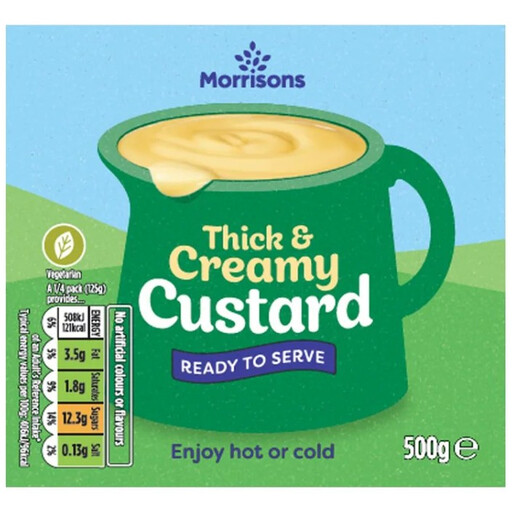
Morrisons Ready To Serve Custard 500g
The 500g pack is worth considering when expected portions fall between a smaller can and a group-service pack. Check its current milk allergen declaration and opened-pack instructions before service. A resident with a prescribed texture still needs the prepared product checked at serving temperature.
View on Joybuy
Frequently asked questions
Is ready-to-serve custard automatically suitable for an IDDSI diet?
No. The International Dysphagia Diet Standardisation Initiative calls for testing under intended serving conditions, particularly the serving temperature. Follow the resident’s swallowing plan and test the specific prepared product; its name or smooth appearance cannot confirm an IDDSI level.
Should a care home serve the same custard to every resident?
Not without checking individual requirements. For CQC-regulated services in England, Regulation 14 requires nutritional needs to be assessed and food provided to meet them. Swallowing instructions, allergies and the resident’s preferences also affect the choice.
How long can an opened can or carton of custard be kept?
Follow the instructions on that pack. The reviewed Ambrosia, Tesco, Sainsbury’s and Bird’s products specify refrigeration and consumption within three days after opening; canned products may also require unused custard to be transferred to another container. Check the current label rather than applying that period to every custard.
What allergen check matters when serving custard?
Check the ingredient and allergen declaration on the delivered pack against each resident’s requirements before serving. The reviewed custards contain milk. GOV.UK guidance says food businesses must provide allergen information and follow applicable labelling rules; a previously viewed listing is not a substitute for the current product information.


