What should you check before ordering?
Start with comparable nutrition panels, then check the ingredients and how the tomatoes will be used in the finished meal.
| Priority | What to check | Your needs |
|---|
| Sugars and claims |
Compare sugars per 100g on like-for-like chopped tomatoes. Read the ingredients separately: naturally occurring sugars, ‘no added sugar’ and ‘reduced sugar’ do not mean the same thing. |
I need a comparable figure for the recipe specification, not a claim inferred from the front of the tin. |
| Individual nutrition |
Check the resident’s assessed nutrition plan and the contribution of the complete dish. Check the current ingredient and allergen declarations against individual requirements. |
A lower-sugar ingredient must still fit the meal planned for each resident. |
| Salt |
Compare salt per 100g alongside sugars and check any no-added-salt wording. Tesco lists less than 0.01g salt per 100g for Everyday Value Chopped Tomatoes; Mutti lists 0.30g per 100g for Polpa. |
When tomatoes go into sauces and soups, I want to account for the salt in the tin and elsewhere in the recipe. |
| Finished texture |
Check the resident’s prescribed IDDSI level and assess the prepared dish using the applicable care-plan instructions. A ‘chopped’ or ‘finely chopped’ description does not establish the final texture. |
If a resident has a modified-texture diet, the served meal—not the wording on the tin—has to meet their instructions. |
| Pack and storage |
Match the number and size of tins to planned use. Follow the chosen product’s instructions for transferring, refrigerating and using opened contents. |
I need a pack format that the kitchen can use within its labelled open-life period. |
Brand and product-line references
These label examples provide points of comparison; each figure applies to the named product, not every tin from the brand.
Mr Organic
A chopped-tomato option for specifications that call for explicit no-added-sugar and no-added-salt wording.
- Ocado lists 2.3g naturally occurring sugars and 0.03g salt per 100g for Mr Organic Italian Chopped Tomatoes.
- No added sugar does not mean sugar-free or establish a reduced-sugar claim.
Tesco
An own-label chopped-tomato example for comparing declared sugars and salt.
- Tesco lists 2.8g sugars and less than 0.01g salt per 100g for Everyday Value Chopped Tomatoes.
- Check the current product listing and label before including this specific line in a procurement plan.
Napolina
A chopped-tomato option for recipes where the desired finished texture permits tomato pieces.
- Napolina lists 3.6g sugars and 0.10g salt per 100g for its chopped tomatoes.
- A chopped texture does not establish suitability for a prescribed modified-texture meal.
M&S
An organic chopped-tomato example where organic sourcing is part of the kitchen’s specification.
- Ocado lists 3.4g sugars and 0.02g salt per 100g for M&S Organic Italian Chopped Tomatoes.
- Organic labelling does not itself describe the product’s sugar content relative to other tins.
Mutti
Polpa is a finely chopped tomato option for recipes where that format is wanted.
- Mutti lists 2.8g sugars per 100g for Polpa.
- Mutti also lists 0.30g salt per 100g; fine chopping does not confirm an IDDSI texture level.
Asda
An own-label chopped-tomato example for comparing recipe-base labels.
- ASDA lists 3.8g sugars and 0.01g salt per 100g for its Chopped Tomatoes 400g.
- Compare both figures with the alternatives relevant to the recipe rather than selecting on salt alone.
Joybuy chopped-tomato options
These multipacks cover finely chopped and standard chopped tomatoes for care-home recipes. Compare the current label and pack instructions before ordering for a particular menu.
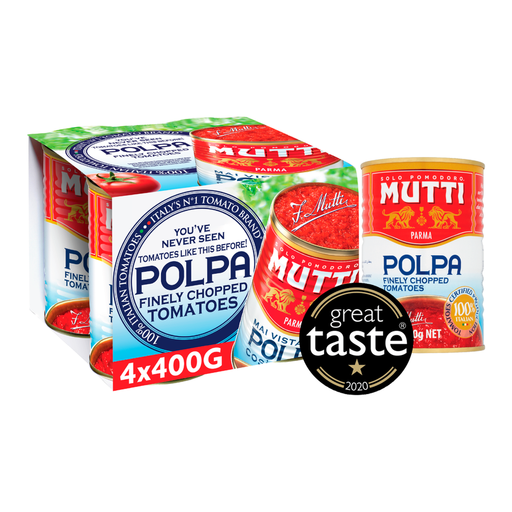 Image unavailable
Mutti Finely Chopped Tomatoes 4 x 400g
The four-tin format offers a finely chopped tomato base for recipes calling for that texture. Compare the current sugars and salt declarations, and check the finished dish against any prescribed texture level.
View on Joybuy
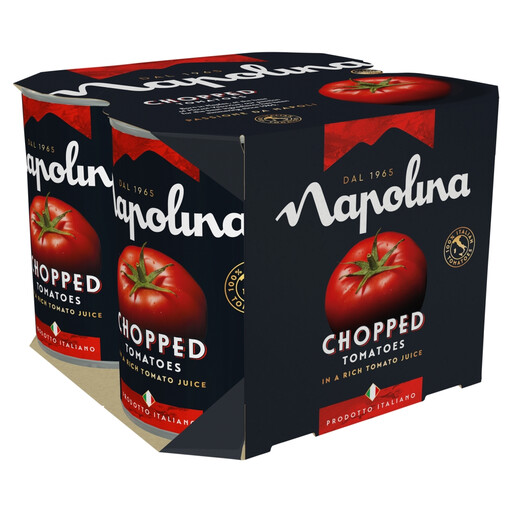 Image unavailable
Napolina Chopped Tomatoes 4 x 400g
This four-tin pack provides chopped tomatoes for recipes where tomato pieces are appropriate. Napolina lists 3.6g sugars and 0.10g salt per 100g for its chopped tomatoes; check the current pack and any resident-specific texture instructions.
View on Joybuy
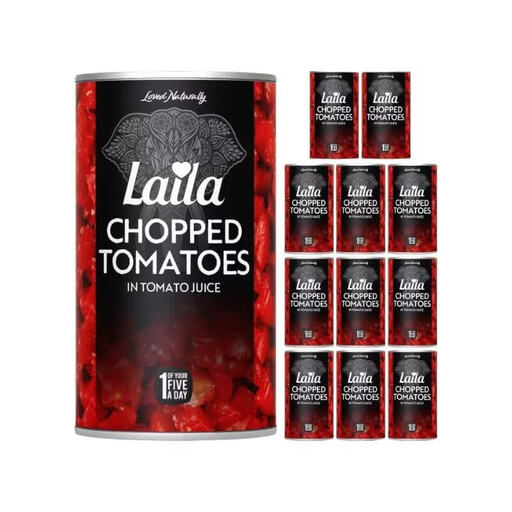 Image unavailable
Laila Canned Chopped Tomatoes 12 x 400g
The 12-tin pack is an option when planned meal production calls for more chopped tomatoes. Check its current sugars and salt per 100g, and match opened-tin handling to the instructions on the pack.
View on Joybuy
Questions about choosing and using them
Are ‘no added sugar’ and ‘reduced sugar’ the same thing?
No. Tomatoes can contain naturally occurring sugars without sugar being added, while ‘reduced sugar’ is a separate nutrition claim. Compare the sugars declared per 100g on similar chopped-tomato products; Great Britain’s Department of Health and Social Care publishes guidance on making nutrition claims.
Which of the compared chopped tomatoes declares the least sugar?
Mr Organic Italian Chopped Tomatoes has the lowest declared figure among the compared products: Ocado lists 2.3g sugars and 0.03g salt per 100g, with no added sugar or salt. That label comparison does not determine whether it suits an individual resident’s meal plan.
Should every resident with diabetes receive the lower-sugar tin?
No blanket substitution follows from the tin’s sugar figure. Norfolk and Waveney Integrated Care System advises that care-home residents’ nutritional needs be assessed and reviewed; choose ingredients within the individual’s assessed meal plan.
Can finely chopped tomatoes be used in a modified-texture meal?
Only when the prepared meal meets the resident’s prescribed texture instructions. South Tees Hospitals NHS Foundation Trust describes modified-texture diets using IDDSI levels; ‘finely chopped’ on a tin does not establish the finished dish’s level.
What should staff do with tomatoes left in an opened tin?
Follow the chosen product’s current storage instructions, including how to transfer and refrigerate unused contents and when to use them. Plan pack sizes around the kitchen’s expected use rather than assuming every product has the same open-life period.


