
24/7 Customer Support

Free returns

Same-day & Next-day Delivery

Quality Guaranteed

Unlock Your Welcome Offers: FREE Delivery | Up to 80% OFF | Free 30-day JoyPlus trial
Download the APP
A standard round pencil on a building site or in a workshop is a recipe for frustration. It rolls off uneven surfaces, the fine lead snaps under pressure and the mark it leaves on rough timber or concrete is often too faint to see clearly. For any professional tradesperson or serious DIY enthusiast, having the right tool for the job is essential, and that includes the humble pencil. A purpose-built carpenter's pencil is designed to overcome these exact challenges, providing a reliable mark every time.
This guide is designed to help you understand the key features of carpenters pencils and select the right type for your specific tasks. We will look at the different lead grades and what they mean for your work, helping you make a practical choice for your toolbox.
Selecting the correct pencil goes beyond just grabbing the first one you see. The material you are marking and the precision you require should guide your decision. Here are a few key points to consider.
The core of a pencil, often called the lead, is a mixture of graphite and clay. The ratio of these two components determines its hardness. This is a critical factor for marking pencils for construction.
One of the most recognisable features of builders pencils is their shape. Unlike the round or hexagonal barrels of writing pencils, a flat carpenters pencil has a rectangular or oval profile. This design serves two practical purposes. Firstly, it prevents the pencil from rolling away when placed on a sloped roof, a workbench or an uneven floor. Secondly, the rectangular lead can be sharpened to create either a fine point for precise lines or a broad, flat edge for bold, highly visible marks.
Joiners pencils and other trade-specific marking tools are built to withstand the rigours of a work environment. Their robust wooden bodies and strong, thick lead cores are far less likely to break than those of standard office pencils. This durability ensures they remain a reliable part of your toolkit, ready for marking cuts, drill points and guidelines on a variety of materials.
Based on their features and suitability for different tasks, here are our recommendations to help you find the right marking tool for your projects.
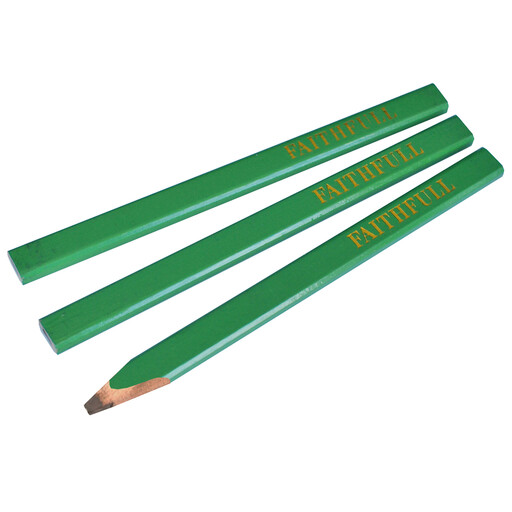
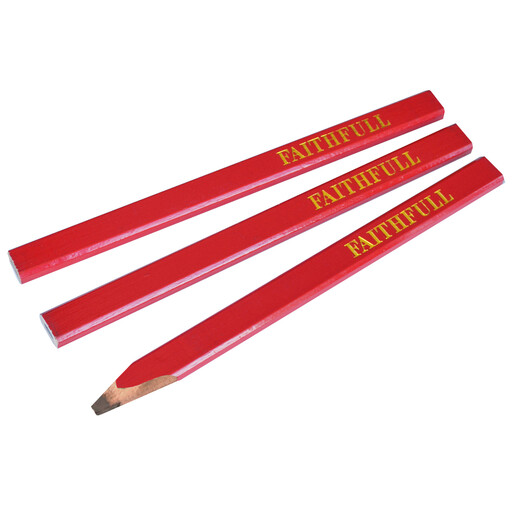
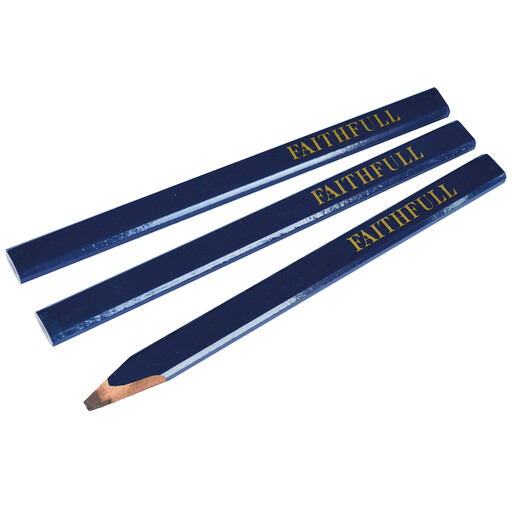
A good pencil is just one part of a well-stocked toolkit. If you are looking for other essential equipment to complete your projects, from marking gauges to chisels, we have a wide selection to browse.
Explore our full range of hand packing tools to find everything you need for your next job.
The main differences are in the shape and the lead. A carpenter's pencil has a flat, rectangular body to stop it from rolling away and a strong, rectangular lead core. This robust design makes it more durable for job site conditions and allows the user to sharpen it for either broad or fine lines.
The traditional and most common method is with a sharp utility knife. You carefully shave away the wood on one side to expose the lead, then shape the lead to a point or a chisel edge depending on your needs. Specialised sharpeners designed for flat pencils are also available.
A soft grade lead is generally the preferred choice for marking on concrete. It deposits more graphite onto the abrasive surface, creating a dark, thick and highly visible line that won't be easily missed. A hard lead would produce a very faint mark and wear down quickly on such a rough material.