
24/7 Customer Support

Free returns

Same-day & Next-day Delivery

Quality Guaranteed

Unlock Your Welcome Offers: FREE Delivery | Up to 80% OFF | Free 30-day JoyPlus trial
Download the APP
A suitable car polisher can make waxing, buffing and paint care more manageable, but choosing the wrong machine can lead to wasted money or disappointing results. UK buyers often focus on motor wattage or battery capacity while overlooking pad size, motion type and heat control.
Three common buying traps deserve attention:
A dual action car polisher, also called an orbital car polisher, combines rotation with an eccentric movement. This helps distribute motion across the pad and is generally easier for beginners to control during waxing, buffing and light paint correction.
A rotary polisher spins on a fixed axis. It can provide direct, concentrated movement for targeted correction, but requires more careful handling. Keeping the machine moving and using suitable pressure is important to reduce heat build-up.
Some mini car polishers offer both DA and rotary modes. This can be useful for motorbikes, wheel details, mirror housings, bumpers and other hard-to-reach areas.
A variable speed polisher gives you more control over different tasks. Lower settings are commonly used for spreading waxes, sealants and glazes, while higher settings may be used for more demanding polishing or oxidation work, depending on the compound, pad and paint condition.
Look for:
RPM figures are not directly interchangeable between rotary and orbital machines, so compare the motion type as well as the stated speed.
A 125 mm or 5-inch backing plate is a practical general-purpose size for many vehicle panels. Larger pads can cover broad areas more quickly, while smaller backing plates offer greater control around trim, pillars and curved sections.
A mains-powered car polishing machine can provide consistent power for a full vehicle. However, the cable requires careful positioning, especially outdoors. A cordless car buffer avoids cable management and is convenient for driveway detailing, although battery runtime and charging time should be checked before purchase.
For occasional waxing, a lighter machine may be preferable. For paint correction, sanding or extended polishing, consider motor design, cooling, replacement carbon brushes where applicable and the availability of compatible pads.
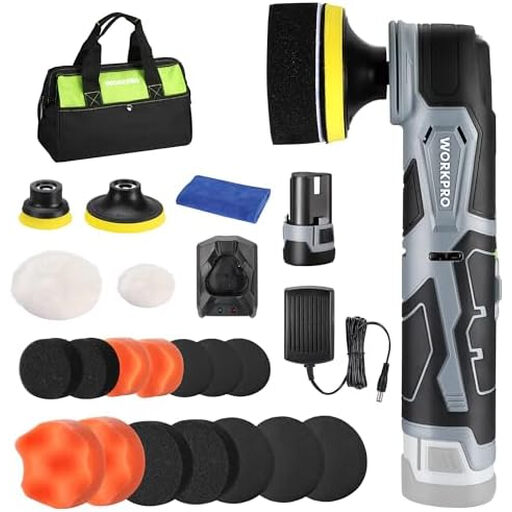
Why This Fits Their Persona: Its cordless 12 V format and 0.85 kg weight suit occasional driveway users who want a portable tool for waxing, sanding and small polishing jobs.
The five speed settings are clearly displayed, while the stated 6–7 minute high-speed thermal protection period makes continuous-use limitations visible before purchase.
Includes a 2.0 Ah battery, charger, carrying bag, multiple pads and six sandpapers. Standard-size replacement parts are available.
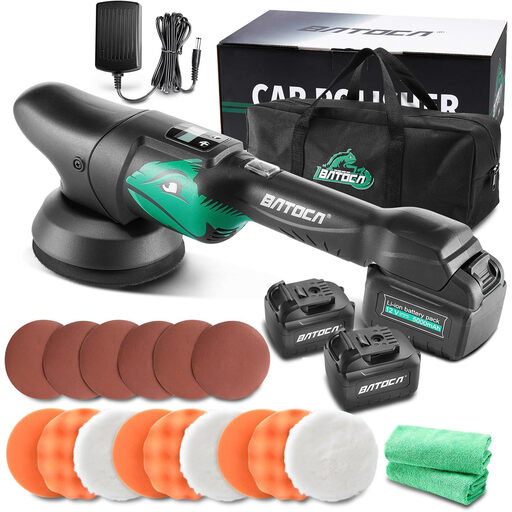
Why This Fits Their Persona: This battery polishing machine is suited to users wanting cordless convenience with a larger stated runtime for planned detailing sessions.
The kit includes two 5 Ah batteries, so one can be charged while the other is in use. The LCD shows speed and battery information during operation.
Offers six speed levels from 2000 to 4500 RPM, an 8 mm eccentric action and a 125 mm pad size.
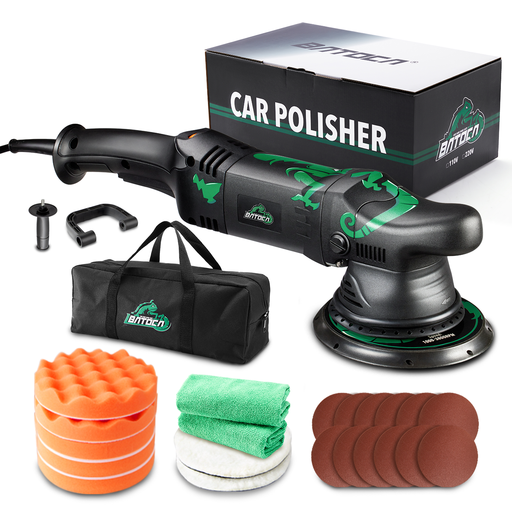
Why This Fits Their Persona: The 1100 W corded format is suited to users carrying out longer polishing, buffing or sanding sessions where a continuous power supply is useful.
Six electronic speed settings from 2500 to 5500 RPM provide more adjustment than a fixed-speed car buffer, while replaceable carbon brushes support ongoing maintenance.
Includes a side handle and D-shaped handle, with foam pads for waxing, buffing, sanding and polishing.
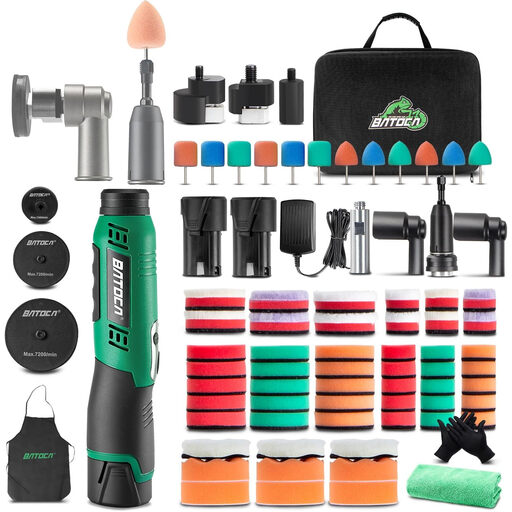
Why This Fits Their Persona: Its compact backing plates and switchable DA and rotary systems are designed for motorbikes, rims, corners and small paintwork areas.
The kit identifies its 25 mm, 50 mm and 75 mm backing plates, eccentric drives and separate speed ranges, making the intended detail work clearer.
Includes two 12 V 2.0 Ah batteries and a mini polishing system rated from 4200 to 21000 RPM without load.
Before buying a car detailing polisher, check that the plug, charger and electrical information are suitable for UK use. Products supplied for the UK should carry the appropriate conformity marking and safety information. For corded equipment, use a suitable RCD-protected supply and keep the cable away from the pad, water and vehicle wheels.
For reliable results:
A cordless machine has no direct fuel cost, but battery replacement and charging time affect long-term value. A corded machine may be more practical for frequent full-car work, while a battery tool can reduce setup time for small jobs.
We have compiled a complete, real-time list of products that fully satisfy these strict selection criteria and UK safety regulations.
A DA machine is often easier to control than a rotary polisher because its eccentric movement spreads the action across the pad. Beginners should still start at a low speed, use a suitable pad and avoid holding the machine over one spot.
Runtime varies with speed, pressure, pad size, paint condition and battery capacity. Check whether the stated runtime is under load or without load. Two batteries can be useful for longer sessions, but allow for charging time and thermal protection pauses.
Electricity use is usually modest compared with the purchase price, but the actual cost depends on wattage, session length and your tariff. For cordless models, include battery charging and possible replacement batteries in your ownership calculation.