
24/7 Customer Support

Free returns

Same-day & Next-day Delivery

Quality Guaranteed

Unlock Your Welcome Offers: FREE Delivery | Up to 80% OFF | Free 30-day JoyPlus trial
Download the APP
A car polishing machine can reduce the effort involved in waxing, buffing and paint finishing, but choosing the wrong type may create more work rather than less. A large rotary car polisher may be difficult to control on curved panels, while a small cordless car polisher may lack the runtime or pad coverage needed for a whole vehicle.
The main buying traps are easy to overlook:
A dual action polisher, also called a random orbital or orbital car polisher, combines rotation with eccentric movement. This distributes motion across the pad and is generally easier for DIY users to control than a rotary machine. It is suitable for waxing, buffing and gradual paint correction when used with the correct pad and compound.
A rotary car polisher spins on a fixed axis. It can provide concentrated cutting action, but it requires careful speed, pressure and heat management. For occasional home detailing, a dual-action design may offer a more forgiving operating style.
Do not confuse a random orbital sander with a dedicated car detailing polisher. Random orbital sanders are designed primarily for wood, metal and painted surfaces using abrasive discs. They may be suitable for light finishing or polishing with compatible accessories, but check the manufacturer’s instructions before using one on vehicle paint.
A variable speed polisher is more adaptable than a single-speed tool. Lower settings are normally useful for spreading waxes, sealants and glazes, while higher settings may be used for buffing or selected correction work. Start slowly, keep the pad moving and avoid applying excessive pressure.
The displayed RPM should be considered alongside the machine’s action and intended use. For example, the BATOCA S2 offers six settings from 2,000 to 4,500 RPM, while the wired BATOCA dual-action model provides six settings from 2,500 to 5,500 RPM. These figures describe the available speed range, not a guaranteed finish on every paint type.
Soft-start functionality, an LCD display or speed memory can also improve control. They are practical features when working around edges or when frequently stopping to inspect the panel.
A corded electric sander or polisher provides continuous mains power, which can be useful for furniture restoration, workshop sanding or polishing an entire vehicle. A cordless car polisher is easier to move around a driveway, but battery capacity, spare batteries and charging time should be checked together.
Pad size affects coverage and manoeuvrability:
For sanding, dust extraction is an important consideration. An eight-hole suction base, dust bag or external collector can help reduce airborne particles, but it does not replace eye protection, suitable respiratory protection or ventilation. Before buying, check the product instructions and confirm that the tool is appropriate for your material. Some sanders specifically exclude walls or lime-based materials.
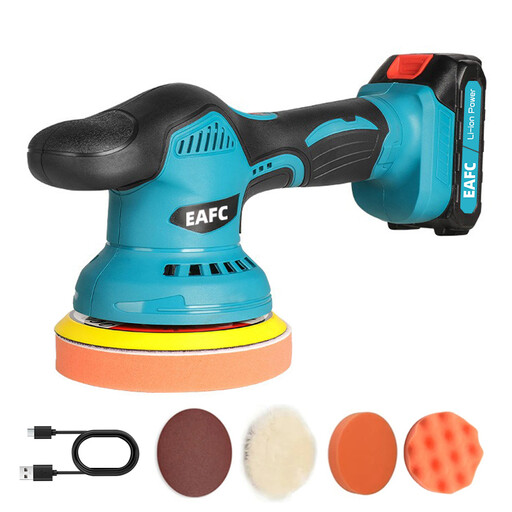
Why This Fits Their Persona: A practical cordless option for occasional car waxing, furniture polishing and light DIY work around the home, without being tied to a mains cable.
Its eight selectable speeds and 5 mm random orbital movement provide more control than a fixed-speed buffer, while the 125 mm disc covers general panels.
Listed features include 2,800–5,500 RPM, a 1.13 kg body and accessories for waxing, sanding and polishing.
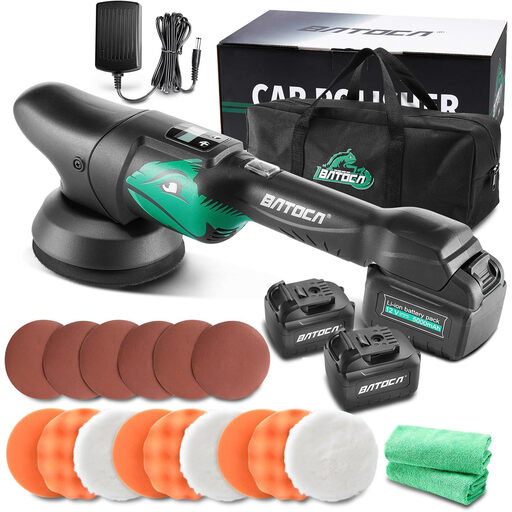
Why This Fits Their Persona: A cordless 8 mm eccentric polisher for car owners who value portability, speed visibility and the ability to continue working with a spare battery.
The LCD shows speed and battery information, and the kit includes two batteries, reducing interruption during longer detailing sessions.
Six speed settings from 2,000–4,500 RPM, two 5 Ah batteries and a listed charging time of 2.5 hours.
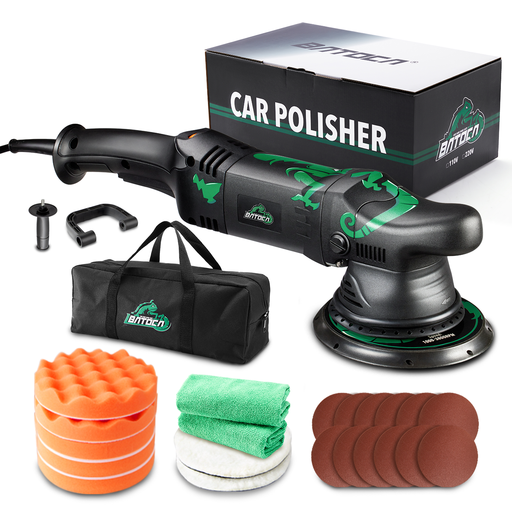
Why This Fits Their Persona: The corded format suits workshop users, professional detailers and home mechanics who need continuous operation across larger vehicles or repeated projects.
Its 5-inch pad balances panel coverage with control, while six electronic speed settings help separate low-speed waxing from higher-speed correction tasks.
The listed motor output is 1,100 W, with a 2,500–5,500 RPM range, locking switch and removable side and D-shaped handles.
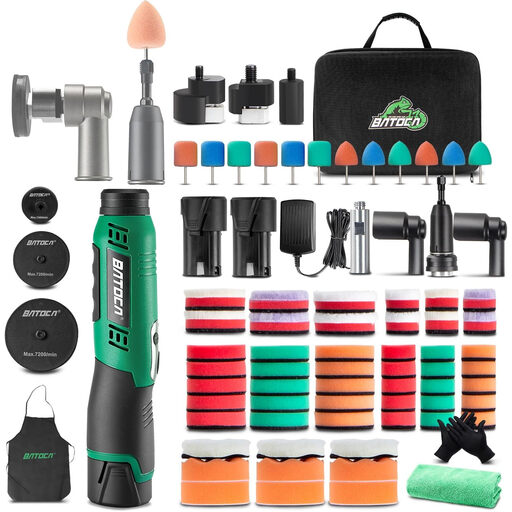
Why This Fits Their Persona: Designed for small areas, motorcycle parts, wheels, door jambs and tight bodywork where a full-size car buffer cannot manoeuvre easily.
It addresses the pad-size problem with 25 mm, 50 mm and 75 mm backing plates, plus switchable dual-action and rotary modes.
It includes two 12 V 2 Ah batteries, six RO/DA speed settings and a separate mini polishing range listed at 4,200–21,000 RPM.
Before using any car polishing machine, wash and dry the panel, remove loose grit and inspect the paint. Test the compound and pad combination on a small inconspicuous area. Keep the pad flat where appropriate, use light pressure and work in manageable sections.
For mains-powered tools, check the plug, cable and instructions before use. For battery models, factor in replacement battery availability, charging time and battery storage. The WORKPRO cordless mini polisher, for example, includes a 2,000 mAh battery and lists a one-hour charging time, but also states that high-speed use may activate heat protection after six to seven minutes. That makes it more suitable for short detail work than uninterrupted large-panel polishing.
UK buyers should also check the supplied instructions, manufacturer information, age guidance and applicable product markings before purchase. Use eye protection and suitable dust protection for sanding, and never use a tool in wet conditions unless it is specifically rated for that environment.
We have compiled a complete, real-time list of products that fully satisfy these strict selection criteria and UK safety regulations.
A dual action polisher is often easier to control than a rotary design because its movement is distributed across the pad. Beginners should still start at a low setting, use a suitable pad and avoid lingering over one area, as friction can create heat.
Some random orbital sanders may accept compatible polishing pads, but they are primarily designed for abrasive sanding. Check the manual, backing-plate compatibility and speed range first. A dedicated car detailing polisher usually provides more appropriate pad options and handling.
Runtime depends on battery capacity, pressure, speed, pad load and surface area. Product listings may quote no-load runtime, so treat figures as guidance rather than a guaranteed full-vehicle duration. A kit with two batteries can reduce downtime, provided the spare is charged and compatible.