Daily carrot juicers with little worktop space
You need a model intended for hard carrots, but also need room to operate it and somewhere practical to store it after use.


A compact centrifugal juicer is a sensible choice if you want to juice carrots quickly and can accommodate its feed chute and full footprint. Consider a cold-press model if pulp options and juice texture matter more to you than speed. Good Housekeeping UK notes that centrifugal juicers tend to be faster but can produce frothier juice; whichever type you choose, check that the specific model is intended for hard vegetables and fits where you will use it.
You need a model intended for hard carrots, but also need room to operate it and somewhere practical to store it after use.
You want to limit cutting and washing up. The feed opening, removable cleaning parts and container capacity may matter more to you than extra functions.
You are willing to consider a slower process for pulp options or a different juice texture, provided the appliance still fits your kitchen. Check any noise claims against the specific model rather than assuming every cold-press juicer is quieter.
For carrot juice in a small kitchen, establish where the assembled juicer will fit, then weigh cutting and juicing time against texture and the cleaning routine.
| Concern | What to check | Who this matters to |
|---|---|---|
| Kitchen fit | Check assembled width, depth and height, including space above the feed chute and room to remove parts. | If I have little worktop or cupboard space, a juicer that cannot be loaded or put away comfortably will be difficult to use regularly. Roughly 40% of consumers put physical fit first. |
| Carrot preparation | Confirm stated carrot or hard-vegetable suitability and compare feed-chute openings; follow the model’s instructions for cutting produce. | On a busy morning, I want to spend less time cutting carrots and stopping between batches. Speed and preparation are the primary concern for around 40% of consumers. |
| Texture and upkeep | Look at pulp options and which removable parts can go in the dishwasher; check model-specific information about noise. | If I will make juice often, pulp texture and the work of cleaning the machine affect whether I keep using it. Those considerations come first for roughly 20% of consumers. |
Wattage does not tell you how large the feed opening is or whether the model is intended for hard vegetables. Models take different approaches: Sage specifies a hard-vegetable speed setting for its Nutri Juicer Cold, while Ninja describes an anti-clog filter for the JC151UK.
Check the exact model’s produce guidance, feed opening and cleaning parts alongside its dimensions.
A narrow appliance may still be awkward beneath wall cupboards. SharkNinja lists the JC151UK at 18.16 cm wide and 40.46 cm high.
Measure the operating position in all three directions, leaving room to load carrots and remove the lid and containers.
Manufacturer comparisons about yield or nutrient retention depend on their particular test conditions. They do not establish what every juicer will produce with your carrots and preparation method.
Prioritise stated carrot suitability, fit, feed opening and cleaning requirements before using such claims to distinguish models.
A citrus press or blender serves a different purpose from a juicer intended to extract juice from hard vegetables.
Check the product type and its explicit guidance for carrots or other hard produce, rather than relying on the word juicer in a listing title.
The Viva HR1832/01 is a compact centrifugal option to consider when quick carrot juicing and limited worktop space are priorities.
The JC151UK is a narrow cold-press option for people interested in pulp choice and removable parts that can go in the dishwasher.
The Nutri Juicer Cold BJE430SILUK is a centrifugal option to assess if a wider feed opening and larger batches matter more than the smallest footprint.
The Juice Expert 3 is a multifunction option if carrot juice is only one of the drinks you intend to make.
These centrifugal juicers address two different space and preparation priorities: a wider-chute model for reducing carrot cutting and a compact model for smaller servings. Check each appliance’s operating clearance before deciding which suits your kitchen.
 No image available
Consider this centrifugal model if reducing carrot cutting matters more than choosing the smallest appliance. Its title specifies a 3-inch chute, a 1.5 L pulp basin and dishwasher-safe parts. Check the space needed above it for loading produce and removing parts.
 No image available
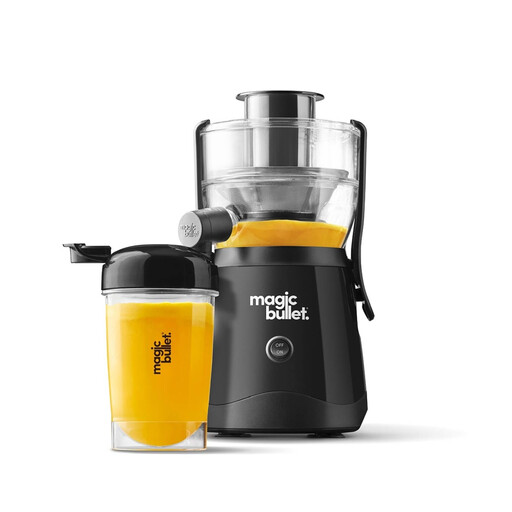
Consider this compact centrifugal model if you make smaller servings and need to put the juicer away after use. Its title specifies a 470 ml capacity and dishwasher-safe parts. Check the feed opening against the size of the carrots you normally use.
Either type can work if the specific model is intended for hard vegetables. A centrifugal model suits a priority for faster juicing; Good Housekeeping UK notes that this type tends to be faster but can make frothier juice. Consider cold press if a model’s pulp options appeal to you, while checking its dimensions and preparation requirements.
Peeling is not part of Magimix’s carrot-juice recipe: it instructs users to wash, top and tail the carrots. Follow the instructions for your own juicer and cut carrots as needed to fit its feed opening safely.
Check that the model is supplied for the Great Britain market by an identifiable seller and review its applicable conformity information. GOV.UK states that CE marking continues to be recognised alongside UKCA marking for many products in Great Britain; check the requirements separately if you are buying for Northern Ireland.