
24/7 Customer Support

Free returns

Same-day & Next-day Delivery

Quality Guaranteed

Unlock Your Welcome Offers: FREE Delivery | Up to 80% OFF | Free 30-day JoyPlus trial
Download the APP
Cat food multipacks can simplify shopping, reduce packaging clutter and give your cat more flavour choice. However, a large box is not automatically economical or suitable. The right choice depends on your cat’s age, the food’s nutritional status and whether every pouch will actually be eaten before it expires.
A selection of flavours may look appealing, but some products are complementary pet food, intended as a topper or treat rather than a sole meal. Lily’s Kitchen Tuna with Salmon Shredded Fillets, for example, is described as complementary and suitable alongside a balanced diet. It contains shredded tuna and salmon in broth, but should not replace complete adult cat food or kitten wet food at every meal.
Look for the statutory wording “complete pet food” if you want a product that can form your cat’s main diet. “Complementary” means you need to combine it with another nutritionally complete food.
A 40-pouch case may offer a lower price per pouch, but it only saves money if your cat accepts the flavours and the food can be stored properly. A fussy cat may leave unwanted portions, while an unsuitable multipack can become expensive waste.
Calculate the cost per 85g or 100g pouch, then compare it with the recommended daily amount. Individual pouches can also support portion control and help keep food fresh.
Kitten food is formulated for growth, while adult cat food is intended for maintenance. Do not choose kitten wet food simply because the pack contains attractive fish flavours. Check the stated age range carefully.
For example, the Felix Kitten Fish Selection is labelled for kittens aged 2–12 months, while the BLINK Chicken Selection is designed for adult cats aged 1 year and above. A food suitable for one life stage should not automatically be used for another.
The label should clearly state whether the food is:
Cat treats, including creamy snack sachets, should remain a small part of the daily intake. Dreamies Creamy Snack with Salmon or Chicken recommends up to one sachet per day and states that it should not replace a complete and balanced diet.
Compare the feeding guide with your cat’s weight, age and activity. An adult cat may need two to four pouches daily depending on the recipe and body size, whereas a kitten has different growth-related requirements.
Useful information includes:
These figures are not directly comparable without considering moisture levels and the complete ingredient profile. Use them as practical reference points rather than judging a food by one number alone.
For cats that prefer seafood, fish selection cat food may include tuna, salmon, cod, trout, sardine or whitefish. Chicken cat food and mixed poultry recipes may suit cats that regularly eat meat-based flavours.
Grain-free cat food can be useful for owners avoiding cereals, but “grain-free” does not by itself prove that a recipe is nutritionally superior. Check whether the product is complete, whether your cat accepts it and whether the ingredients suit its known sensitivities. A jelly, gravy or shredded texture can also influence whether a cat finishes the meal.
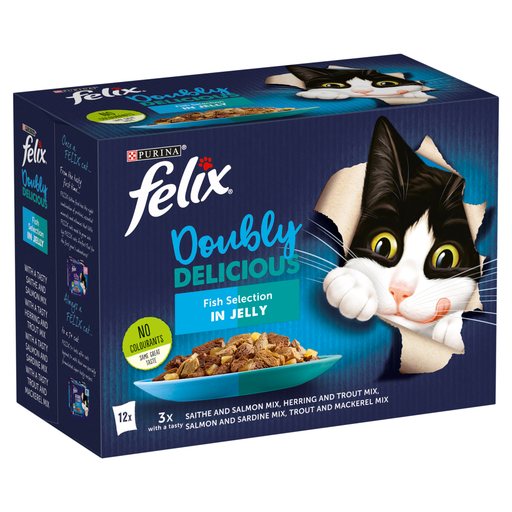
Why This Fits Their Persona: A 12-pouch fish selection gives new cat owners a manageable way to offer several flavours without committing to a very large case.
It is described as 100% complete and balanced, helping distinguish a main meal from a complementary pouch or treat.
Four paired fish recipes; 85g pouches; listed at 75 kcal per 100g.

Why This Fits Their Persona: Suitable for owners who want several recipes, named meat and fish ingredients and convenient 100g portions for adult cats and kittens from 8 weeks.
The pack lists complete wet meals, four recipes and feeding guidance rather than relying on variety alone as the selling point.
Ten 100g pouches; four recipes; product information states 93% real meat and fish content.

Why This Fits Their Persona: A large case suits multi-cat homes or owners who feed wet food daily and want a consistent supply of individual portions.
The 3.4kg total is clearly stated, while the pack includes different formulas and feeding guidance for adult cats.
40 individual 85g pouches; chicken, chicken and turkey and fish formulas; grain-, sugar- and salt-free according to the listing.

Why This Fits Their Persona: Designed for kittens aged 2–12 months, it gives owners four flavours while keeping the pack size suitable for testing preferences.
The life stage is clearly specified, and the listing identifies the pack as kitten food rather than adult maintenance food.
Four flavours; 8 × 85g pouches; listed at 14.5% crude protein and 81 kcal per pouch.
We have compiled a complete, real-time list of products that fully satisfy these strict selection criteria and UK safety regulations.
They can reduce the price per pouch, but the saving depends on pack size, feeding rate and waste. Compare the total weight and price per 100g, then check whether your cat will eat every flavour.
Kittens should generally receive food labelled for their growth stage. Choose kitten wet food or a complete kitten recipe, such as a selection labelled for 2–12 months. Check the packaging before feeding, particularly when a multipack contains several recipes.
Follow the product label. Many wet cat food pouches advise refrigerating unused portions and consuming them within two days. Smaller pouches can help households where a cat does not finish a full serving at once.