
24/7 Customer Support

Free returns

Same-day & Next-day Delivery

Quality Guaranteed

Unlock Your Welcome Offers: FREE Delivery | Up to 80% OFF | Free 30-day JoyPlus trial
Download the APP
As a Joybuy Product Recommendation Officer, my role is to help you navigate the market and find practical solutions for your home. For cat owners who value a tidy and stylish living space, the standard plastic litter tray can be a constant source of frustration. It clashes with decor, scatters litter across your floors and does little to contain odours.
Cat litter box furniture promises a solution, elegantly concealing the tray within a cabinet or bench. However, not all designs are created equal. Many fall short, leaving you with a purchase you regret. Before you invest, be aware of these common pitfalls that can turn a clever solution into a costly mistake.
To ensure your chosen piece is both a stylish addition to your home and a functional cat washroom furniture, focus on these core parameters.
The longevity of your litter box enclosure furniture depends entirely on its construction. Look for pieces made from high-quality, dense particleboard or MDF with a durable, water-resistant veneer or paint finish. This surface is crucial for easy cleaning and preventing moisture damage. Check the product specifications for the maximum load capacity of the top surface. A sturdy top (e.g., 60 kg or more) indicates a robust build and allows the unit to double as a practical side table or bench.
Measure your current litter tray before you even start browsing. Compare its length, width and height against the internal dimensions of any cabinet you consider. A good rule of thumb is to allow at least 5-10 cm of clearance around the tray for easy removal and cleaning.
The entryway is also critical. For larger breeds like Maine Coons or Ragdolls, ensure the opening is spacious enough. If you have a dog, look for a dog proof litter box design. These often feature an elevated entrance or an internal partition, creating a path that a cat can easily navigate but a larger, less agile dog cannot.
Effective odour management relies on airflow, not containment. Look for designs that incorporate discreet ventilation slots, often on the back or sides of the unit. This allows air to circulate, preventing the build-up of ammonia and keeping the space fresher.
To reduce litter tracking, the best designs incorporate an entryway that encourages cats to walk over a surface before exiting. An internal divider or a longer entryway forces them to take a few steps, causing litter to fall from their paws inside the cabinet rather than onto your floor.
Based on these practical criteria, we've matched several products to common UK household needs.

Why This Fits Their Persona: This is for the homeowner who wants a discreet, single-purpose solution. Its clean lines and cloud white finish allow it to function as a stylish side table or hallway bench, seamlessly integrating the cat's needs without compromising on aesthetics. It's a perfect `hidden litter box cabinet`.
It addresses the sizing pitfall with a spacious interior suitable for large cats and most standard litter trays. The durable particleboard construction and high load capacity (75 kg) counter the flimsy material trap.
The enclosed design is effective at keeping curious dogs out and significantly reduces litter scatter. Its simple, functional form offers excellent value.
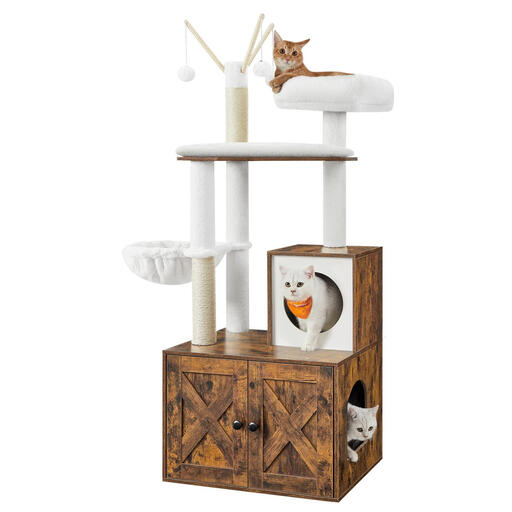
Why This Fits Their Persona: Ideal for those in flats or smaller homes where floor space is at a premium. This `cat tree with litter box enclosure` combines play, rest and toilet facilities into a single, vertical unit, satisfying all of a cat's needs without cluttering the room.
The 2-in-1 design is inherently practical, avoiding the trap of a single-use item taking up too much space. Its sturdy engineered wood and sisal construction ensures it is built for vigorous use, and the included anti-tip kit addresses safety concerns.
It consolidates multiple cat accessories into one piece of furniture. The cushions are removable and machine washable, simplifying maintenance.
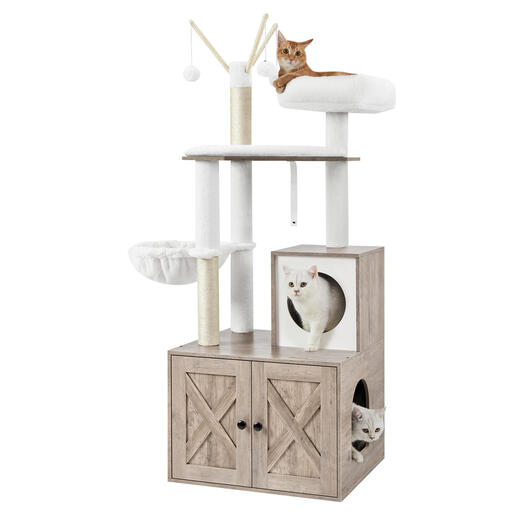
Why This Fits Their Persona: This is for the individual who sees pet furniture as an extension of their interior design. The on-trend greige (grey-beige) colour and modern silhouette make this `stylish cat litter box cover` a statement piece that enhances a contemporary living space.
It directly addresses the maintenance pain point with fully removable and washable cushions and smooth, easy-to-wipe surfaces. The durable particleboard and natural sisal construction ensures it withstands daily use, avoiding the flimsy material pitfall.
The sleek, modern aesthetic is its primary draw. The combination of a cat tower and litter enclosure in such a stylish package is ideal for design-forward homes.
We have compiled a complete, real-time list of products that fully satisfy these strict selection criteria and UK safety regulations.
Transition gradually. Assemble the new furniture but leave the door open or off for the first few days. Place their existing, familiar litter tray inside. Once they are comfortably using it, you can add the door. Avoid cleaning the tray right before the transition, as their scent will help them recognise it as their own.
They are designed for convenience. Most feature wide-opening doors that give you full access to slide the litter tray out for scooping and cleaning. The interior surfaces are typically smooth and water-resistant, allowing you to wipe them down easily with a damp cloth and a pet-safe cleaner. For 2-in-1 models, look for removable, machine-washable cushions to simplify upkeep.
A well-ventilated cabinet will significantly reduce odours from permeating your living space, but it is not a substitute for regular cleaning. The primary benefit is containment. To manage odours effectively, you must still scoop the litter tray daily and perform full litter changes as part of your routine. The enclosure helps keep the immediate area much fresher.