
24/7 Customer Support

Free returns

Same-day & Next-day Delivery

Quality Guaranteed

Unlock Your Welcome Offers: FREE Delivery | Up to 80% OFF | Free 30-day JoyPlus trial
Download the APP
A suitable cat scratcher can give your cat an approved place to stretch, scratch and rest while helping reduce attention directed towards sofas, carpets and chair legs. However, choosing one based on appearance alone can lead to wasted money and a product your cat ignores.
The practical approach is to assess the scratching surface, stability, dimensions and any additional play features before buying. The right choice depends on whether your cat prefers horizontal scratching, vertical stretching, lounging or interactive play.
A decorative shape does not necessarily make a useful scratching area. Some products have limited textured coverage, while others use materials that become loose or flattened quickly. Look for a clearly defined scratching zone made from sisal, hemp rope or corrugated cardboard, depending on your cat’s preference.
A sisal cat scratcher usually provides a firm, fibrous texture for cats that like resistance under their claws. Corrugated cardboard produces a softer, shreddable surface and may appeal to cats that enjoy tearing and digging.
If a cat scratcher slides across laminate, tiles or wooden flooring, your cat may stop using it. Movement is particularly inconvenient for larger cats, vigorous scratchers and multi-cat households.
A non-slip backing, a broad base or a securely attached hanging design can improve practical stability. Adhesive-backed furniture protectors also need to be fitted to a clean, dry surface and checked regularly.
A reversible cat scratcher can provide two usable sides, but it is not maintenance-free. Cardboard can become loose or fragmented, while fibres and fabric may fray after repeated use. Always inspect the product and replace it if it becomes damaged or unsafe.
Catnip and crinkle paper can encourage initial interest, but they do not replace a suitable position or scratching texture. Place the product near a favourite resting area, doorway or existing scratching spot rather than hiding it in an unused corner.
Start by matching the surface to your cat’s habits:
A cat scratching mat or cat scratching pad with two different surfaces can offer more flexibility. For example, one side may provide sisal for scratching while the other offers fabric for resting.
Observe how your cat scratches. Cats that stretch upwards may benefit from a vertical board, hanging toy or tall post. Cats that scratch rugs or flooring are more likely to use a horizontal mat or pad.
A 35cm scratcher can suit many small to medium-sized cats, but check that your cat can lie on it comfortably and extend their body when scratching. In a home with more than one cat, providing separate scratching areas can help reduce competition.
For a floor-based product, check whether it has a non-slip base or a sufficiently wide footprint. A cat furniture protector should sit securely against the area it is intended to protect. Hook-and-loop backing can be practical for attaching a mat to furniture, walls or other flat surfaces, but supervise initial use to confirm it remains secure.
For a hanging product, attach it securely to a suitable doorknob and check that the cat cannot become entangled. Follow the manufacturer’s instructions and remove any product that becomes loose or damaged.
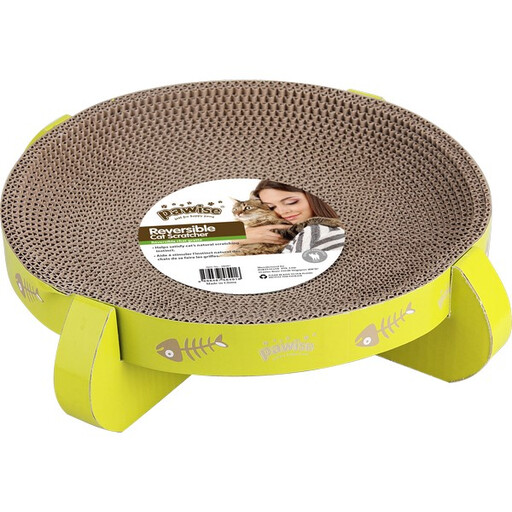
Why This Fits Their Persona: A straightforward horizontal option for owners introducing a first scratcher in a flat, small home or rented property.
The reversible construction allows either side to be used, helping avoid relying on a single quickly worn surface.
Corrugated paper construction; 35cm format; can also be used as a resting bed.
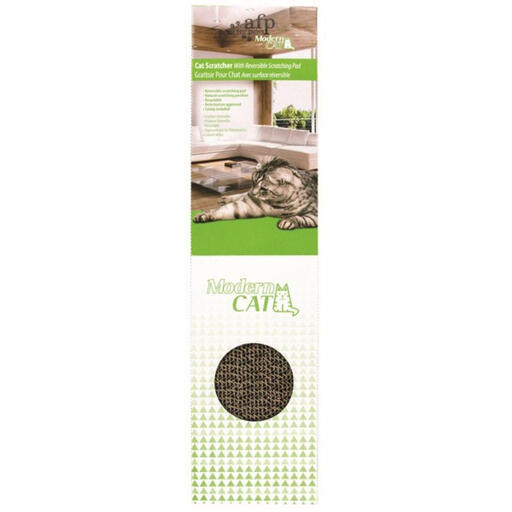
Why This Fits Their Persona: A slim, dual-sided mat for owners who want scratching and lounging in one item without adding bulky cat furniture.
Its non-slip rubber backing is designed to limit movement, addressing the common problem of a mat sliding during scratching.
Sisal scratching side; machine-washable fabric side; slim 6cm profile.

Why This Fits Their Persona: A practical choice for cats that target table legs, chair surfaces or other specific furniture areas.
The reusable hook-and-loop backing is intended for targeted placement rather than leaving furniture unprotected.
L54 x W51cm size; hemp fabric scratching surface; foldable design.
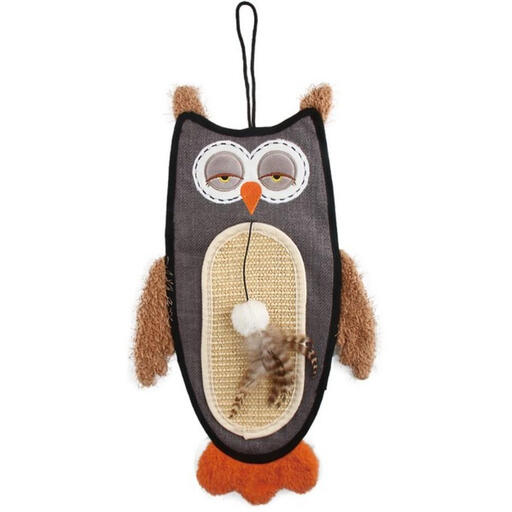
Why This Fits Their Persona: Suitable for indoor cats that respond to movement, texture and interactive features as well as ordinary scratching.
It offers floor or doorknob placement, so owners can test different positions instead of assuming one orientation will suit every cat.
Textured sisal belly; crinkle paper; catnip; two placement modes.
Position matters as much as the product itself. Start by placing the scratcher beside the sofa, bed or doorway your cat already visits. After consistent use, it can be moved gradually if necessary.
For a cat scratcher for sofas, ensure the mat covers the area your cat actually targets. A furniture protector placed several centimetres away may not redirect behaviour effectively. You can rub a small amount of catnip on a compatible surface, but avoid forcing your cat to use it.
In multi-cat households, use more than one location where possible. A horizontal cat scratching pad combined with a vertical scratcher can accommodate different postures and reduce competition.
Inspect scratching products regularly for loose threads, detached backing, sharp fragments or excessive wear. Cardboard products should be kept away from water and damp areas. Do not use a hanging toy if its attachment becomes loose, and supervise initial use of adhesive-backed mats.
There is no fixed lifespan for a cat scratcher. Frequency of use, cat size, clawing style and material all affect replacement timing. A product that remains stable and intact may continue to be suitable, while one showing loose or fragmented parts should be removed promptly.
We have compiled a complete, real-time list of products that fully satisfy these strict selection criteria and UK safety regulations.
Place it near an existing scratching or resting location, particularly beside a sofa, carpeted area or doorway. Cats often use scratching as part of stretching after sleep, so positioning a product near a bed can be effective.
Lifespan varies according to use and construction. Check it regularly and turn a reversible model over when one side is worn. Replace it if the cardboard becomes loose, fragmented or unsafe.
It can provide an approved scratching surface and an activity option within the home. Choose between a cat enrichment toy, scratching mat, pad or furniture protector according to your cat’s preferred posture and the household areas you want to protect.