
24/7 Customer Support

Free returns

Same-day & Next-day Delivery

Quality Guaranteed

Unlock Your Welcome Offers: FREE Delivery | Up to 80% OFF | Free 30-day JoyPlus trial
Download the APP
A cat scratcher mat can help redirect scratching away from sofas, carpets and chair legs, but choosing the wrong design may simply add another unused item to your home. This is particularly frustrating in a flat, where floor space is limited and furniture often serves multiple purposes.
Before buying, look beyond attractive shapes and broad claims about durability. Three common pitfalls deserve attention:
The right choice should match your cat’s scratching style, available space and preferred resting areas. It should also be easy to inspect, clean or replace when the surface becomes loose or heavily frayed.
A sisal cat scratcher offers a fibrous, textured surface that many cats can grip with their claws. Sisal is often suitable for cats that scratch firmly or repeatedly, although no material lasts indefinitely. Check how the fibres are attached and whether the edges are securely finished.
A cardboard cat scratcher usually has a corrugated surface that provides a different sensation under the claws. It can be a practical option for value-conscious owners, but cardboard should be kept away from water and replaced if it becomes loose, fragmented or excessively worn.
Fabric, felt and hemp-based surfaces may provide a softer feel and can sometimes double as a cat lounge mat. However, a lounging surface should not be mistaken for a dedicated scratching surface unless the product clearly includes both functions.
Measure the proposed position before ordering. A slim cat scratching mat can fit beside a sofa or under a coffee table, while a larger pad may be more noticeable but offer additional lounging space.
For cats that scratch horizontally, look for enough length for the cat to stretch out. The Pawise model measures 35cm, making it a compact choice for many small and medium-sized cats. The ZEZE mat measures L54 x W51cm, offering a broader area for scratching and resting.
A low profile can be useful in smaller UK homes, but it should not make the mat too light or easy to move. If the mat shifts whenever your cat uses it, consider a non-slip backing or a secure attachment system.
A reversible cat scratcher can extend practical usage because both sides are available. Always check whether both sides are intended for scratching or whether one is designed for lounging.
For furniture protection, attachment is equally important. A hook-and-loop system may work on a clean, smooth surface, but it should be tested carefully on the intended furniture. Avoid assuming that any adhesive or fastening method is suitable for painted, delicate or textured upholstery.
Look for straightforward care instructions, including:
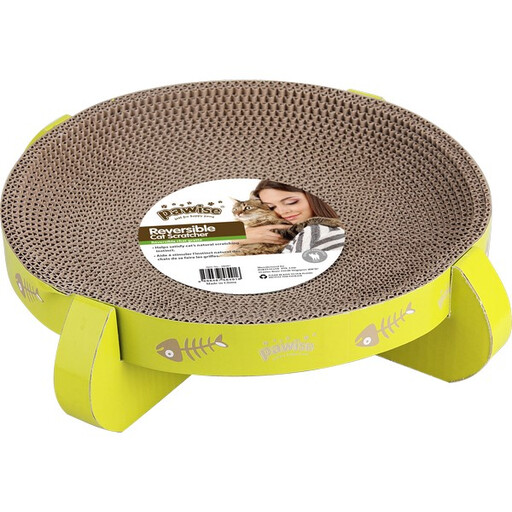
Why This Fits Their Persona: Its compact 35cm format suits smaller homes, starter setups and owners seeking a simple cat scratching pad that can also be used as a resting bed.
The reversible design means the pad can be flipped when one side shows wear, while the dry-storage guidance helps prevent avoidable damage.
Corrugated paper construction; reversible format; suitable for scratching and resting.
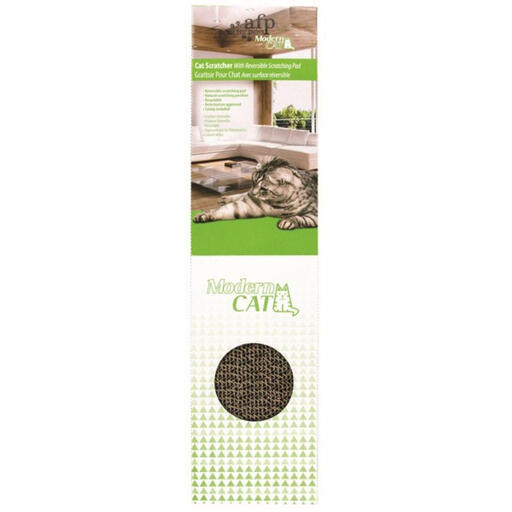
Why This Fits Their Persona: This dual-sided design is suited to owners who want one slim product to support scratching beside furniture and provide a softer place to rest.
The product has a textured sisal side and a machine-washable fabric side, while the non-slip rubber backing addresses movement during use.
Organic sisal fibres; dual-sided layout; slim 6cm profile; machine-washable fabric side.

Why This Fits Their Persona: Its larger shape and reusable hook-and-loop backing suit owners targeting a particular table, chair or furniture edge in a busy multi-cat home.
The backing is reusable rather than permanently adhesive, but it must be applied to a clean, dry, smooth surface and checked during initial use.
L54 x W51cm size; hemp rope surface; foldable construction; suitable for scratching and lounging.
We have compiled a complete, real-time list of products that fully satisfy these strict selection criteria and UK safety regulations.
Place the cat scratcher mat close to the furniture your cat already targets. A sofa-side position may be more effective than a visually tidy corner across the room. You can also position it near a sleeping area, where cats often stretch after waking.
For a new mat, allow your cat to investigate it at its own pace. Catnip may encourage interest where suitable, but it should not replace correct positioning. In multi-cat households, consider providing more than one scratching location to reduce competition.
Lifespan depends on scratching frequency, material, cat size and whether the mat is used by one or several cats. Reversible designs can offer an additional usable side, while sisal and hemp surfaces may suit frequent scratching. Inspect the product regularly rather than relying on a fixed replacement schedule.
Place a cat scratcher for sofas directly beside the sofa section being scratched, ideally along the route between the sofa and a resting or play area. Once your cat uses the mat consistently, it may be possible to move it gradually.
Most scratching mats require no electricity and have no regular running cost. Ongoing expenses generally involve replacement when the surface wears out, plus optional accessories such as catnip. Washable fabric sections may also reduce the need for frequent replacement, provided they remain secure and undamaged.