
24/7 Customer Support

Free returns

Same-day & Next-day Delivery

Quality Guaranteed

Unlock Your Welcome Offers: FREE Delivery | Up to 80% OFF | Free 30-day JoyPlus trial
Download the APP
As a Joybuy Product Recommendation Officer, I often hear from cat owners who are frustrated with their search for a suitable cat tree. If you share your home with a larger breed like a Maine Coon or Ragdoll, or simply have a particularly enthusiastic (and heavy) feline, you know the challenge. Standard cat furniture often isn't up to the task, leading to wobbles, breakages and a waste of money.
This guide is designed to help you navigate the market and identify a truly robust cat tree for large cats. We will look at the common pitfalls to avoid and the key features that genuinely matter, ensuring your next purchase is a safe and lasting investment for your companion.
Many products look appealing online but fail to perform in a real-world home with a large cat. Here are the three most frequent issues that lead to disappointment:
To avoid these issues, focus your attention on a few non-negotiable specifications. These are the factors that determine whether a piece of cat furniture for large breeds will stand the test of time.
Stability starts at the bottom. For any heavy duty cat tree, the base is the most critical component. Look for a base that is both wide and heavy.
The posts bear the brunt of your cat's weight and scratching instincts. This is where sturdiness is paramount.
Large cats need ample room to relax comfortably. A perch that is too small will be ignored, defeating the purpose of the tree.
Based on these practical criteria, we have identified products suited for specific needs. Instead of a generic list, we match our recommendations to different owner profiles.
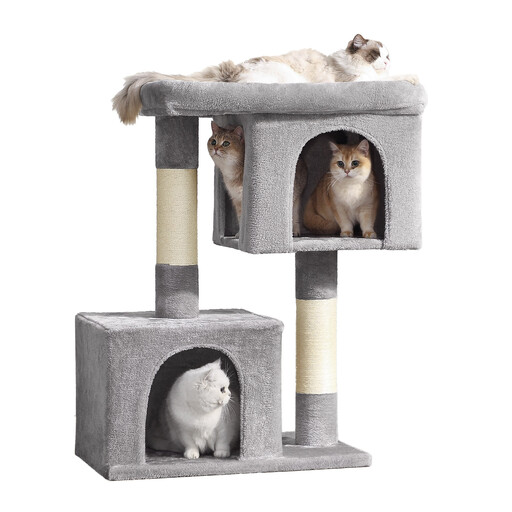
Why This Fits Their Persona: This model is explicitly designed for households with large or heavy cats. Its weight capacity of up to 20 kg directly addresses the primary concern of owners of Maine Coons, Ragdolls or simply bigger-boned felines who need an exceptionally robust structure.
It directly counters the "one-size-fits-all" pitfall with its high weight rating and substantial construction. The wide base (68 x 48 cm) provides the necessary stability, avoiding the wobble common in less sturdy models.
The combination of a large top perch with cushioned edges, two separate hideouts and multiple scratching posts makes this a complete XL cat play tower. It also includes an anti-tip kit for maximum safety.
We have compiled a complete, real-time list of products that fully satisfy these strict selection criteria and UK safety regulations.
Here are answers to a few common questions from UK cat owners.
The most effective way to ensure safety is to choose a model with a wide, heavy base and to always use the anti-tip kit provided. This involves securing the top of the tree to a wall with a strap. It prevents the structure from tipping over, even during vigorous climbing and jumping.
Natural sisal rope is the preferred material for durability and providing a satisfying scratching experience. Check that the rope is thick (at least 6 mm) and tightly wound around the post. Avoid cat trees that use carpet for scratching surfaces, as it can snag claws and wears out much faster than sisal.
For a large breed like a Maine Coon, which can be quite long when stretched out, a perch should ideally be at least 40 cm in both length and width. A rectangular perch of around 50 cm x 40 cm is even better. This gives them enough room to lounge comfortably without having to curl up tightly or hang off the edge.