Who is a small-kitchen celery juicer for?

Frequent celery juicers with little counter space

If you make celery juice often, consider a compact slow juicer or a slim horizontal model. Measure the space it needs both while operating and when stored, rather than relying on its description as compact.

Daily juicers who prioritise easy cleaning

If dismantling and washing the machine will affect how often you use it, examine the filter, removable parts and reassembly steps. Which? assesses cleaning separately from juicing performance and ease of use.

Occasional juicers in very tight kitchens

If you make celery juice only occasionally alongside other fruit and vegetable juices, a compact centrifugal machine is worth considering when appliance size and quick batches matter more to you than celery-focused features.

What matters when choosing a celery juicer?

Celery-focused horizontal slow juicer

Consider it when: Celery is your main ingredient and you have room for a horizontal appliance. Omega describes a celery cap and adjustable pulp-pressure nozzle on its MM1500.

Trade-off: Those features do not establish a higher juice yield, and the MM1500’s stated 50 mm feed chute may still mean preparing stalks before use.

Compact slow juicer

Consider it when: You want a slow-juicing routine for celery and other produce without choosing a celery-focused horizontal machine. Hurom describes its H310 as compact.

Trade-off: A compact design does not remove the need to prepare celery to the size specified for the machine.

Compact centrifugal juicer

Consider it when: Celery juice is occasional and you mainly want a small appliance for general fruit-and-vegetable juicing. Philips describes its HR1832 as a compact centrifugal model.

Trade-off: The HR1832 is not presented as a celery-specialist model; do not assume its celery results match those of a slow juicer without comparable tests.

Concern What to check Who this matters to
Handling fibrous celery Check the exact model’s guidance for celery, feed opening and any pulp-pressure or reverse controls. If celery juice is my regular reason for buying a juicer, I want to know how the machine handles stalks and what preparation they need. Around 36% of consumers put celery handling first.
Footprint and storage Compare the full width, depth and height with your counter and storage space, allowing room for containers and opening lids. I need to leave enough room to prepare food beside the appliance or put it away after use. For around 29% of consumers, fitting and storing the juicer is the primary concern.
Daily cleaning Read the manual’s instructions for washing removable parts and clearing the pulp path. If I plan to juice each day, a cleaning routine I can keep up with matters more to me than a short description such as easy-clean. Around 21% of consumers make cleaning their main priority.
Occasional batches Check the machine’s dimensions, cleaning method and guidance for the produce you intend to use. I make juice now and then, so I would rather assess a small machine for mixed produce than focus on celery-specific controls. Around 14% of consumers put this occasional-use need first.

Buying mistakes to avoid

  • Taking “compact” as a measurement

    A horizontal machine and a vertical one can use space differently. The juice jug, pulp container and any opening lid also need clearance.

    Measure where the juicer will run and where it will be stored, then compare both spaces with the manufacturer’s full dimensions.

  • Treating a celery feature as proof of higher yield

    Omega describes celery-oriented controls on the MM1500, but a feature description is not a comparative celery-yield test. Which? measures extraction and assesses other aspects of use separately.

    Use the feature to identify a model worth examining, then look for comparable tests if yield will decide your purchase.

  • Leaving cleaning until after choosing a model

    Filters, screens and pulp outlets can make the washing routine different from one design to another. That matters particularly if you intend to make celery juice daily.

    Read the exact model’s cleaning instructions and check which food-contact parts must be removed after use.

  • Juicing celery without washing it

    GOV.UK food-hygiene guidance for England, Northern Ireland and Wales recommends washing fruit and vegetables before use and keeping preparation equipment clean.

    Wash celery and hands before preparation, and clean the juicer’s food-contact parts according to its manual.

Brands and product lines to consider

Omega

Omega’s slow-juicer range includes the compact CNC80 horizontal model and the celery-focused MM1500.

  • Omega describes the CNC80 as suitable for limited worktop space; the MM1500 has a celery cap and adjustable pulp-pressure nozzle.
  • The MM1500’s 50 mm feed chute may still require celery preparation. Check the space needed for a horizontal machine before ordering.

Hurom

Hurom positions the H310 as a compact slow juicer for smaller kitchens.

  • Hurom describes the H310 as screen-free, a design detail to consider when examining its cleaning instructions.
  • Check the preparation size required for celery and the complete washing routine rather than assuming a compact machine needs little preparation or cleaning.

Ninja

Ninja’s JC151UK is a cold-press juicer with an auger and an anti-clog filter.

  • The filter is a model-specific feature to examine if pulp flow is important to your celery-juicing routine.
  • Ninja’s claims about reduced clogging and foam should not be taken as proof of a celery-specific advantage over other models.

Philips

Philips’ HR1832 is a compact centrifugal option for general fruit-and-vegetable juicing.

  • Philips lists the HR1832 at 235 × 205 × 297 mm, figures you can compare with your available space.
  • Philips does not present this model as a celery-specialist juicer; check evidence for celery use rather than judging it by motor wattage.

Joybuy options for compact slow juicing

This Joybuy option is a masticating juicer to consider for a small kitchen. If celery will be your main ingredient, check the exact model’s celery preparation guidance and operating space before buying.
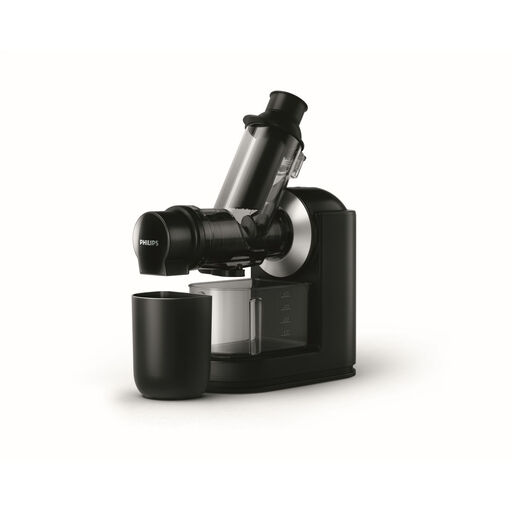
Philips Viva Collection Masticating Juicer HR1889/71

Philips Viva Collection Masticating Juicer HR1889/71

Consider this masticating model if you want to explore slow juicing in a small kitchen. Before choosing it for regular celery juice, check the preparation guidance for celery and measure the space needed to use and store the appliance.

View on Joybuy

Questions about celery juicers

Should I choose a slow or centrifugal juicer for celery?

If celery is your regular main ingredient, consider a slow juicer, including a celery-focused horizontal model if it fits your space; for occasional mixed-produce juice, consider a compact centrifugal model too. Compare the exact machines’ celery guidance, dimensions and cleaning steps rather than assuming either mechanism guarantees a particular result.

What should I measure before buying a juicer for a small kitchen?

Measure the width, depth and height available both for use and storage, with clearance for lids and juice or pulp containers. As points of reference, Philips lists its HR1832 at 235 × 205 × 297 mm, while Omega lists its CNC80 at 36.0 × 16.0 × 30.5 cm; check the dimensions of the model you actually plan to buy.

Does a higher wattage mean better celery juicing?

No: wattage alone does not establish celery juice yield or ease of use. If those outcomes matter to you, compare tests conducted on the same basis alongside each model’s feed opening, pulp-management features and cleaning requirements.

How should I prepare celery for home juicing?

Wash celery before use and prepare it to the size required by your juicer’s instructions. GOV.UK food-hygiene guidance for England, Northern Ireland and Wales recommends washing fruit and vegetables before use and keeping preparation equipment clean; follow the appliance manual when cleaning its food-contact parts.