Daily celery-juice households
Families who regularly juice celery or leafy greens and want to assess equipment designed for fibrous ingredients, even if a narrower feed chute means more preparation.


Choose a celery-focused slow juicer if celery is the main ingredient most mornings and you can accommodate a narrower feed chute. For larger batches with less hands-on feeding, consider a self-feeding slow juicer after checking its celery instructions. If quick batches of mixed juice matter more, consider a centrifugal model and check its capacity and cleaning requirements.
Families who regularly juice celery or leafy greens and want to assess equipment designed for fibrous ingredients, even if a narrower feed chute means more preparation.
Households preparing several servings before school or work, for whom feeding interruptions, morning noise and cleaning effort affect the choice.
Families mainly making mixed fruit and vegetable juice quickly, with celery as one ingredient rather than the reason for choosing a specialist setup.
Start with how often celery is the main ingredient, then decide how much feeding and cleaning work fits your breakfast routine.
Consider it: When you juice celery most mornings and want the celery cap and adjustable pulp-pressure nozzle specified for Omega's MM1500HD.
Trade-off: That model's 50 mm feed chute may mean more cutting and hands-on feeding.
Consider it: When fewer loading interruptions matter for repeated family batches; Hurom specifies a 2-litre self-feeding, auto-cutting hopper for the H400.
Trade-off: Check the H400's instructions for celery preparation rather than assuming hopper size means stalks can be loaded whole.
Consider it: When quick mixed-ingredient servings take priority; Philips lists four servings for its centrifugal HR1922/21.
Trade-off: The cited model is not presented as a celery-specialist setup, so check how its feed tube and pulp container fit your routine.
| Concern | What to check | Who this matters to |
|---|---|---|
| Celery handling | Check the exact model's celery guidance and whether a celery cap or adjustable outlet is included. Omega specifies both for the MM1500HD. | If celery is the main ingredient most mornings, I want a machine with a setup intended for stalks, even if feeding takes longer. Around 33% of consumers put celery handling first. |
| Family batches | Compare stated hopper or serving capacity and feeding design; check model-specific noise information if mornings are quiet at home. | When several glasses need making before everyone leaves, I would rather reload less often and keep preparation manageable. Batch convenience is the primary need for around 27% of consumers. |
| Quick mixed juice | Check the juicer type, stated servings and removable parts. Philips lists four servings and dishwasher-safe parts for the HR1922/21. | Celery goes into my juice alongside other produce, but getting the family's drinks made quickly matters more than a specialist celery setup. Around 20% of consumers prioritise quick mixed batches. |
| Regular cleaning | Review disassembly steps and availability of parts for the exact model; Omega lists replacement components for the MM1500HD. | If I will use the juicer often, cleaning it and finding a replacement for a worn or lost part must remain practical. Ongoing upkeep comes first for around 20% of consumers. |
Wattage does not establish how a juicer handles fibrous celery. Philips specifies the HR1922/21 as a 1,200 W centrifugal model, while Omega's MM1500HD has a celery cap and adjustable pulp-pressure nozzle.
Compare the mechanism and included celery accessories before using wattage to distinguish models.
A self-feeding or wide-feed design does not mean every celery stalk can be loaded whole.
Check the exact model's loading instructions and feed opening against the ingredients you plan to use.
Frequent use makes screens, nozzles and containers part of the ownership decision. Omega Juicers UK lists replacement components for the MM1500HD, but parts need checking by exact model.
Review the cleaning steps, parts available through the manufacturer or distributor, and the applicable warranty terms before buying.
A manufacturer's statements about yield or nutrients do not, on their own, establish that one of these juicers outperforms another under comparable conditions.
Choose using documented features and the preparation, capacity and cleaning demands of your breakfast routine.
Its horizontal slow-juicer range includes the celery-focused MM1500HD, a model to consider when stalk celery is a frequent ingredient.
The H400 is a self-feeding slow-juicer option for households concerned about interruptions during larger batches.
Its EVO820S wide-feed slow juicer may interest households assessing how much chopping fits their morning routine.
Its centrifugal HR1922/21 is a reference point for households prioritising quick mixed-juice servings rather than a celery-specific configuration.
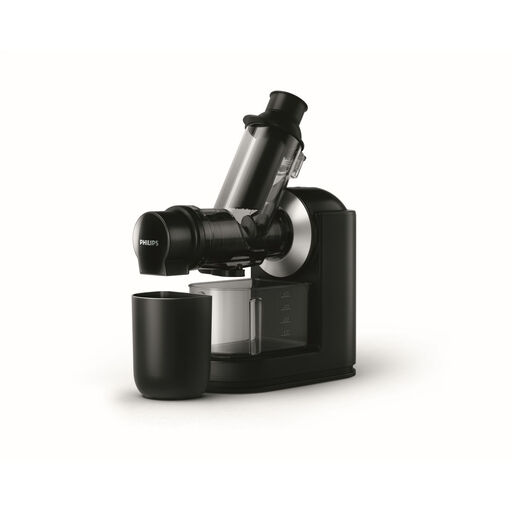
This masticating juicer is a slow-juicing option for a breakfast routine that includes leafy greens. Check the exact model's celery-stalk instructions and the volume your family needs before choosing it.
 No image available
A masticating option to consider for a breakfast routine that includes greens; check the model's instructions before loading celery stalks.
Its stated 1 L juice container should be compared with the amount your family makes before emptying it.
Start with a slow juicer explicitly specified for celery or fibrous greens if celery is your main ingredient. Omega Juicers UK specifies a celery cap and adjustable pulp-pressure nozzle for the MM1500HD; a centrifugal model is an alternative when quick mixed-juice batches matter more.
Compare capacity with the amount you make before stopping to empty or clean the juicer, rather than household size alone. Hurom specifies a 2-litre hopper for the H400, while Philips lists four servings for the HR1922/21; a hopper volume and a serving count describe different things.
Follow the exact model's cleaning instructions and remove fibrous pulp before it dries. Hurom describes the H400 auger as easy to rinse, while Philips specifies dishwasher-safe parts for the HR1922/21; check which components may go in the dishwasher.
Check the exact product's electrical documentation and supply configuration. The Office for Product Safety and Standards states that the Electrical Equipment (Safety) Regulations 2016 set requirements before covered equipment can be placed on the Great Britain market; Northern Ireland has separate provisions.
Yes. The Food Standards Agency identifies celery as an allergen, including its stalks, leaves, seeds and celeriac. If someone has a celery allergy, do not serve them celery juice and take care to prevent cross-contact through shared juicer parts.