
24/7 Customer Support

Free returns

Same-day & Next-day Delivery

Quality Guaranteed

Unlock Your Welcome Offers: FREE Delivery | Up to 80% OFF | Free 30-day JoyPlus trial
Download the APP
A good ceramic frying pan promises the best of both worlds: the effortless food release of a non stick frying pan and the peace of mind that comes from cooking on a surface free from traditional chemicals. For the health-conscious UK home cook, it seems like the perfect choice.
Yet, the marketplace is filled with options that can lead to disappointment. Many of us have bought a pan that looked great, only for it to lose its non-stick properties after a few months, or discovered it doesn't work on our new frying pan for induction hob. To help you make a better choice, we've identified the common pitfalls and the key features to look for.
The 3 Traps to Avoid When Buying a Ceramic Frying Pan:
To ensure your new pan is a reliable kitchen workhorse, focus on these three non-negotiable features.
The body of the pan, typically aluminium, is responsible for how quickly and evenly it heats. A thin, flimsy base is prone to warping, creating hot spots that burn food. Look for a pan with a thick, forged or die-cast aluminium body and a heavy-gauge, flat base. For induction hob users, it is essential to confirm the product is specified as induction compatible. This indicates it has a ferromagnetic steel plate bonded to the bottom, ensuring a strong connection with your hob.
The term non toxic frying pan is a key reason many people choose ceramic. Most are a pfas free frying pan, meaning they are made without per- and polyfluoroalkyl substances. However, the durability of this ceramic coating varies significantly. Some manufacturers reinforce their coatings with harder materials like diamond or titanium particles. This enhancement improves scratch resistance and can extend the lifespan of the non-stick performance, making it a more durable and healthy frying pan for daily use.
Consider how you cook. If you like to sear a steak on the hob and finish it in the oven, you need an oven safe frying pan. Check the maximum oven-safe temperature. This is largely determined by the handle material.
Based on these practical criteria, we've matched a few standout options to different cooking styles and needs.

Why This Fits Their Persona: An excellent choice for everyday tasks like frying eggs, making pancakes or sautéing vegetables. Its 28cm size is versatile for small families, and the focus is on reliable, no-fuss hob performance and simple cleanup.
It directly counters the "induction incompatible" trap by featuring a thickened base compatible with all hobs, including induction. The Bakelite handle is heat-resistant for hob use, avoiding the false promise of high-heat oven safety.
Features a PFAS-free ceramic coating for easy food release and is dishwasher-safe for effortless cleaning. Its lightweight design and ergonomic handle make it easy to manage.
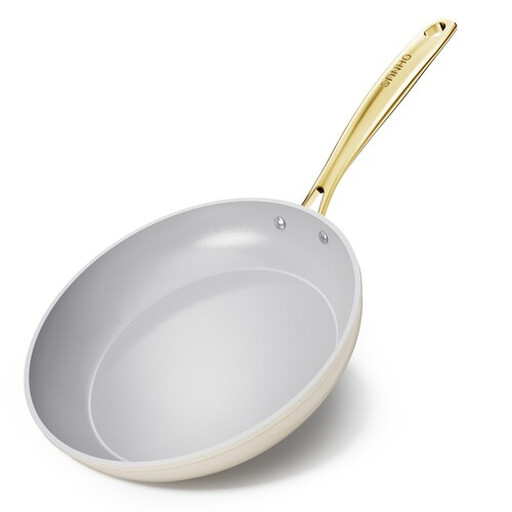
Why This Fits Their Persona: For the cook who demands more. This pan is built for performance, allowing for searing on the hob and finishing in a hot oven. It's for those who appreciate durable construction and are willing to invest in longevity.
It tackles the "rapid wear" trap head-on with a patented diamond-titanium reinforced coating for enhanced scratch resistance. It also avoids the "oven-unsafe" issue with its high oven-safe temperature of 260°C.
Exceptional versatility with its high-temperature oven safety and all-hob compatibility. The reinforced coating is designed for greater durability than standard ceramic surfaces.
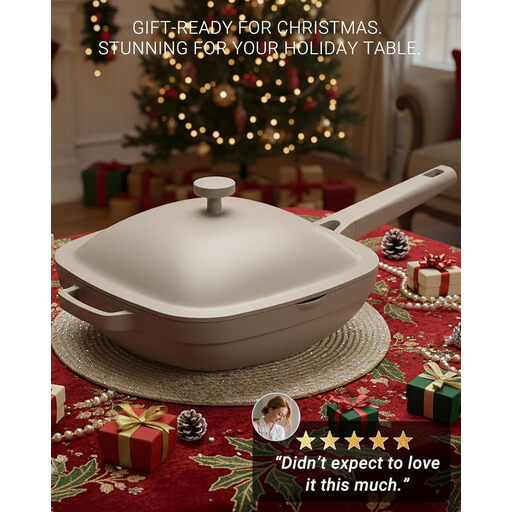
Why This Fits Their Persona: Perfect for those who cook larger quantities. Its generous 3.8-quart capacity and deep sides are ideal for one-pan family dinners, sauces and braises. The included lid is a practical addition for simmering and retaining moisture.
This pan avoids being a small, single-purpose item. Its deep sauté pan design and large capacity provide genuine versatility for family cooking, moving beyond just frying. It is also clearly stated as compatible with all hobs.
The generous depth and capacity are its main strengths. It comes as a set with a lid, wooden spatula and scrubber, offering excellent value for those needing a complete solution.
We have compiled a complete, real-time list of products that fully satisfy these strict selection criteria and UK safety regulations.
The lifespan of a ceramic coating typically ranges from one to three years, depending heavily on the quality of the coating and how it is cared for. To prolong its life, always use wooden or silicone utensils, avoid excessively high heat and let the pan cool down before washing it by hand with a soft sponge.
While many ceramic pans are marketed for oil-free cooking, using a small amount of a high-smoke-point oil (like rapeseed or sunflower oil) is recommended. It helps protect the non-stick surface from direct, high heat and can extend its longevity, while also improving the browning and flavour of your food.
Check the product description or packaging for the "induction compatible" claim or a symbol that looks like a coil of wire. A simple way to check any pan is with a magnet; if a magnet sticks firmly to the bottom of the pan, it is suitable for use on an induction hob.