What matters when choosing?
For consumers choosing a ceramic heater to take the chill off a room, decide whether the priority is warmth nearby or across several occupied areas. Then check whether the controls and a safe place to use the heater suit that plan.
| Concern |
What to check |
Who this matters to |
| Close-range warmth |
Check the exact model’s intended use area, thermostat and heat settings. |
If I mainly feel cold at my desk or beside my bed, I want warmth near that spot without choosing a larger format just for its reach. Around 27% of consumers put personal-zone warmth first. |
| Wider airflow and control |
Check oscillation, thermostat and timer options alongside the maker’s room-use guidance. |
When people sit in different parts of my room, I need airflow beyond one fixed spot and controls that fit the time I spend there. For around 27% of consumers, wider distribution and control are the primary concern. |
| Safe placement and electrical setup |
Confirm the exact model’s tip-over and overheat functions, and plan clear space and a suitable socket. |
With a busy walkway, pets or furnishings nearby, I need a place where the heater cannot easily be knocked or sit close to combustible materials. Safe siting and electrical setup come first for around 33% of consumers. |
| Flexible everyday use |
Check lower heat settings, fan-only mode and stated noise information if those features matter. |
If I use the same room for work and relaxation, I want settings that fit different times of day rather than relying on maximum heat. Around 13% of consumers make this flexibility their main priority. |
Relevant brands to consider
These brands offer examples of different ceramic-heater formats and controls. Check the exact model rather than assuming a feature applies across a brand’s range.
Dimplex
Dimplex lists both a compact DXUC2BS fan heater for small spaces and a taller Studio G model with oscillation.
- The DXUC2BS is specified with three power settings, an adjustable thermostat, fan-only mode, tip-over protection and overheat safety.
- Dimplex says the Studio G is suitable only for well-insulated spaces or occasional use; its digital thermostat, timer, remote and 76° oscillation should not be taken as features of the compact model.
De'Longhi
De'Longhi’s HFX65V20 is a ceramic tower model for consumers interested in remote control and two stated heat settings.
- De'Longhi specifies 1,200 W and 2,000 W settings, a safety thermostat, automatic shut-off and a tip-over switch for the HFX65V20.
- Check the precise model number: these listed features do not establish the specifications of other De'Longhi heaters.
Russell Hobbs
Russell Hobbs lists the RHFH1008 as an oscillating ceramic fan heater with model-specific room-size guidance.
- Its listing specifies 1,200 W and 2,000 W settings, an adjustable thermostat, tip-over and overheat protection, and suitability for spaces up to 20 m².
- Treat the stated room size as guidance for the RHFH1008, not a guarantee for every room or another Russell Hobbs model.
HOMCOM
A Joybuy-listed HOMCOM ceramic heater provides an example of a 1.5 kW model with oscillation and a timer.
- The listing specifies 1,000 W and 1,500 W heat modes, a fan mode, 50° oscillation and a 24-hour timer.
- Its stated 15 m² coverage is a seller-provided figure for that model; check the exact listing and instructions against your room and intended placement.
Ceramic heater choices on Joybuy
These models offer different ways to warm an occupied room: one combines an oscillating base with a remote and timer, one is a ceramic fan heater with digital controls, and one is a smart ceramic model with stated 360° oscillation. Choose according to the area you need to warm and where the heater can stand safely.
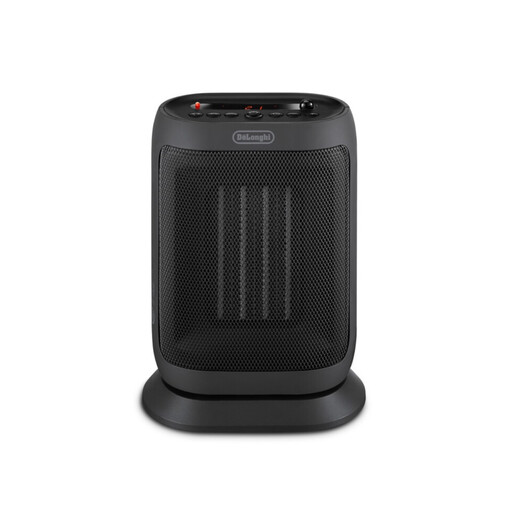 Image unavailable
De'Longhi Capsule You & Me Ceramic Fan Heater, 2000 W, Dark Grey
Consider this model if you want an oscillating heater with controls you can use from elsewhere in the occupied room.
The product name specifies a 2000 W rating, oscillating base, remote, 24-hour timer and ECO mode. Check that its intended room use and cable reach suit a safe position away from combustible materials.
View on Joybuy
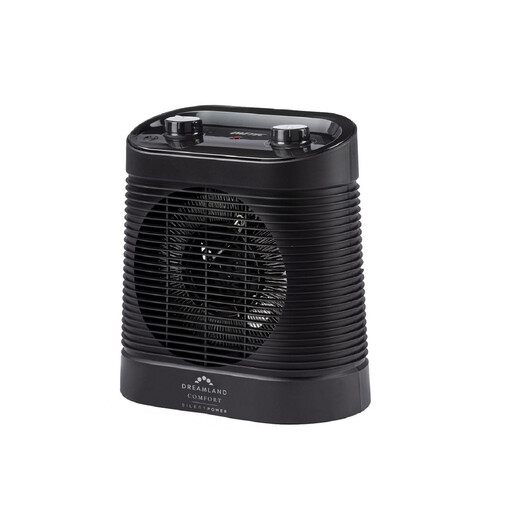 Image unavailable
Dreamland Silent Power Comfort Ceramic Fan Heater, 2000 W, Grey
Consider this ceramic fan heater if digital control matters for your room-warming routine.
The product name specifies a 2000 W rating, Silence System and digital control; the Silence System name alone does not establish how quiet it will sound in your room. Confirm tip-over protection in the exact model’s instructions if accidental knocks are a concern.
View on Joybuy
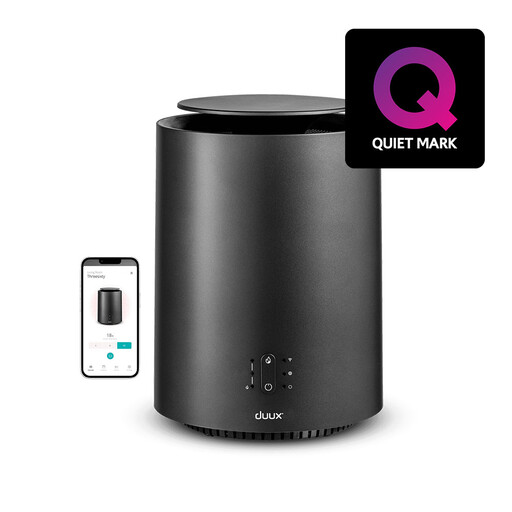 Image unavailable
Duux ThreeSixty 2 DXCH09UK Smart Ceramic Heater, 1800 W, Black
Consider this model if oscillation around the heater is relevant to where people sit in your room.
The product name specifies an 1800 W rating and 360° oscillation. Check the model’s room-use guidance, controls and placement instructions against your space rather than treating the oscillation figure as a room-coverage guarantee.
View on Joybuy
Common questions
Should I choose a compact ceramic heater or an oscillating model?
Choose a compact model for warmth near one occupied spot; consider an oscillating model when warmth needs to reach several parts of the room. Check the exact model’s intended use: Dimplex says its Studio G tower heater is suitable only for well-insulated spaces or occasional use.
Which safety features matter on a ceramic heater?
Check whether the exact model has tip-over protection and overheat shut-off, then make sure it can stand securely with clear space around it. These features do not make it safe to cover the heater, dry clothes on it or place it close to curtains and bedding.
Can I use an extension lead with a portable heater?
Use a suitable wall socket where practical rather than relying on an extension lead for a high-powered heater. Electrical Safety First warns against overloading extension leads and socket-outlets; if an extension lead or reel is unavoidable, check its rating, fuse and condition, avoid daisy-chaining and fully unwind a cable reel.
How can I work out a heater’s electricity use?
Multiply its power draw in kilowatts by the hours it runs at that draw to get kilowatt-hours. For example, a heater drawing 2,000 W continuously for one hour uses 2 kWh; actual use can differ when a thermostat reduces or stops heating.


