A compact ceramic fan heater can provide directed warmth while you study, provided your accommodation permits it and you can position and power it safely. If you need warmth beyond one seat, compare controls and the manufacturer’s room-size guidance, but do not rely on a portable heater to remedy damp, cold walls or faulty fixed heating; report those problems to your accommodation provider or landlord.
Who is this for?
Students studying at one desk
If you mainly want warmth where you sit, a compact fan heater is more relevant to your decision than a room-size claim alone. Dimplex describes its DXUC2BS for desks and small spaces, while Pro Breeze provides specifications for a compact model.
Students with a persistently cold room
If you move around a small bedroom, consider how heat reaches more than one position. Where the walls are damp or fixed heating is faulty, report the housing problem as well: a portable heater cannot put it right.
Students in halls or shared rentals
Check your accommodation agreement before buying. Scottish Fire and Rescue Service warns that halls agreements may prohibit portable heaters, and Electrical Safety First cautions against overloading sockets and extension leads.
What matters when choosing?
Check permission and safe placement before comparing heat coverage, electricity use or the heater’s fit in a study-and-sleep space.
| Concern |
What to check |
Who this matters to |
| Permission and safe setup |
Read your accommodation agreement; check for a suitable socket and a stable position clear of bedding and clothes. Look for overheat and tip-over protection. |
If my halls rules prohibit heaters, or I cannot place one clear of textiles, the other features will not settle the purchase. About 33% of consumers would put permission and safe setup first. |
| Warmth beyond one seat |
Compare the manufacturer’s room-size guidance, thermostat and oscillation; treat coverage figures cautiously where cold walls cause heat loss. |
I move between my desk and the rest of a small bedroom, so directed warmth at one chair may not meet my need. Roughly 27% of consumers would make usable room coverage their primary concern. |
| Electricity use |
Check maximum wattage, lower settings and controls, then consider your own tariff and likely running time. |
If I pay for the electricity I use, I want to understand how long the heater will run rather than assume ceramic technology uses less energy. Around 20% of consumers would prioritise electricity use. |
| Study-room fit |
Check dimensions, cord length and any stated noise figure against a position that remains clear of curtains, papers and bedding. |
My bedroom is also where I study, so the heater needs a practical position without getting in the way. Approximately 20% of consumers would put compact, manageable use first. |
Buying pitfalls
-
Treating a heater as a repair for cold walls
A ceramic heater supplies heat but cannot fix damp, mould or defective fixed heating. Government guidance for England says landlords should identify and tackle the underlying cause when damp and mould are reported.
Photograph and report the problem promptly. Use a heater only as permitted, temporary support while the cause is investigated.
Continuing to heat a room with an unresolved fault can mean more electricity use without resolving the fault.
-
Assuming ceramic means low electricity use
Energy use depends on power draw and running time, as well as how the controls operate; the heating technology alone does not settle it.
Compare rated power and lower settings, then work out likely use from your own routine and electricity tariff. A 2 kW heater running at full output for one hour uses 2 kWh.
-
Ordering before checking accommodation rules
Portable heaters may be restricted by a halls agreement. Scottish Fire and Rescue Service specifically flags this possibility for students in halls; it is not a universal rule for every student room.
Read your agreement and ask accommodation staff if the wording is unclear before ordering.
-
Placing a heater beside laundry or overloaded sockets
Electrical Safety First warns that heaters can overload socket outlets and extension leads, and advises keeping portable heaters away from flammable materials rather than using them to dry clothes.
Choose a stable, clear position, inspect the plug and cable, avoid daisy-chained extensions and switch the heater off when it is not in use.
Brands to consider for these heater formats
Dimplex
The DXUC2BS is described by Dimplex as a compact option for desks and small spaces.
- Dimplex lists three power settings, an adjustable thermostat, fan-only mode, tip-over protection and overheat safety.
- Check its fit for your room and study routine rather than assuming a personal heater will warm a room with substantial heat loss.
De'Longhi
The HFX65V20 is a tower-format choice for someone considering remote control and two stated heat settings.
- De'Longhi lists 1,200 W and 2,000 W settings, a remote, an Eco function, a safety thermostat and tip-over auto-off.
- Check room suitability separately; those controls do not establish how warm a cold-walled bedroom will feel.
Russell Hobbs
The RHCTH2002G offers controls relevant to heating more than one position in a small room.
- Russell Hobbs lists oscillation, a thermostat, a 24-hour timer and tip-over and overheat protection.
- Its up-to-20 m² room-size figure is manufacturer guidance, not a promise of comfort in a room with cold or damp walls.
Pro Breeze
The PB-H-01 provides stated figures that may help assess a compact heater for a study-and-sleep space.
- Pro Breeze lists a 57 dB noise figure, a 1.7 m cord, oscillation and tip-over and overheat protection.
- Its stated maximum room size of 15 m² may not reflect comfort where wall heat loss is substantial; the noise figure is a manufacturer specification, not an independent quietness assessment.
Joybuy product choices for personal warmth
These ceramic fan heaters are choices to compare for warmth around a desk or within a student room. Confirm your accommodation rules and safe placement before choosing among their controls and stated power ratings.
 No image available
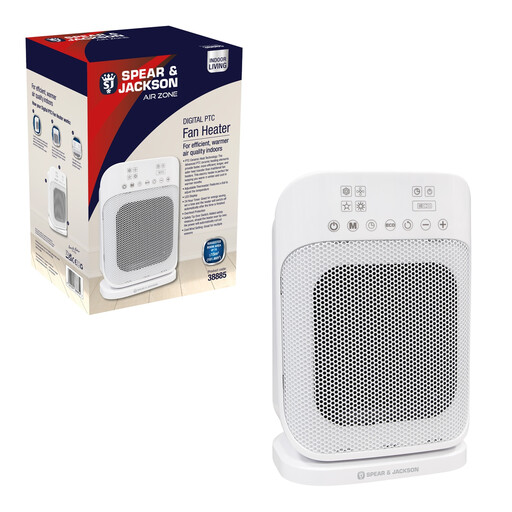
SPEAR & JACKSON 38885 Digital PTC Heater, white, 1500 W
Consider this model if you want adjustable personal warmth while studying. Its title specifies digital controls, oscillation and a timer; check the room fit and your preferred noise level before buying.
Joybuy
 No image available
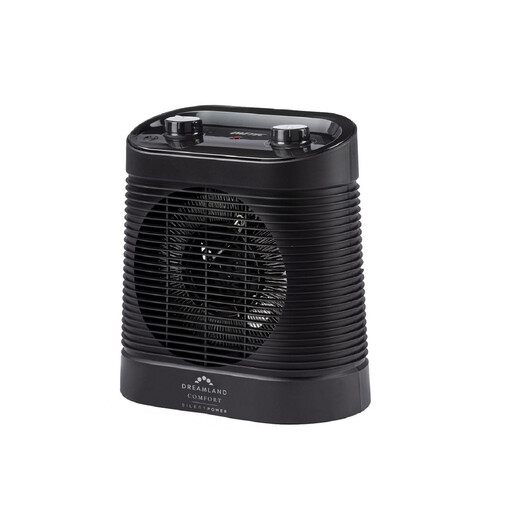
Dreamland Silent Power Comfort Fan Heater, grey, 2000 W
Consider this ceramic model if digital control matters to you in a bedroom or workspace. Check the room-size guidance, operating noise and tip-over protection you need; the model name alone does not establish quietness.
Joybuy
 No image available
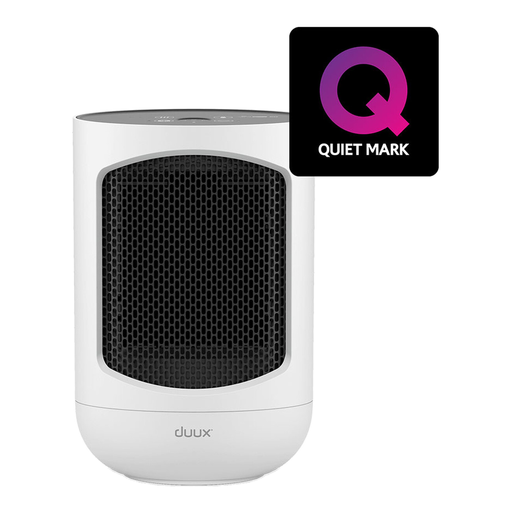
Duux Zone DXCH43UK Personal Fan Heater, white, 1500 W
Consider this model for personal warmth at a desk where you want to compare several settings. Its title specifies three heat settings and 60° oscillation; check whether its controls and stated room suitability meet your needs.
Joybuy
Common questions
Will a ceramic heater solve a room made cold by its walls?
No: it can supply temporary warmth, but it cannot remedy damp, mould or faulty fixed heating. Report the cause to your accommodation provider or landlord; government guidance for England says landlords should identify and tackle the underlying issue when damp and mould are reported.
Can I use a portable ceramic heater in student accommodation?
Check your own accommodation agreement and ask staff before buying. Scottish Fire and Rescue Service warns that halls agreements may prohibit portable heaters, but that does not establish a blanket rule for every student room.
Can I run a heater from an extension lead?
Do not assume an extension arrangement is suitable just because it has a free outlet. Electrical Safety First warns against overloading extensions with high-powered appliances such as heaters and against daisy-chaining leads; check the device’s rating and fully unwind a cable reel before use.
Does a 2 kW ceramic heater always use 2 kWh each hour?
A 2 kW heater uses 2 kWh over an hour only if it operates at that input throughout the hour. Lower settings, thermostat cycling and shorter sessions change total use, so compare the controls with how you expect to heat the room.


