
24/7 Customer Support

Free returns

Same-day & Next-day Delivery

Quality Guaranteed

Unlock Your Welcome Offers: FREE Delivery | Up to 80% OFF | Free 30-day JoyPlus trial
Download the APP
Finding a reliable non-stick frying pan can feel like a chore. You want something that lets you flip a pancake with ease, but you're also rightly concerned about the materials used in the coating. With terms like PFOA, PFAS and PTFE often causing confusion, it’s difficult to know which pan is a safe and durable choice for your kitchen.
This guide is designed to cut through the clutter. As the Joybuy Product Recommendation Officer, my role is to provide clear, practical information to help you select a high-quality ceramic non stick frying pan that meets your needs for healthy cooking, durability and convenience. We will explore what features truly matter and look at a few standout options available today.
Before you make a decision, it helps to understand the key features that separate a great pan from a mediocre one. Here are three essential points to consider.
The primary reason many people switch to ceramic is for a non toxic frying pan. Modern ceramic coatings are typically made without Per- and Polyfluoroalkyl Substances (PFAS), including PFOA and PTFE. This means that even if the pan is accidentally overheated, it is not expected to release the same fumes associated with some traditional non-stick surfaces.
For enhanced durability, look for pans with reinforced coatings. Some of the more robust options feature a diamond non stick pan coating, where industrial diamond and titanium particles are infused into the ceramic. This significantly increases hardness and scratch resistance, contributing to a longer lifespan and a better surface for healthy cooking pan performance with minimal oil.
If you have a modern kitchen, a frying pan for induction hob compatibility is a must. For a pan to work on an induction cooktop, its base must be made of a magnetic (ferrous) material. Always check the product specifications for "induction compatible."
Beyond compatibility, look for a pan with a multi-layer or encapsulated base. A thick, bonded base, often containing an aluminium core and a stainless steel plate, ensures heat spreads quickly and evenly across the entire cooking surface. This prevents hot spots, which can cause food to burn in one area while being undercooked in another. An oven safe frying pan also offers greater versatility, allowing you to sear a steak on the hob and then transfer it to the oven to finish cooking.
The right size depends on your household. A 20cm frying pan is ideal for single servings, eggs or small side dishes. A 24cm frying pan is a versatile all-rounder for couples or small families, while a 28cm frying pan is better suited for larger family meals.
For convenience, an easy clean frying pan is essential. The smooth surface of a quality ceramic pan should release food effortlessly, often requiring just a simple wipe. While many are labelled as a dishwasher safe skillet, gentle hand-washing with a soft sponge is often recommended to prolong the life of the non-stick coating. Finally, consider the handle—a stay-cool Bakelite or hollow stainless steel handle provides a safe and comfortable grip during stovetop cooking.
Based on features that prioritise safety, performance and user convenience, here are a few recommendations to consider for your kitchen.
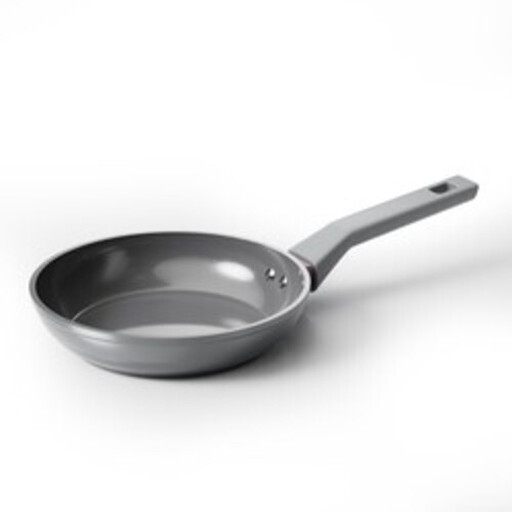
Why It Stands Out: This pan combines a high-performance diamond-titanium coating with a compact, practical size. Its multi-layer base ensures it heats up quickly and evenly on all hob types, including induction. The coating is rigorously tested to be free from PFAS, PFOA, lead and cadmium.
Pros:
Who is it for?: Perfect for individuals, students or anyone needing a small, reliable pan for daily tasks like cooking eggs, omelettes or a single portion of fish.
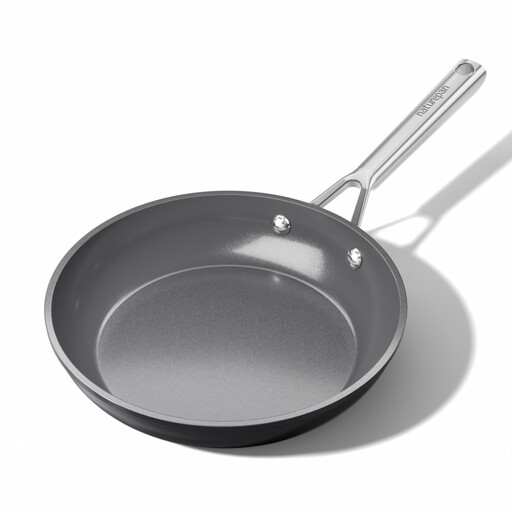
Why It Stands Out: This 24cm pan strikes an excellent balance between size and versatility. It features a reinforced diamond and titanium ceramic coating and is oven-safe up to a high temperature of 260°C, making it suitable for a wide range of recipes.
Pros:
Who is it for?: An ideal all-rounder for couples and small families. Its versatility makes it suitable for everything from morning fry-ups to searing meat before finishing it in the oven.
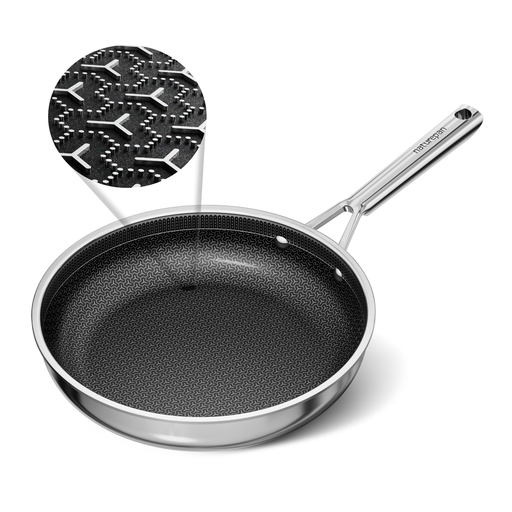
Why It Stands Out: This pan uses an innovative hybrid construction. It combines the searing power of stainless steel with the convenience of non-stick. A laser-etched hexagonal pattern raises stainless steel ridges for browning, while the ceramic-coated valleys provide effortless food release.
Pros:
Who is it for?: Keen home cooks and larger families who want professional-level results. It’s for those who love a good sear on their steak but still want the easy cleanup of a non-stick pan.
A great pan can certainly transform your cooking, but the overall atmosphere of your kitchen is just as important. The right lighting can make your culinary space feel brighter, cleaner and more inviting.
If you're also looking to refresh your kitchen's ambiance, explore our curated selection of Modern White Ceiling Lights to find the perfect fixture for your home.
1. Are ceramic non-stick pans truly safe? High-quality ceramic pans are generally manufactured without chemicals like PFOA, PFAS, lead and cadmium, making them a popular choice for a healthy cooking pan. It is always advisable to check the product's specifications to confirm it is certified free from these substances.
2. How do I care for my ceramic non-stick pan to make it last? To maintain the non-stick surface, avoid using metal utensils; opt for silicone, wood or nylon instead. While many pans are dishwasher safe, hand-washing with a soft sponge and mild soap can help extend the coating's life. Also, avoid using very high heat, as medium heat is usually sufficient for most cooking and is gentler on the coating.
3. Can I use a ceramic pan on an induction hob? It depends entirely on the pan's construction. For a pan to be induction-compatible, it must have a magnetic base. Most modern ceramic pans designed for versatility include a steel plate in the base for this purpose. Always look for "induction compatible" or an induction symbol on the packaging or in the product description.