What matters when choosing?
Plan a safe position first, then compare the heater’s stated room coverage, controls and fan noise against the way you use the room.
| Concern |
What to check |
Who this matters to |
| Safe placement |
Check for documented tip-over and overheat protection, and identify a stable position with unobstructed airflow away from curtains, furniture and hobby materials. |
When paper or fabrics are close to my work area, I need room to position a heater without blocking it or putting materials near it. Around 42% of consumers put safe operation around hobby materials first. |
| Warmth at one workstation |
Compare the exact model’s stated room coverage and heat settings; look for an adjustable thermostat. |
If I stay at one bench for hours, I want controllable warmth where I sit rather than choosing output on its own. For around 33% of consumers, local warmth is the primary need. |
| Warmth across the room |
Compare oscillation, physical size and stated room coverage for a position with clear airflow. |
Moving between my bench and storage makes a fixed stream of warm air less useful. Wider distribution comes first for around 25% of consumers. |
Ceramic heaters on Joybuy
These portable ceramic fan heaters offer different controls and outputs for use near a hobby-room workspace. Compare their stated features with your room and planned position; before use, confirm the plug and product documentation for the exact model.
 No image available
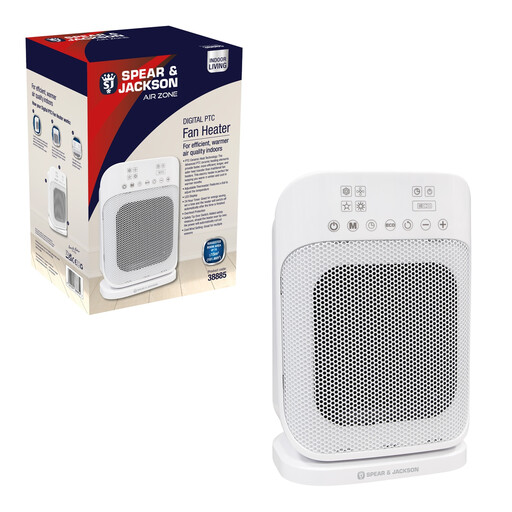
SPEAR & JACKSON 38885 Digital PTC Heater, 1500 W, white
Consider this model if you want a heater you can adjust from a workstation while directing warmth across the nearby area.
The product name specifies digital controls, oscillation, a timer and 1500 W output. Check its room-coverage guidance, operating noise, plug and documented safety features against your setup.
View on Joybuy
 No image available
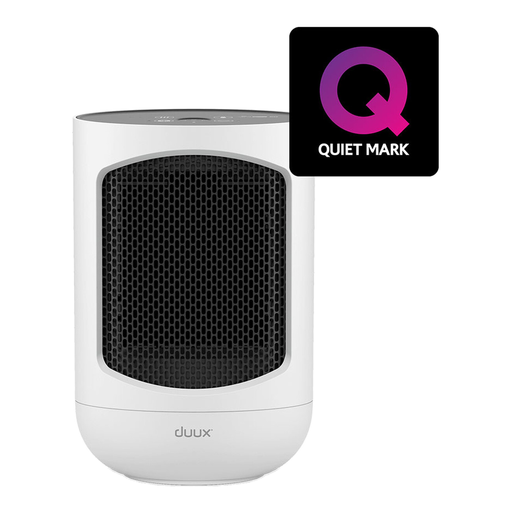
Duux Zone DXCH43UK Personal Fan Heater, 1500 W, white
Consider this portable heater if you work in a compact area but want oscillation rather than airflow fixed in one direction.
The product name specifies ceramic heating, 60° oscillation and three heat settings. Confirm its room-coverage guidance, operating noise, plug and documented safety features before choosing it for your room.
View on Joybuy
 No image available
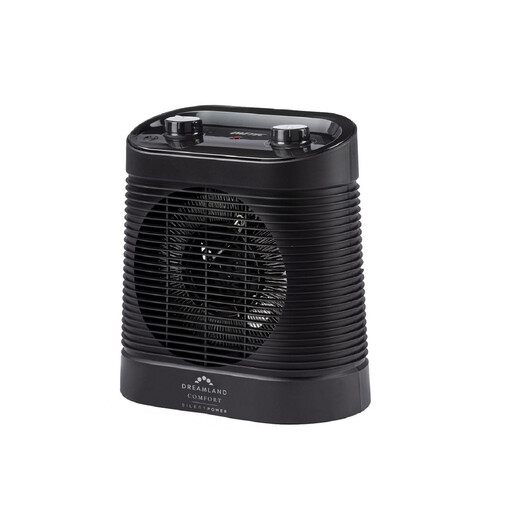
Dreamland Silent Power Comfort Fan Heater, 2000 W, grey
Consider this 2000 W ceramic model if you want digital controls, but check its fit for the room rather than relying on output or its name alone.
Confirm room-coverage guidance and a measured noise level if quiet operation matters. Check the plug and whether a tip-over switch is documented for the exact model.
View on Joybuy
Common questions
Can I use a ceramic fan heater in an occupied hobby room?
Yes, if the exact heater suits the room and you can position it safely with clear vents and space from people and combustible materials. Electrical Safety First notes that portable fan heaters provide immediate heat but can be noisy, so consider the work you do in the room too.
Can I leave the heater running when I leave or go to sleep?
No: do not use a portable heater unattended or overnight. Electrical Safety First advises against overnight use, and GOV.UK advises unplugging electric heaters when you go out or go to bed. A timer or safety cut-out does not replace supervision.
Should I choose 1.5 kW or 2 kW for a small hobby room?
Choose by the exact model’s stated room coverage, settings and your need for local or wider warmth, not wattage alone. Russell Hobbs states coverage of up to 15 m² for its 1.5 kW RHFH1006B and up to 20 m² for its 2 kW RHFH1008; insulation, draughts and your preferred temperature can affect the result in your room.
How do I keep a fan heater clear of craft-room debris?
Follow the manufacturer’s cleaning instructions, check the cable and plug before use, and keep intake and outlet grilles free of dust, fluff and hobby materials. Electrical Safety First warns that restricted airflow from dust and fluff can contribute to overheating.


