Check your accommodation rules before choosing a ceramic heater: some university halls prohibit portable heaters. If one is permitted, a compact fan heater suits warmth near a study position, while an oscillating tower is worth considering when you need air directed across more of the room and have a safe floor position. In either case, check the exact model’s safety features, placement instructions and electrical demand.
Who this choice affects
Students who need accommodation approval
Check the residence agreement before choosing a portable heater. The University of St Andrews prohibits heaters in study bedrooms, while the University of Manchester lists portable heaters as banned in halls; your own accommodation rules determine what you may use.
Students seeking desk-side warmth
If warmth near your study position matters more than directing heat across the room, a compact format may fit the space. Dimplex positions its DXUC2BS for desks, bedside tables and small spaces, subject to its placement instructions.
Students seeking wider heat distribution
Where portable heaters are permitted and clear floor space is available, an oscillating tower offers a way to direct warm air beyond one position. Check its dimensions, required clearance and power settings before choosing one.
What to check before buying
For a chilly student room, settle permission and safe placement before comparing warmth near your desk, distribution around the room and electrical use.
| Concern | What to check | Who this matters to |
|---|
| Permission and placement |
Read your accommodation rules and ask staff if permission is unclear. Check that the heater can stand clear of bedding and curtains. |
Before buying for halls, I need to know that a heater is allowed and that I can place it safely; around 36% of consumers would put permission and placement first. |
| Local warmth in limited space |
Check the unit’s footprint, permitted placement, thermostat and listed tip-over and overheat protection. |
With little space to spare, I want warmth near my study position rather than a large floor-standing unit; roughly 29% of consumers would prioritise local warmth and a compact footprint. |
| Heat distribution |
Compare oscillation, output settings and the clear floor area required for a tower model. |
If the chill affects more than my desk, I want warm air directed towards other parts of the room; around 21% of consumers would make wider distribution their main concern. |
| Electrical use |
Compare the exact model’s power settings and expected running time. Use a suitable socket without overloading it. |
When I expect to use the heater while studying, I want to understand its electrical demand and avoid a crowded adaptor; about 14% of consumers would put electrical use first. |
Mistakes to avoid
-
Buying before checking residence rules
A cold room does not mean a portable heater is permitted. The University of St Andrews and the University of Manchester both give examples of restrictions in their accommodation.
Read your residence handbook and ask accommodation staff for written confirmation if the rule is unclear.
-
Relying on safety cut-outs instead of clear space
Tip-over and overheat protection do not make placement near bedding, curtains or paper safe. Electrical Safety First advises keeping portable heaters away from flammable materials.
Follow the model’s clearance instructions, keep it away from clothes and furnishings, and turn it off when you are not using it.
-
Using a crowded extension arrangement
Electrical Safety First warns that overloading sockets and extension leads can be dangerous, particularly with high-powered appliances.
Use a suitable wall socket where possible. Do not connect one extension lead to another, and check an extension’s rating if you need to use one.
-
Choosing a plug-in mini heater on appearance alone
The UK Office for Product Safety and Standards has reported electric-shock risks for specific portable plug-in fan heaters. Small size is not a safety assessment.
Choose a traceable seller, check whether the exact product is subject to a safety alert, and stop using a heater if its plug, cable or casing is damaged or unusually hot.
Brands to consider for these heater formats
Dimplex
Dimplex positions its DXUC2BS as a compact ceramic fan heater for desks, bedside tables and small spaces.
- Dimplex lists three power settings, a thermostat, fan-only mode, tip-over protection and overheat safety for this model.
- Its small-space positioning should not be taken as a promise of even warmth throughout a larger room.
De'Longhi
The De'Longhi HFX65V20 represents a ceramic tower format for students considering heat distribution beyond one position.
- De'Longhi lists 1,200 W and 2,000 W heating settings, a thermostat, remote control and tip-over switch for the HFX65V20.
- Check that a tower can stand with the clearance required by its instructions and that its maximum electrical demand suits the available socket.
Pro Breeze
Pro Breeze lists a 2,000 W ceramic PTC tower heater with automatic oscillation.
- The brand specifies two power settings and 80° automatic oscillation for that tower model.
- Oscillation changes where warm air is directed; it does not remove the need for clear placement and suitable electrical connection.
Ceramic heaters on Joybuy
These ceramic fan heaters offer compact and oscillating options to compare for a student room where portable heaters are permitted. Check each model’s placement instructions and features against your available space.
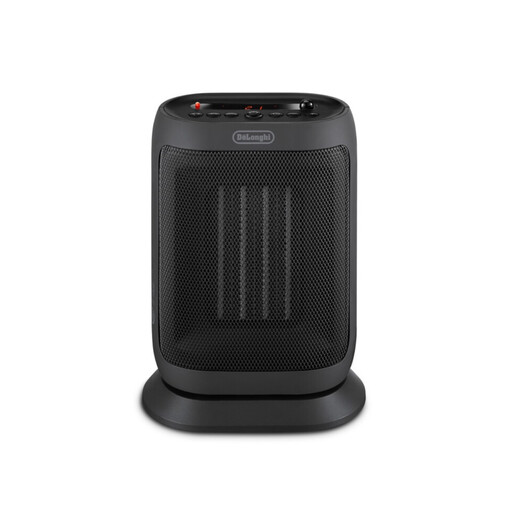 Image unavailable
De'Longhi Capsule You & Me Ceramic Fan Heater, 2,000 W, Dark Grey
For a permitted room where you want an oscillating heater rather than air directed at one fixed spot. Its listed features include an oscillating base, remote control, 24-hour timer and ECO control; check that its placement and 2,000 W rating suit your room and socket.
View on Joybuy
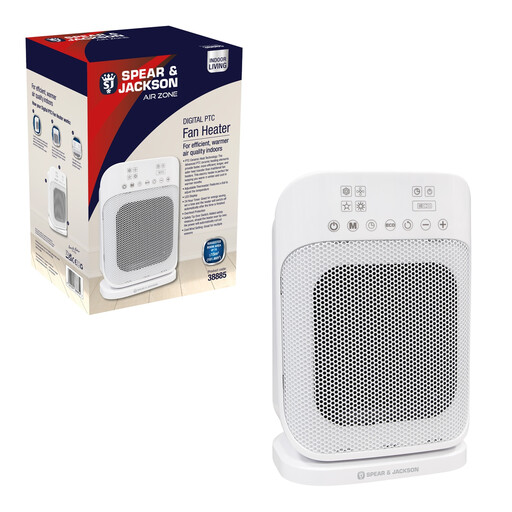 Image unavailable
SPEAR & JACKSON 38885 Digital PTC Heater, 1,500 W, White
A compact option to consider when a portable heater is allowed and space is limited. The product name lists oscillation and a timer; check its dimensions, thermostat control and individual heat settings against your needs.
View on Joybuy
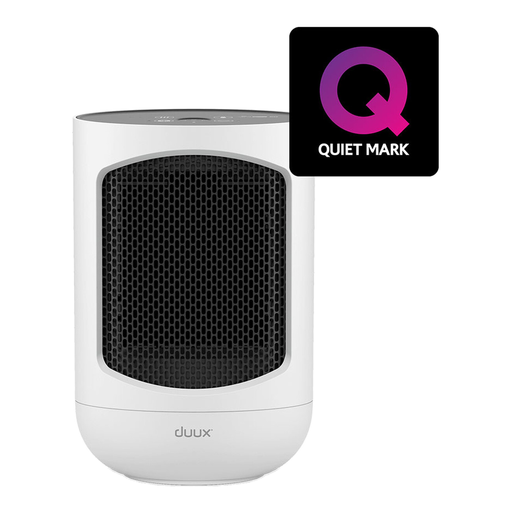 Image unavailable
Duux Zone DXCH43UK Ceramic Fan Heater, 1,500 W, White
A personal-heater format to consider for warmth near a study position, subject to permission and safe placement. Its name lists 60° oscillation and three settings; check which settings provide heat, whether it has thermostat control and where it may safely stand.
View on Joybuy
Frequently asked questions
Can I use a ceramic heater in university halls?
Check your own hall’s rules before buying; permission is not the same across accommodation providers. The University of St Andrews prohibits heaters in study bedrooms, while the University of Manchester lists portable heaters among items banned in halls.
Can I leave a ceramic heater on overnight?
Turn a portable heater off before going to bed unless the exact model’s instructions explicitly permit overnight use. Hertfordshire County Council advises switching portable heaters off at bedtime; a timer or thermostat alone does not establish that overnight use is suitable.
Should I plug a heater into an extension lead?
Use a suitable wall socket where possible and avoid an overloaded extension arrangement. Electrical Safety First warns about overloading sockets and extension leads and advises against connecting one extension lead to another.
Which safety features matter in a student room?
Look for manufacturer-listed overheat protection and tip-over shut-off, alongside controls that suit how you will use the heater. These features do not replace accommodation permission, the model’s required clearance or switching it off when appropriate.
Will a lower-wattage heater always use less electricity?
A lower power setting uses less electricity over the same period of continuous operation, but total use also depends on how long the heater runs. Compare the exact settings and likely running time rather than assuming that a lower rating will warm the whole room adequately.


