Calorie-first commuters
If you are taking one bar on a rushed morning, its kcal per bar and portion weight matter more to that choice than how small it looks.


For a calorie-first grab-and-go breakfast, compare the kcal in the bar you will eat, then check its weight and kcal per 100g. Kellogg's UK lists 104 kcal for a 27g Special K Red Berry Bar, and Weetabix Cereals lists 106 kcal for a 28g Alpen Fruit & Nut bar; the checked protein-bar examples have larger portions and more calories per bar. Sugars, fibre, protein and dietary suitability can change which option fits your needs, so a small per-bar figure is not the whole decision.
If you are taking one bar on a rushed morning, its kcal per bar and portion weight matter more to that choice than how small it looks.
A portable bar still needs to meet your dietary requirements. Check suitability and the complete allergen statement for the exact product alongside its nutrition figures.
If protein is your priority, compare grams of protein and kcal per bar together. A protein-oriented flapjack is not necessarily the lower-calorie choice.
Start with the portion you expect to eat, then compare differently sized bars using the per-100g figures. The NHS explains that food labels give nutrition information per 100g and may also give it per portion.
| Priority | What to check | Your needs |
|---|---|---|
| Calories and portion | Check kcal per bar, the bar's weight in grams and kcal per 100g. If you will eat more than one bar, account for the amount you actually eat. | I want a portion that fits my breakfast plan, without mistaking a small bar for a lower-energy product overall. |
| Sugars, saturates and salt | Compare the figures per bar and per 100g. Read these alongside calories rather than treating any single number as the full nutrition picture. | If two portions have similar calories, I also want to see how their sugars, saturates and salt compare. |
| Fibre and protein | Check the exact bar's fibre and protein figures or its labelled fibre claim, alongside portion size and kcal. A protein-focused format does not establish a lower calorie count. | A small cereal bar may suit a calorie-first stopgap; for a protein-oriented snack, I would compare the larger bars on their own figures. |
| Dietary suitability | Read the ingredients, allergen declaration and any vegan or gluten-free statement on the exact pack. Include any may-contain information relevant to you. | I need the bar to meet my dietary requirements as well as being convenient to carry. |
A smaller bar can have fewer kcal per portion without having fewer kcal per 100g than another bar.
Compare kcal per bar, weight and kcal per 100g, then decide how much you are likely to eat.
Tesco Groceries lists 219 kcal per 50g TREK Original Oat flapjack and 220 kcal per 40g Eat Natural Peanut and Dark Chocolate bar. Their portions differ from the smaller cereal bars in this comparison.
Choose on the protein and portion figures if protein is your priority; use kcal per bar if limiting that portion's calories comes first.
A comparison about sugars answers a different question from how many kcal a serving contains.
Check both the sugars and energy figures on the pack, using comparable serving sizes where possible.
Oat, fruit and protein bars can differ in their ingredients and may-contain statements; a format name does not establish dietary suitability.
Check the current pack's ingredients, allergens and suitability wording for the particular flavour and variant.
For a smaller cereal-bar portion, Weetabix Cereals lists 106 kcal per 28g Alpen Fruit & Nut bar.
Kellogg's UK lists 104 kcal per 27g Special K Red Berry Bar.
Tesco Groceries lists 131 kcal per 30g serving for Graze Cherry Bakewell Oat Boosts and describes that product as suitable for vegans.
TREK's checked Original Oat Protein Flapjack is a larger, protein-oriented option: Tesco Groceries lists 10g protein and 219 kcal per 50g portion.
Tesco Groceries lists 220 kcal per 40g Eat Natural Peanut and Dark Chocolate Protein bar.
Nature Valley describes wholegrain-oat Crunchy bars and a separate Protein range.
These options include smaller cereal-bar packs, an oat-bar pack and protein-flapjack packs for different grab-and-go preferences. Compare the exact pack labels before choosing between the formats.
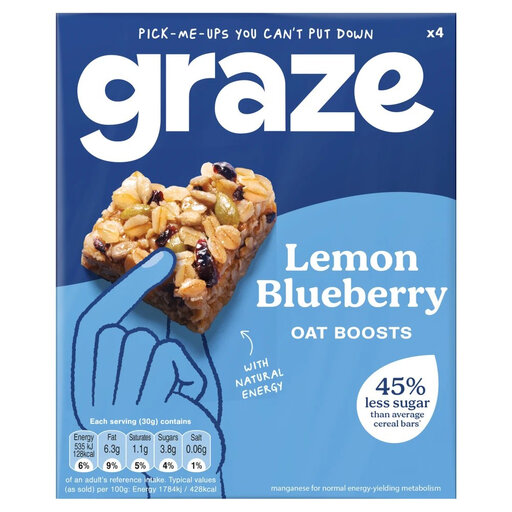 No image available
This oat-bar pack offers 30g portions. Check its own kcal, fibre and suitability information rather than applying figures from another Graze flavour.
 No image available
For a calorie-first choice, check the calories and serving weight printed for this cereal bar; the word Light does not supply those figures.
 No image available
The stated 21.5g bar size is useful when comparing portions. Check this Dark Chocolate variant's own nutrition panel rather than using figures for Special K Red Berry.
 No image available
This is a 50g protein-flapjack format. Compare its per-bar kcal and protein with smaller cereal bars, and check the Salted Caramel pack for dietary suitability.
No image available
Each stated portion in this protein-flapjack pack is 50g. Read the Cocoa Oat label for its kcal, protein and allergens; figures for other TREK flavours may differ.
Compare both: kcal per bar describes the stated portion, while kcal per 100g helps you compare bars of different sizes. The NHS notes that labels provide per-100g information and may also give per-portion figures; account for the amount you actually eat.
A small per-bar figure alone does not establish that. For example, Kellogg's UK lists 104 kcal for a 27g Special K Red Berry Bar but 385 kcal per 100g, so check both the portion and the weight-based figure.
Not among these checked examples: Tesco Groceries lists 219 kcal per 50g TREK Original Oat Protein Flapjack, while Kellogg's UK lists 104 kcal per 27g Special K Red Berry Bar. Compare protein as well as kcal if protein is the reason you are considering a larger flapjack.
No: a sugar comparison does not tell you the product's kcal. Read its sugars and energy figures separately, paying attention to whether each figure is per bar or per 100g.
Check the exact pack's ingredients, allergen and may-contain statements, and any vegan or gluten-free wording. Suitability for one flavour or bar in a range should not be assumed for another.