Revision snackers watching portion calories
If you want a cereal bar for a study break, compare kcal for the amount you plan to eat. The per-100g figure helps you see whether a smaller bar accounts for a lower per-bar total.


For a lower-calorie cereal bar to eat during exam revision, compare the kcal in the portion you will actually eat, then check kcal per 100g when bar sizes differ. Waitrose & Partners lists Graze Banana Bread and Cocoa Vanilla Oat Boosts at 115 and 116 kcal per 30g bar respectively, below the specific Kellogg's, Nature Valley and Eat Natural servings compared here. That does not settle which bar suits your ingredients, dietary requirements or preferred portion size.
If you want a cereal bar for a study break, compare kcal for the amount you plan to eat. The per-100g figure helps you see whether a smaller bar accounts for a lower per-bar total.
If protein or fibre matters more to you than the lowest calorie total, compare those figures alongside kcal for the whole serving. Check the ingredients and allergens as well.
Check the exact pack's ingredients, allergen information and dietary-suitability statements. An oat, vegan or protein label does not answer every allergen question.
Start with the portion you expect to eat, then use the rest of the label to decide whether that particular bar fits your needs.
| Priority | What to check | Your needs |
|---|---|---|
| Portion calories | Read kcal per bar or labelled serving and the serving weight. If you plan to eat more than one bar, check how many bars the labelled serving contains. The NHS notes that the stated portion may differ from the amount eaten. | I want to know the calories in the portion I will have during a revision break, not just the figure printed most prominently on the pack. |
| Bar size | Compare kcal per 100g as well as kcal per serving when weights differ. Waitrose & Partners lists Graze Banana Bread Oat Boosts at 115 kcal per 30g bar and 382 kcal per 100g. | A small bar might suit a short break, but I want to distinguish its portion size from its per-100g calorie figure. |
| Other nutrition figures | Check sugars, saturates, salt, fibre and protein on the nutrition panel, using the same per-100g or per-serving basis for each comparison. The NHS explains how these figures appear on food labels. | If I expect to choose this snack regularly, calories alone do not tell me what else the bar contains. |
| Protein or fibre | Compare protein and fibre per bar alongside its calorie total. Eat Natural lists its Cocoa, Peanut & Almond Protein Bar at 8.0g protein, 2.5g fibre and 218 kcal per 40g bar. | Protein or fibre may be my priority, even if that means choosing a bar with a higher calorie total. |
| Ingredients and allergens | Read the exact pack's ingredients and allergen statements; check any gluten-free or vegan declaration separately. Nature Valley states that its Crunchy Oats & Honey bars contain oat gluten. | I need a bar that fits my dietary requirements, so an oat-based or vegan description on its own is not enough. |
A smaller bar can have fewer calories per bar without having the same advantage on a per-100g basis.
Compare both figures. Waitrose & Partners lists Graze Banana Bread Oat Boosts at 115 kcal per 30g bar and 382 kcal per 100g; Kellogg's lists Rice Krispies Squares Corn Flakes at 127 kcal per 31g bar.
A calorie figure does not tell you the bar's sugars, saturates, salt, fibre or protein.
Read the nutrition panel on a consistent per-serving or per-100g basis before deciding which details matter for your choice.
Dietary descriptions do not replace the allergen information for the particular product. Nature Valley, for example, states that its Crunchy Oats & Honey bars contain oat gluten.
Check the current pack's ingredients, highlighted allergens and any gluten-free declaration rather than relying on the bar's category or flavour.
Norfolk and Norwich University Hospital NHS Foundation Trust's snack guidance notes that snacks can contribute nutrients, while some also add fat, sugar and salt.
Consider the portion and the rest of your food choices across a revision day, rather than expecting one bar to cover every snack preference.
These examples describe particular bars or product lines; a brand name alone does not establish a calorie figure or dietary suitability for every variant.
The Banana Bread and Cocoa Vanilla Oat Boosts are 30g bars with stated per-bar calorie figures.
Rice Krispies Squares Corn Flakes provides a separate 31g serving to compare with oat-based bars.
Its Crunchy Oats & Honey and Protein bars serve different comparison needs.
Its Cocoa, Peanut & Almond Protein Bar is an example to consider when protein and fibre are priorities.
Tesco describes the Smooth Lemon and Salted Caramel Protein Flapjacks as plant-based options.
Alpen Light appears in a Weetabix product list dated November 2021.
These cereal-bar packs offer different flavours, bar sizes and formats for a revision snack. Check the current pack's per-bar calories, nutrition panel and ingredients before choosing; the external calorie examples above do not establish figures for these different variants.
 No image available
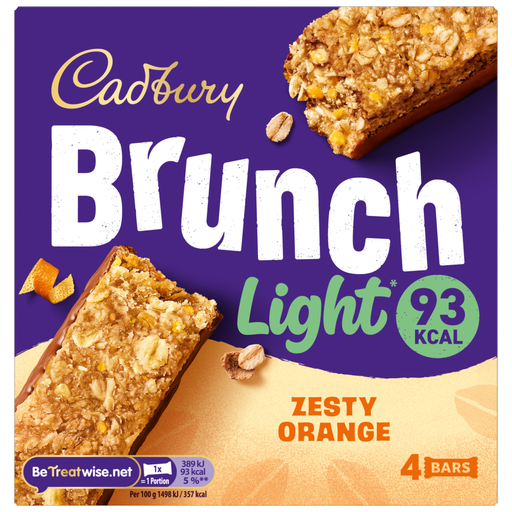
For a revision break, check the calories and ingredients for the amount you intend to eat from this four-bar, 104g pack. The word “Light” in the name is not a substitute for the nutrition panel.
 No image available
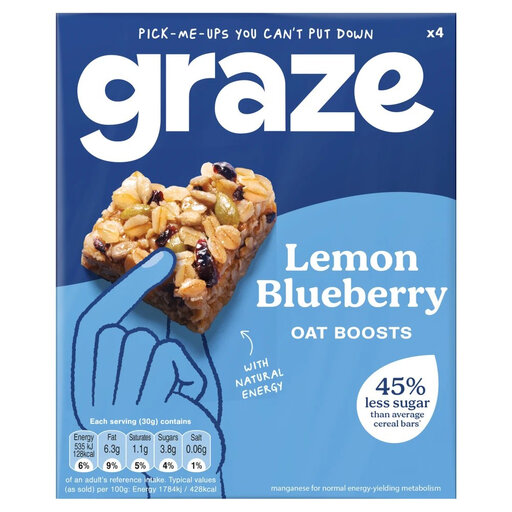
Each bar in this pack is labelled 30g. If portion size is your starting point, check this flavour's own kcal per bar and per 100g rather than using figures for other Graze Oat Boost variants.
 No image available
This pack contains four 30g Cherry Bakewell bars. Compare its own nutrition and ingredient label with other 30g bars, particularly if a specific allergen or dietary declaration matters to you.
 No image available
At 21.5g per bar, this is a smaller labelled bar size than the 30g and 40g options shown here. Read both kcal per bar and kcal per 100g before comparing their calorie figures.
 No image available
For a protein-focused revision snack, compare the full 40g bar's calorie figure with its protein and fibre figures. Nature Valley UK lists its Peanut & Chocolate Protein bars at 10g protein and 4g fibre per bar; check the current pack's nutrition and allergen information.
Start with kcal for the amount you intend to eat, then compare kcal per 100g to account for different bar weights. The NHS explains that food labels give nutrition information per 100g and sometimes per portion; the labelled portion may not match what you eat.
Yes, for these specific labelled servings: Waitrose & Partners lists Graze Banana Bread and Cocoa Vanilla Oat Boosts at 115 and 116 kcal per 30g bar. Nature Valley UK lists Crunchy Oats & Honey at 196 kcal per two-bar, 42g serving, while Eat Natural lists its Cocoa, Peanut & Almond Protein Bar at 218 kcal per 40g bar. Those figures do not describe every variant from those brands.
No. Eat Natural lists 8.0g protein and 2.5g fibre in its Cocoa, Peanut & Almond Protein Bar, alongside 218 kcal per 40g bar. Compare all three figures for the portion you would eat rather than treating “protein” as a calorie claim.
No. Check the exact product label: Nature Valley says its Crunchy Oats & Honey bars contain oat gluten. The Food Standards Agency states that food labelled gluten-free must contain no more than 20mg/kg gluten and that oats must still be emphasised as an allergen.
Read the current pack's serving size, nutrition panel, ingredients and allergen information. These checks help you compare the portion you expect to eat and identify whether that particular flavour and variant meets your dietary requirements.