What should you check?
Start with a like-for-like nutrition comparison, then check the portion and ingredients of the bar that will go into your lunch.
| Priority | What to check | Your needs |
|---|
| Fat claims |
Compare total fat per 100 g. For a solid food, legislation.gov.uk gives no more than 3 g per 100 g as the low-fat claim condition; a reduced-fat claim requires at least 30% less of that nutrient than a similar product. |
I want to know whether the bar meets a stated fat-claim condition, rather than merely having less fat than another option. |
| Whole label |
Read fat, saturates, sugars and salt per 100 g, then check the figures for the portion you will eat. GOV.UK explains that traffic-light labels, where shown, indicate high, medium or low amounts of these nutrients. |
A smaller bar may suit my packed-lunch portion, but I still want to compare its nutrition with bars of other sizes. |
| Protein and fibre |
Check the stated amounts for the exact bar and portion. Compare fat and sugars separately rather than treating a protein or fibre statement as a fat claim. |
If I choose a bar for its protein or fibre, I also want to see what else that serving contains. |
| Ingredients |
Read the current ingredient and allergen statements for the exact flavour. Check any dietary description against the pack you are buying. |
I need a bar whose ingredients fit my requirements, not just a familiar brand or a description on the front. |
Brand references
These brand examples show why the exact product and its nutrition declaration matter more than the brand name alone.
Graze
The Oat Boost range includes flapjack-style cereal bars.
- Graze makes a lower-sugar comparison for Oat Boosts; that is a statement about sugar, not fat.
- Tesco Groceries lists 22 g fat per 100 g and 6.5 g per 30 g serving for Cocoa Vanilla Oat Boosts. Check the declaration for other flavours separately.
Nature Valley
Its range includes oat bars and protein-focused bars, which call for product-by-product comparison.
- Nature Valley UK lists protein and fibre information for its Protein Chocolate & Coffee bar.
- Nature Valley UK lists 19.8 g fat per 100 g for Crunchy Oats & Dark Chocolate. A protein or oat description does not establish lower fat.
Eat Natural
Its Apple Soft Fruit Bar provides a fruit-bar example for comparing declared fat.
- Tesco Groceries lists 4.9 g fat per 100 g and 1.2 g per 25 g bar for this product.
- At 4.9 g per 100 g, it exceeds the low-fat claim condition for solid food published on legislation.gov.uk.
TREK
TREK presents Protein Flapjacks and High Protein bars as plant-protein options.
- TREK states 9 g plant-based protein for its Protein Flapjacks and 15 g for its High Protein bars.
- If fat is your deciding factor, compare the total-fat declaration on the exact flavour and portion.
Kellogg’s
The Special K range includes cereal-bar formats.
- Kellogg’s advises checking the ingredient list and nutrition declaration on the pack before purchase.
- Assess each flavour by its current label rather than assuming that bars in the range have the same fat content.
Cereal bars on Joybuy
These cereal-bar and oat-bar options can be considered for a packed lunch. Compare the current labels for fat per 100 g and per bar before treating any one of them as a lower-fat choice.
 No image available
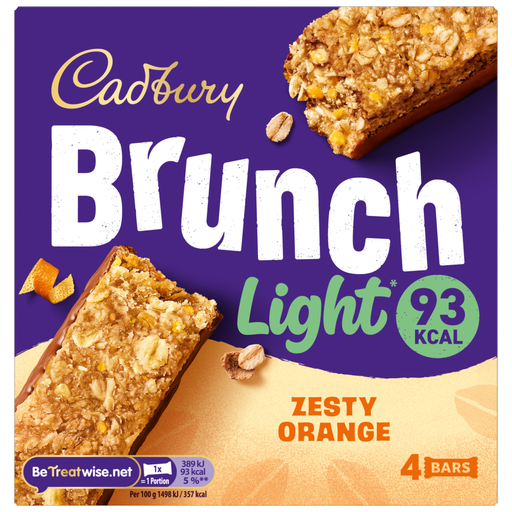
Cadbury Brunch Light Orange Cereal Bar, 4pk, 104g
For a ploughman’s lunch, check the fat per 100 g and per bar on this 4-pack. “Light” in the product name does not, by itself, tell you whether the bar meets a reduced-fat or low-fat claim condition.
View on Joybuy
 No image available
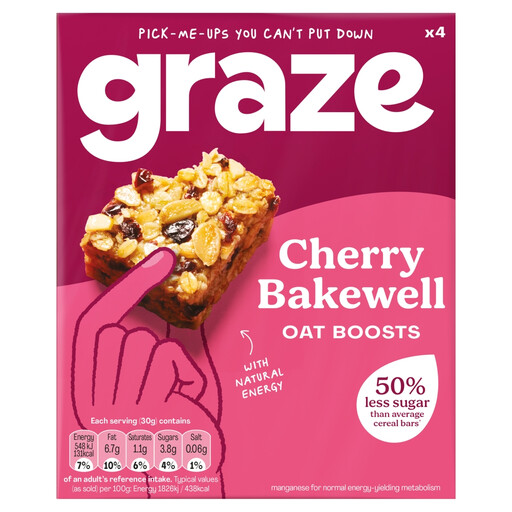
Graze Oat Boosts Cherry Bakewell, 4 x 30g
If you are considering an oat bar for your lunch, compare this Cherry Bakewell flavour’s own fat, saturates and sugars per 100 g. The pack contains four 30 g portions; nutrition figures for a different Oat Boosts flavour should not be substituted for its label.
View on Joybuy
 No image available
Special K Dark Chocolate Snack, 6 x 21.5g
For this six-bar pack, check the current Dark Chocolate nutrition declaration per 100 g before comparing it with larger bars. Then read the values for a 21.5 g bar to assess the portion you would pack.
View on Joybuy
 No image available
Graze Oat Boosts Lemon Blueberry, 4 x 30g
This Lemon Blueberry pack contains four 30 g portions. If lower fat is the aim, use this flavour’s own per-100-g total-fat figure; an oat-bar description or a sugar comparison cannot answer that question.
View on Joybuy
 No image available
Special K Red Berry Cereal Bar, 6 x 21.5g
If a 21.5 g bar fits the lunch you are packing, check this Red Berry version’s current fat and sugars both per 100 g and per bar. Read its ingredient statement separately from that of other Special K flavours.
View on Joybuy
Questions about choosing a bar
Does “reduced fat” mean a cereal bar is low in fat?
No. For UK nutrition claims, the conditions published on legislation.gov.uk distinguish at least 30% less fat than a similar product for a reduced-fat claim from no more than 3 g fat per 100 g for a low-fat claim on solid food. Having less fat than one other bar does not establish either claim.
How do I compare bars of different sizes?
Use the nutrition figures per 100 g for a like-for-like comparison, then check the figures for the bar or serving you will pack. GOV.UK explains that traffic-light labels, where provided, indicate high, medium or low amounts of fat, saturates, sugars and salt.
Does a protein or fibre description mean a bar has less fat?
No. Protein and fibre are separate measures from total fat. Read all three figures for the exact product, alongside saturates and sugars, before deciding whether it fits your lunch.
What should I check if ingredients or allergens matter to me?
Read the ingredient and allergen statements on the current pack for the exact flavour. GOV.UK’s allergen guidance covers ingredients including cereals containing gluten, milk, peanuts, soy and tree nuts; do not assume that another bar from the same brand has the same ingredients.


