What should you compare?
Start with the per-100g nutrition figures, then check the portion and ingredient information for the bar going into the lunchbox.
| Priority | What to check | Your needs |
|---|
| Fat and saturates |
Compare both figures per 100g, then per bar. The NHS defines low fat as 3g or less per 100g on its general food-label guide. |
I want to compare different-sized bars without mistaking a small portion for a low-fat product. |
| Sugars |
Read sugars per 100g and per bar alongside fat; use traffic-light colours where shown. |
Lower fat alone does not answer my question about the bar’s sugar content. |
| Portion and recipe |
Check the bar weight and nutrition declaration. Wholegrain, fruit-and-nut and protein descriptions do not replace those figures. |
I need to know what one packed bar contributes to lunch, rather than choosing by its front-of-pack description. |
| Allergens |
Read the current ingredients, highlighted allergens and any ‘may contain’ statement for the exact variant. |
For a child with a food allergy, I need to check the specific pack before considering its nutrition figures. |
Relevant brand ranges
These are product-line references for reading labels, not a ranking of brands; figures for one flavour should not be applied to another.
Alpen
Weetabix Cereals lists Alpen Light Summer Fruit as a 19g bar.
- Its stated figures are 0.8g fat and 0.3g saturates per bar.
- Check the exact pack’s ingredients and allergens before choosing it for a child.
Kellogg's
Kellogg's publishes nutrition figures for individual Special K and Rice Krispies bar formats.
- Its listed Special K Red Berry Bar has 1.7g fat and 0.6g saturates per serving.
- The same listed serving has 7.6g sugars; check the weight and label of the variant you buy rather than applying these figures across the range.
Graze
Graze describes Oat Boost as an oat flapjack range.
- An oat flapjack format may be of interest if that is the type of bar you want to compare.
- Check the chosen flavour’s total fat per 100g and per bar before treating it as a lower-fat option.
Eat Natural
Eat Natural’s Almond & Apricot is a fruit-and-nut cereal bar.
- Its 40g serving weight gives a clear portion basis for label comparison.
- Eat Natural lists 10.7g fat and 7.5g saturates per 40g bar; also check the exact pack for allergens.
TREK
TREK’s Cocoa Oat is a 50g oat protein flapjack.
- TREK lists 9g protein per bar for shoppers comparing that declared nutrient.
- It also lists 11g fat and 5g saturates per bar, so protein content does not establish lower fat.
Nature Valley
Nature Valley describes its Crunchy Oats & Honey bars as containing wholegrain oats.
- The named oat-bar range offers another recipe type to compare.
- Check the current pack’s fat, sugars, portion size and allergens rather than assuming wholegrain oats indicate lower fat.
Cereal bars on Joybuy
These cereal-bar and snack-bar packs are options to assess for a school-holiday lunch. Compare each exact pack’s fat and sugar figures, portion size and allergens before deciding whether it meets a lower-fat requirement.
 No image available
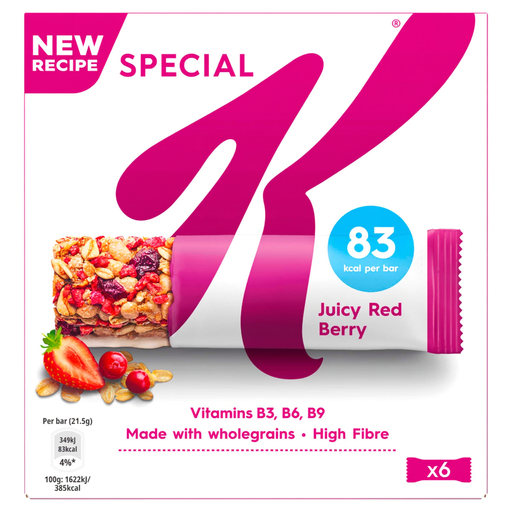
Special K Red Berry Cereal Bar 6 x 21.5g
For a packed lunch, the stated 21.5g bar size provides the portion to compare with the pack’s per-100g fat and sugar figures. Check this variant’s current ingredients and allergen statement.
Joybuy
 No image available
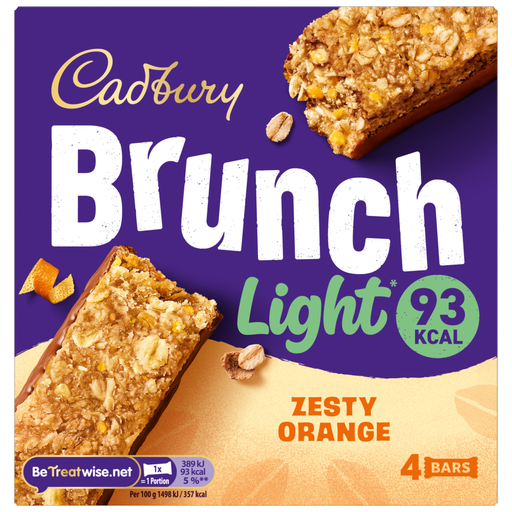
Cadbury Brunch Light Orange Cereal Bar 4pk 104g
The pack is labelled 4pk 104g. For a child’s lunch, check the individual bar’s declared serving size, nutrition figures and allergen warnings; ‘Light’ in the name does not establish its fat classification.
Joybuy
 No image available
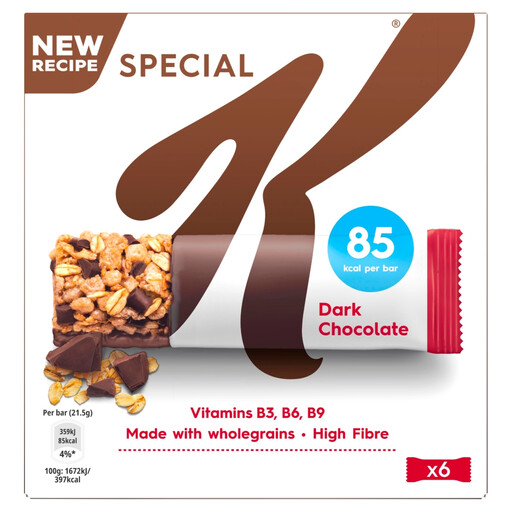
Special K Dark Chocolate Snack 6 x 21.5g
The stated 21.5g portion can be considered for a packed lunch. Compare this dark-chocolate variant’s own fat, saturates and sugars per 100g and per bar, and read its current allergen statement.
Joybuy
Common questions
How can I compare fat in different-sized cereal bars?
Compare fat per 100g first, then check the amount in each bar and its saturated fat figure. The NHS uses 3g fat or less per 100g as its general low-fat label benchmark; less fat in a smaller bar does not necessarily meet it.
Does less fat make a cereal bar a suitable lunch on its own?
No. Fat is only one part of the label comparison, and a bar should be considered alongside the rest of lunch rather than as the meal. The NHS recommends fruit and vegetables as children’s snack choices.
Why check sugars if I am choosing by fat content?
The two figures answer different questions: a lower fat figure does not tell you the sugar content. Read sugars per 100g to compare products and per bar to understand the portion being packed.
What should I check for a child with a food allergy?
Read the exact current pack’s ingredients, highlighted allergens and any ‘may contain’ statement before packing the bar. Repeat the check when changing flavour, format or pack size rather than relying on another product in the range.
Can traffic-light colours replace the nutrition panel?
No. Where traffic-light labelling appears, its colours offer a quick indication of low, medium or high levels, as GOV.UK explains. Use the nutrition declaration for the exact per-100g and per-serving figures needed to compare bars of different sizes.


