Shared-kitchen clean-up prioritiser
You want to clear cheese residue before someone else uses the appliance. Removable, dishwasher-safe plates are worth considering, alongside a cleaning routine everyone can follow.


For cheese toasties in a shared kitchen, choose a sealed deep-fill toaster if containing melted cheese matters most, or removable, dishwasher-safe plates if cleaning between users takes priority. Upright storage helps when the appliance must be put away; extra grill and waffle plates make sense only if the group will use and store them. A microwave toastie maker is another option where a compatible microwave is available, but check its filling containment and cleaning instructions separately.
You want to clear cheese residue before someone else uses the appliance. Removable, dishwasher-safe plates are worth considering, alongside a cleaning routine everyone can follow.
You often make thick toasties and want a plate shape and hinge suited to the filling. A seal or enclosed design may help contain cheese, but bread fit and the amount of filling still matter.
You need to clear the worktop after cooking. Check how the appliance stores upright, whether it stays closed in storage and where any extra plates will go.
For a shared-kitchen cheese-toastie maker, decide which concern comes first, then check the features that address it. Several features may matter to the same kitchen.
| Concern | What to check | Who this matters to |
|---|---|---|
| Cleaning between users | Check whether food-contact parts detach and which parts the instructions permit in a dishwasher. Agree a cleaning routine if users have different allergen needs. | When several people use the maker, I want to clear cheese residue before the next turn; roughly 36% of consumers put cleaning between users first. |
| Containing cheese filling | Check the plate shape against the household’s bread and make sure the lid closes without force. Look for a seal or enclosed-plate design if leakage is the main nuisance. | If I make generously filled toasties, I want to keep melted cheese off the shared worktop; around 29% of consumers prioritise filling containment. |
| Storage space | Measure the available cupboard space and check whether the maker stores upright. Allow room for any separate plate sets. | I need to put the appliance away after each use rather than leave it on the worktop; roughly 21% of consumers make storage their main concern. |
| Extra cooking formats | Confirm which sandwich, grill or waffle plates are included and how each set is cleaned and stored. | We would also use grill or waffle plates, provided they earn their cupboard space; around 14% of consumers place multiple cooking formats first. |
Cheese residue can remain for the next user. For food-business use, the Food Standards Agency also calls for measures to prevent cross-contamination.
Let the maker cool and clean it as instructed after use. Agree how plates will be cleaned between users, particularly if allergens are a concern.
Deep-fill plates provide room for filling, but forcing a thick sandwich shut can still leave cheese outside the sealed area.
Check the fit using the bread your kitchen normally buys, keep filling away from the edges and follow the appliance’s closing instructions.
Interchangeable plates add cooking formats, but each set needs storage and cleaning. Detachable plates do not establish that replacements are available.
Confirm the included sets, plan their cupboard space and check spare-part availability for the exact model if it matters to you.
A shared workplace kitchen may have its own controls for personal appliances and maintenance. Food-business operations raise separate hygiene questions.
Ask the employer or facilities manager whether the appliance is permitted and which equipment and cleaning procedures apply before bringing it in.
Breville UK lists both sealed deep-fill and removable-plate toastie makers, giving buyers two different ways to address cheese-filled sandwiches.
The Russell Hobbs Creations 3-in-1 26810 suits a kitchen that will use more than its deep-fill sandwich plates.
Salter’s XL 3-in-1 EK2143 is relevant when the group wants deep-fill toasties alongside waffles and paninis.
The GRSM1U illustrates a removable-plate option with deep pockets and variable temperature control.
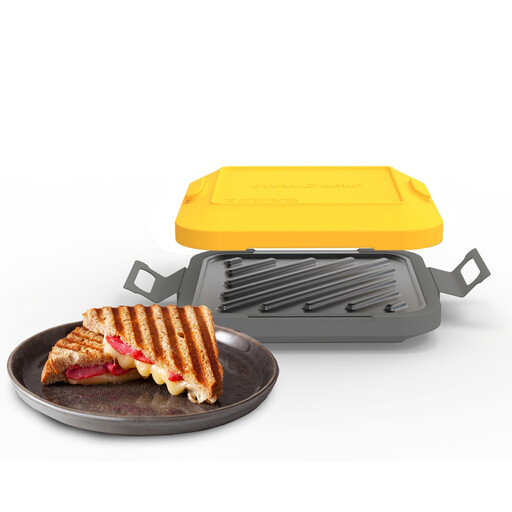
This compact microwave option is for a shared kitchen with a compatible microwave. Compare its cleaning and bread-fit instructions with your needs rather than assuming it has the seal or removable plates of a plug-in deep-fill toaster.
 No image available
A compact option for making toasties where the shared kitchen has a microwave. Check the stated 1200 W microwave limit against the microwave and the product instructions.
The product is described as dishwasher-safe; confirm which components can go in the dishwasher. If containing melted cheese is your priority, check bread fit and the maker’s closing instructions.
They are worth considering when users need to wash food-contact surfaces thoroughly between cheese toasties. Breville UK lists dishwasher-safe detachable plates for the VST082, and Russell Hobbs UK lists dishwasher-safe interchangeable plates for the 26810; either way, agree a cleaning routine rather than relying on a quick wipe.
A deep-fill design cannot guarantee that cheese stays inside. Breville UK describes the VST091’s enclosed plates, walled hinges and cut-and-seal shape as features intended to contain filling; bread fit and closing the lid without force still matter.
Sharing a household kitchen does not, by itself, make household toasties a food business. If food is being prepared as a business, check the Food Standards Agency’s registration guidance and the requirements of the relevant local authority before operations begin.
A PAT test is not automatically required for every portable appliance under the Health and Safety Executive’s workplace guidance. The workplace should follow its equipment policy and decide on appropriate user checks, inspection and testing according to the circumstances.