Tiny-kitchen toastie makers
If both worktop and cupboard room are tight, you need to compare stored dimensions or consider a microwave maker that can be put away between uses.


Choose a microwave toastie maker when storage space is the priority, provided you have a suitable microwave and want that cooking format. For sealed triangular cheese toasties, look at a plug-in model that stores upright; consider deep-fill plates when room for generous fillings matters more than minimising the appliance’s size. Check the exact model’s stored dimensions and cleaning instructions before choosing.
If both worktop and cupboard room are tight, you need to compare stored dimensions or consider a microwave maker that can be put away between uses.
If melted cheese or generous fillings regularly make cleaning awkward, plate shape, sealing design and the permitted cleaning method deserve closer attention.
If you want a conventional sandwich toaster without leaving it on the worktop, an upright-storage model may suit you, provided it fits your cupboard.
Consider it when: putting the maker away in a small space is your main concern and you already have a suitable microwave.
Trade-off: it uses a different cooking format from a plug-in sandwich toaster; check that it suits your usual bread and fillings.
Consider it when: you want sealed triangular toasties from a plug-in appliance that can be stored vertically.
Trade-off: fixed plates, as on the Russell Hobbs 26800, need cleaning in place after the appliance cools.
Consider it when: extra room for cheese and other fillings takes priority over choosing the smallest maker.
Trade-off: upright storage does not establish cupboard fit, so check the closed dimensions of the model you choose.
| Concern | What to check | Who this matters to |
|---|---|---|
| Stored size | Compare closed dimensions with your cupboard space; check vertical storage or microwave requirements as applicable. | If I cannot leave another appliance on the worktop, I need one that fits where I will put it away. Around 42% of consumers put stored size first. |
| Cheese containment | Check for cut-and-seal plates and whether the plate shape accommodates your usual bread and filling. | When I make generously filled cheese toasties, I want enough plate room and a design intended to seal the edges. For around 33% of consumers, containing the filling is the primary concern. |
| Cleaning | Confirm whether plates are removable, which parts are dishwasher-safe and how the maker must be cleaned after cooling. | If cheese escapes during cooking, I want a cleaning method I am willing to use each time. Ease of cleaning comes first for around 25% of consumers. |
Even a sandwich toaster designed to stand upright may be too tall or deep for its intended cupboard.
Measure that space and compare it with the exact model’s closed dimensions before buying.
Extra filling room addresses a different need from minimum stored size; the two should not be treated as interchangeable.
Prioritise deep-fill plates if thicker sandwiches matter to you, then check how the appliance will fit when put away.
Breville describes removable dishwasher-safe plates on the VST082, while the Russell Hobbs 26800 has plates cleaned in place.
Follow the cleaning instructions for the exact model, and let a plug-in toaster cool before cleaning it.
A crowded worktop can make it harder to keep a hot appliance away from liquids and its cable clear of the cooking area.
Use a stable, heat-resistant surface and check the plug and cable before use. Electrical Safety First advises checking for a standard UK three-pin plug and fuse.
Its VST082 is a conventional deep-fill sandwich toaster designed to make sealed triangular toasties and stand upright for storage.
The Creations Easy Clean Sandwich Maker 26800 is a conventional two-sandwich model with cut-and-seal plates and vertical storage.
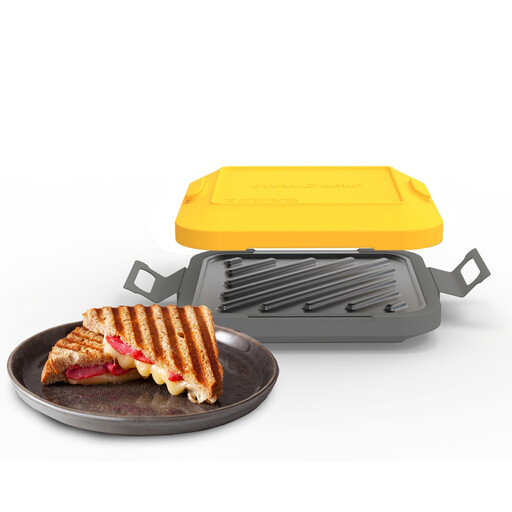
The Mico is a microwave toastie maker rather than a mains-powered sandwich toaster.
This microwave option is relevant if you want to make cheese toasties without keeping a separate plug-in sandwich toaster on the worktop.
 No image available
This microwave toastie maker suits consumers who have a suitable microwave and want to put the maker away between uses.
Check your microwave’s instructions against the stated 1200 W maximum before use. If escaped cheese is a concern, confirm whether its plate design seals the sandwich; also check which components can go in the dishwasher.
Choose a microwave maker if putting it away is your main concern and you have a suitable microwave. If you want sealed triangular toasties from a plug-in appliance, look for upright storage and check the model’s closed dimensions.
No; fixed non-stick plates are an option if you are content to wipe them after the appliance cools. If cleaning up escaped cheese is a priority, check whether the exact model has removable plates and whether those plates are dishwasher-safe.
Electrical Safety First advises checking for a standard UK three-pin plug and fuse. Read the manufacturer’s instructions and inspect the plug and cable before use.
Let a plug-in sandwich toaster cool fully before cleaning or storing it. Salter’s deep-fill sandwich toaster manual also instructs users to unplug that appliance after use; follow the instructions for your own model.