Solo over-the-board players
If another person is not available, a robot that physically makes the opponent’s moves can keep practice on a real board. SenseRobot and Chessnut describe products with automatic piece movement.


If you want an opponent’s moves made on a physical board, compare articulated-arm robots with self-moving-piece boards rather than assuming every smart chessboard moves pieces. Choose around the practice content and assembled space you will use, and check the app requirements and the supplied power and conformity information for the exact version and UK delivery region.
If another person is not available, a robot that physically makes the opponent’s moves can keep practice on a real board. SenseRobot and Chessnut describe products with automatic piece movement.
If you want more than an automatic reply to each move, compare the exact model’s adjustable opposition, exercises and endgame material. SenseRobot’s product information describes models with built-in study content.
If you want to play remotely through a physical board, check which app, network connection and account the particular model requires. SenseRobot, Chessnut and Particula describe connected-play features for some of their products.
For home practice, settle the movement mechanism first, then compare included solo-study features, assembled dimensions and the app or network needed for connected play.
| Concern | What to check when buying | Who this matters to |
|---|---|---|
| Automatic movement | Check that the exact variant moves the opponent’s pieces, not just lights up suggested moves. | If I want both sides’ moves made on a physical board, the movement mechanism comes first. About 36% of consumers prioritise automatic piece movement. |
| Solo study | Separate built-in AI and lessons from connected analysis or optional paid features. | If I plan to practise alone, I want difficulty settings and study material I can use for that routine. About 29% of consumers put structured solo study first. |
| Space and setup | Compare assembled width, depth and height with the available table and overhead clearance. | If table space is limited, I need the whole assembled board to fit where I intend to play. About 21% of consumers prioritise home space and setup. |
| Connected play | Confirm the app, network, account and specific online functions required by the exact model. | If I want to play remote opponents through the board, I need to know how its connected features work before choosing. About 14% of consumers prioritise connected play. |
Particula distinguishes its light-guided Mini and Lite boards from its robotic XR models; on the former, players move the pieces themselves.
Check automatic opponent-piece movement for the exact variant, rather than relying on the brand or product-family name.
If automatic movement is essential, choosing a light-guided model may mean replacing it to get that feature.
SenseRobot Chess Lite’s stated assembled dimensions are 22.44 × 18.5 × 15.16 inches, including the arm’s height.
Measure your table and overhead clearance against the assembled dimensions for the exact model, not its packaging.
Chessnut describes built-in engines for Move and app-connected online play; Particula identifies GoChess Pro as an optional paid area.
Check separately which practice and review functions work locally and which need an app, account, connection or optional service.
Some features may involve extra app or subscription requirements, so check what is included before relying on them.
A retailer listing for SenseRobot RC3G-N identifies a UK power adapter, but that alone does not establish the specifications or conformity information for the particular unit supplied.
Before buying an electrically powered model, check the supplied adapter details and the applicable product-conformity information for the exact version and delivery region.
SenseRobot describes articulated-arm chess robots with different piece formats and practice content.
Chessnut Move is a self-moving-piece alternative to an articulated-arm board.
Particula’s GoChess range includes both internally robotic boards and light-guided boards.
Miko describes Chess Grand as a self-moving chessboard with app-linked features.
These Joybuy options are SenseRobot articulated-arm chess robots for solo practice on a physical board; check the precise features and supplied power information for each version.
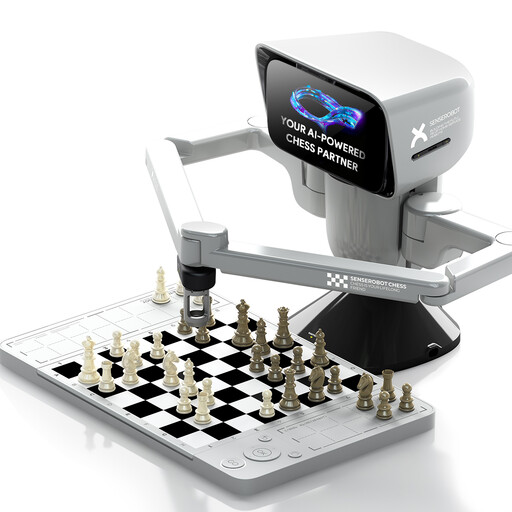 No image available
The listing describes a robotic arm and electronic chessboard for physical-board practice, with app connection.
The product name states support for 3D-printed DIY pieces. Check the supplied power and conformity information for the exact version and delivery region.
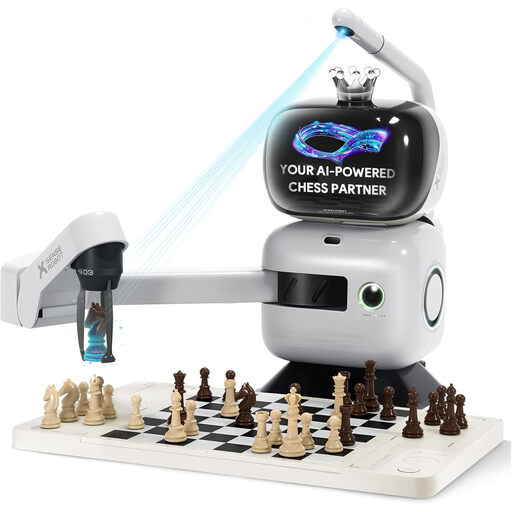 No image available
The listing describes an articulated arm that moves pieces, with practice features including 25 AI levels, guided exercises, endgame training and classic-game replay.
It also describes Lichess integration and app sync; its listing says a phone or tablet is not needed after initial Wi-Fi setup. Use only the supplied power adapter and check its details and the applicable conformity information for your delivery region. The listing warns of pinch points while the arm operates, says the product is not suitable for children under 3, and requires adult supervision for children aged 3–6.
No. Particula describes those variants as light-guided boards where you move the pieces yourself; its 1XR and 4XR models use robotics to move pieces.
Some models describe built-in practice that does not rely on an ongoing lesson subscription. SenseRobot’s Chess Lite product information describes its built-in library as available without a separate content subscription, and Chessnut describes built-in engines for Move. These statements do not establish that every app review or connected feature is included.
Check the exact model’s assembled width, depth and height, including any arm and overhead clearance. SenseRobot states dimensions of 570 × 470 × 385 mm for Chess; compare those measurements with your intended table and setup area.
Check the supplied adapter details and applicable product-conformity information for the exact version and delivery region. GOV.UK guidance distinguishes the relevant arrangements for Great Britain and Northern Ireland, so do not assume a listing or a single marking answers the question for every product and destination.
For an applicable distance sale, GOV.UK guidance says a customer can notify the seller of cancellation within 14 days of receiving the item and then has another 14 days to return it. Faulty or misdescribed goods involve separate rights, and a manufacturer’s warranty does not remove statutory rights.