What to consider before buying
Self-moving chess boards
Choose this when: You want the opponent’s pieces moved on the physical board, or want the board to arrange selected positions.
Trade-off: Movement systems differ, and you should confirm the exact model, space requirements and UK delivery and support terms. Chessnut Move’s product page displayed United States shipping when checked.
Guided boards and standalone chess computers
Choose this when: Move guidance, lessons, hints or an onboard opponent matter more than seeing the opponent’s pieces move automatically.
Trade-off: You move the pieces yourself. ChessUp lists bots and lessons, but its feature information does not establish that every lesson works offline; DGT says Centaur does not retain the previous game’s information once a new game starts.
Boards for recording games
Choose this when: Saving over-the-board games for later review matters more than automatic movement.
Trade-off: You move both sides’ pieces and should check app compatibility and export options. Chessnut says Air stores up to 20 games on the board; that does not establish how every later analysis feature works.
For solo study at home, decide whether you want the board to move pieces, guide your play, work without another device, or preserve games for review.
| Concern |
What to check when buying |
Who this matters to |
| Physical movement |
Check the exact movement method, piece type and assembled dimensions. |
I want the opponent’s moves made on the board rather than moving both sides myself. About 33% of consumers put physical movement first. |
| Guidance and lessons |
Distinguish move indicators, hints, built-in exercises and app-delivered lessons. |
I want prompts or structured exercises while playing at a physical board. About 27% of consumers prioritise board-based guidance. |
| Device independence |
Check separately whether setup, play, lessons and review need a phone, computer or connection. |
I want to practise without relying on another device or continuing service. About 20% of consumers prioritise device-independent play. |
| Game retention |
Check storage capacity, position setup, export options and what happens when a new game begins. |
I want to keep games or positions to revisit later. About 20% of consumers put recording and later review first. |
Joybuy product choices
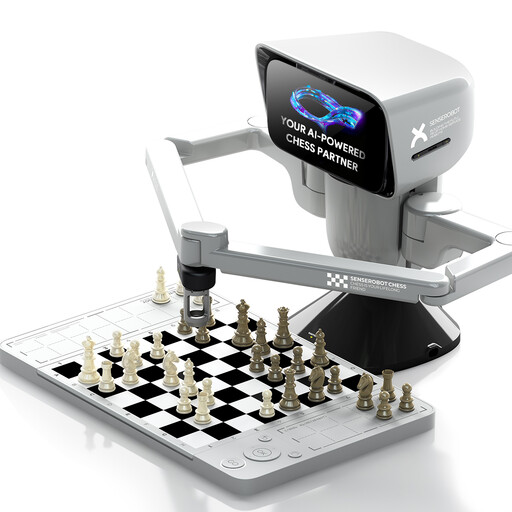
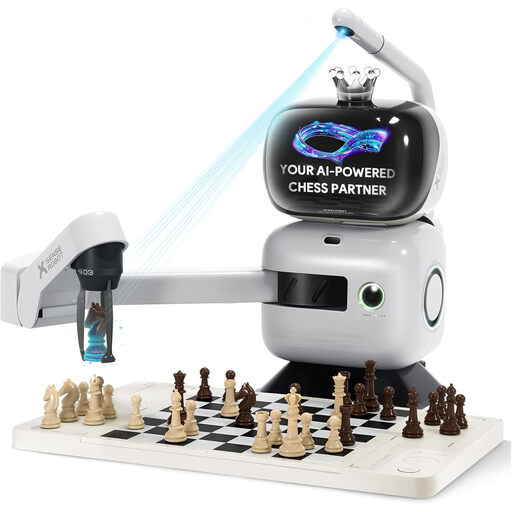
These Joybuy listings cover SenseRobot robotic-arm chess boards for solo physical-board play. Compare the stated features and check power and UK support details for the exact model.
 No image available
SenseRobot Mini AI Chess Robot with Robotic Arm
The robotic arm provides a physical-board route for playing chess solo.
The product name states that it supports app connection and 3D-printed DIY pieces.
Check the supplied power equipment and UK support terms for this exact model before buying.
Joybuy
 No image available
SenseRobot AI Chess Robot with Robotic Arm, 25 AI Levels
The robotic arm and listed AI levels suit solo play on a physical board.
The product description lists 1,200+ exercises, endgame training and classic-game replay. It describes screen-free operation after initial Wi-Fi setup.
The description says to use only the supplied power adapter. Confirm its UK suitability before buying, and keep fingers, loose clothing, hair and jewellery clear while the arm is operating.
Joybuy
Frequently asked questions
Is an illuminated “automatic” chessboard necessarily a robot?
No. Particula says GoChess Mini illuminates moves but requires you to move both your own and the opponent’s pieces; it identifies GoChess XR as the self-moving model. Check the exact variant and its movement method.
Which features can I use without a phone, computer or continuing subscription?
It depends on the model and the function. DGT describes Centaur as a standalone chess computer, Chessnut describes a built-in engine for Move, and SenseRobot describes built-in Chess Lite training without a separate content subscription. Check setup, lessons and review separately; these descriptions do not establish that every connected feature works offline.
Will a board that plays against me also save my games?
Not necessarily. DGT says Centaur loses information about the previous game when a new game starts, while Chessnut says Air stores up to 20 games on the board. Check storage, retention and export for the exact model if later review is important.
Does a UK-facing product page confirm UK delivery and power compatibility?
No. Chessnut Move’s en-UK product page displayed United States shipping when checked. Before buying a mains-powered board, confirm the delivery destination, whether the supplied adapter is suitable for UK use and the seller’s support terms for that exact variant.
What electrical-safety markings should I check for a board bought in the UK?
The Department for Business and Trade’s guidance distinguishes Great Britain from Northern Ireland: its electrical-equipment table lists UKCA or CE for Great Britain, and CE or UKNI together with CE for Northern Ireland. Which requirements apply depends on the product and its electrical equipment. GOV.UK guidance also advises checking appropriate markings, instructions and manufacturer details; a product listing alone does not establish compliance.


