Small shared-household organisers
For a limited number of bread-roll bags, a compact cabinet and a clear way to keep each person’s food from being buried matter more than bulk capacity.


For modest bread-roll stocks in a shared kitchen, start with a compact chest freezer that leaves room to open the lid and makes labelled bags easy to retrieve. Frequent bulk deliveries may justify a larger model, but deeper storage and a bigger footprint make stock organisation and maintenance responsibilities more important.
For a limited number of bread-roll bags, a compact cabinet and a clear way to keep each person’s food from being buried matter more than bulk capacity.
Groups handling regular bulk purchases or frequent replenishment need to compare peak storage volume with the floor space a larger chest freezer occupies.
Where the kitchen is part of a workplace or food business, the person overseeing the freezer also needs to consider temperature checks, food separation and electrical-equipment maintenance.
Work out the largest bread-roll stock likely to be stored at once, then check the installation space and agree how everyone will organise and look after the freezer.
| Concern | What to check | Who this matters to |
|---|---|---|
| Space and capacity | Compare peak bread-roll stock with net capacity. Measure the route in, cabinet footprint, ventilation clearance and space above the open lid. | When floor space is tight, I need the usual bread-roll bags to fit without making the freezer awkward to use; around 33% of consumers put space and capacity first. |
| Shared access | Check the basket and lid arrangement, then plan labelled zones so older bags remain easy to find. | If several people retrieve rolls, I want my bag to stay visible rather than disappear beneath other food; about 27% of consumers prioritise access and stock organisation. |
| Temperature and separation | Check how users will notice a temperature rise and keep bread rolls apart from raw-food packaging. For a food business, match the freezer to its monitoring process. | Where bread rolls share freezer space with other food, I need temperature oversight and separation I can rely on; around 20% of consumers put these controls first. |
| Ongoing upkeep | Check whether the model is manual defrost, low frost or no frost, and agree who will clean it. Compare annual energy figures for the exact models under consideration. | When nobody has sole responsibility, I want defrosting and cleaning to be manageable; roughly 20% of consumers prioritise ongoing upkeep. |
A cabinet can fit its floor space yet still be difficult to use if the lid cannot rise fully or the required ventilation space is blocked.
Measure the delivery route, footprint and space above and around the freezer against the exact model’s installation instructions.
Temperature warnings, fast freeze and counterbalanced lids vary by model. A shared group should not rely on a feature it has not checked for the appliance it intends to buy.
Compare the exact model’s product fiche and manual, particularly if the freezer will be left unattended for long periods.
More volume does not prevent bread-roll bags from being covered by other food in a deep chest.
Agree labelled sections for users and dates, and keep older bread rolls accessible for rotation.
A freezer used for catering or food sales needs to fit the business’s food-safety controls, including how frozen stock is labelled, separated and monitored.
Confirm those procedures before choosing the appliance. GOV.UK advises food businesses to label frozen food and note when it was frozen; food-separation guidance from the Food Standards Agency MyHACCP service also addresses cross-contamination.
These examples illustrate different cabinet sizes and features; each description applies to the named model, not every freezer made by that brand.
The CF4308W illustrates a larger manual-defrost option for groups handling bulk stock.
The HCE300NFEK illustrates a large frost-free option where regular manual defrosting would be difficult to organise.
The MCF142EB offers a smaller shared-use example where access to individual bags matters.
The MCF140EW is a shared-use model to consider when a visible temperature warning is a priority.
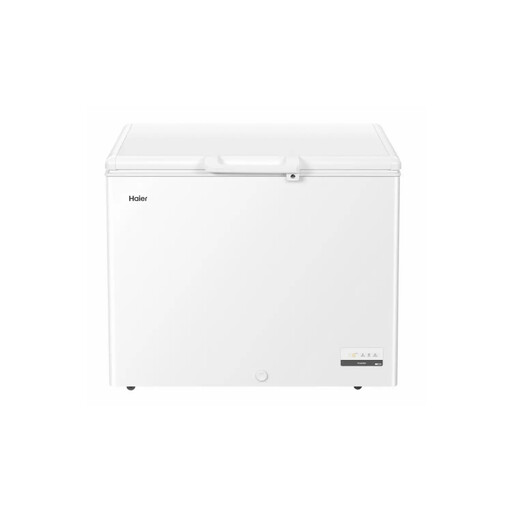
This 300l chest freezer is a size to consider for larger shared bread-roll stocks. Compare its capacity with your peak number of bags, and check that the kitchen has room to install and open it.
 No image available
For larger shared bread-roll stocks, compare the stated 300l capacity with the amount your group needs to store at once.
Agree who will handle manual defrosting and where frozen food will go during that task. Check the exact model’s instructions for ventilation and lid-opening clearance, and confirm its temperature-warning arrangements if your kitchen depends on them.
For food-business frozen storage, Coventry City Council guidance says frozen food should be kept at −18°C or lower and its temperature checked and recorded daily as part of a food-safety management system. A shared domestic kitchen can also agree a checking routine, but the business record-keeping requirement does not automatically apply to it.
Yes, owner-and-date labels make shared bags easier to identify and rotate. For food businesses, GOV.UK guidance says to label everything you freeze and note the date it was frozen; that guidance should not be mistaken for a stated legal labelling duty in an ordinary shared household.
An annual portable appliance test is not automatically required for a freezer in a UK workplace kitchen. The Health and Safety Executive says employers must maintain electrical equipment to prevent danger, but the law does not specify a particular test or interval; the employer should assess maintenance and inspection needs for the appliance and its use.
They can if storage is arranged to prevent raw-food packaging from contaminating the bread rolls. Keep rolls enclosed and separate from anything that could leak; for food businesses, Food Standards Agency MyHACCP guidance calls for potential cross-contamination between raw and ready-to-eat food to be identified and eliminated through layout or other appropriate controls.