
24/7 Customer Support

Free returns

Same-day & Next-day Delivery

Quality Guaranteed

Unlock Your Welcome Offers: FREE Delivery | Up to 80% OFF | Free 30-day JoyPlus trial
Download the APP
A chest freezer can make bulk buying, batch cooking and seasonal food storage far more manageable. However, choosing by capacity or price alone can lead to a freezer that does not fit your space, costs more to run than expected or becomes difficult to organise.
Joybuy’s Product Recommendation Officer has filtered the key specifications and practical considerations to help UK households, meal-preppers, cafés and convenience stores compare options more confidently.
A large chest freezer may offer useful storage, but it also needs sufficient floor space and clearance around the cabinet. Measure doorways, stairways and the final installation area before ordering. Check the appliance’s width, depth and height, not just its litre capacity.
Remember that a chest freezer needs room for the lid to open fully. A 300L model can be approximately 90–112cm wide, while a 99L chest freezer may be around 55cm wide. The difference is significant in a utility room, garage or small café.
Cold UK winters can affect appliance operation. A standard freezer may not be designed for unheated spaces where temperatures fall close to or below freezing. Look for a stated operating range or a feature such as Winter Guard or garage suitability.
For example, the HISENSE FC386D4AWLE is listed as suitable for outbuildings down to -15°C, while the Midea MDRC284FZE01 is specified for ambient temperatures down to -18°C. Always check the product instructions and ensure the area is dry, ventilated and protected from extreme conditions.
The UK energy label uses classes from A to G, with A generally indicating lower energy use than E or F. Yet the most useful figure for comparing annual running costs is the stated annual energy consumption in kWh.
For example, the HISENSE FC386D4AWLE lists 231kWh per year, while the Midea MDRC154FZE01 lists 169kWh per year. A smaller appliance will often use less electricity, but the right comparison depends on how much storage you need and how efficiently you use the available space.
A small chest freezer of around 95–99L can suit a flat, couple, small household or utility room. A 198L chest freezer offers more room for weekly shopping, batch-cooked meals and frozen meat. A large chest freezer around 291–300L is more appropriate for large families, bulk-buyers and small food businesses.
Capacity is only useful if the interior remains manageable. Check whether the appliance includes a chest freezer with baskets, removable storage baskets or internal lighting. Baskets keep frequently used products near the top, reducing the need to search through the full cavity.
Many freestanding chest freezers use manual defrosting. Ice gradually builds up on the inner walls, reducing usable space and potentially increasing energy consumption. A drainage port can make the process easier.
Defrost the appliance according to the manufacturer’s instructions, usually when ice becomes noticeably thick. Unplug it, remove the food and allow the ice to melt naturally. Do not use sharp metal tools, as these can damage the interior or refrigerant circuit.
Noise levels are measured in decibels, or dB. Models listed at 37–42dB may be more suitable for a utility room near living areas than louder alternatives, although the sound may vary during cooling cycles.
A mechanical thermostat is straightforward and commonly found on budget models. Digital controls and LED displays can make temperature adjustment easier, while features such as fast freeze, counterbalanced lids and interior lights improve daily use.
A convertible chest freezer can switch between freezer and refrigerator modes. This may be useful when you need extra chilled storage for drinks or fresh food, but check the operating instructions and temperature range before relying on the conversion function.
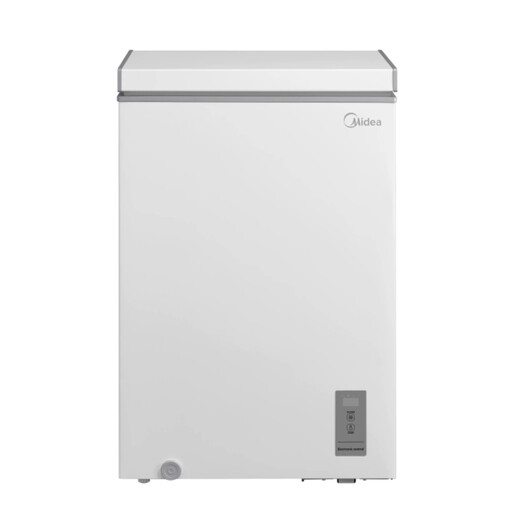
Why This Fits Their Persona: A compact option for flats, smaller utility rooms and households that need flexible overflow storage without committing to a large cabinet.
Its 99L capacity avoids paying for unused space, while the listed 169kWh annual consumption provides a clear figure for running-cost comparisons.
E-rated; switchable fridge/freezer mode; 38dB noise level; removable basket and LED controls.
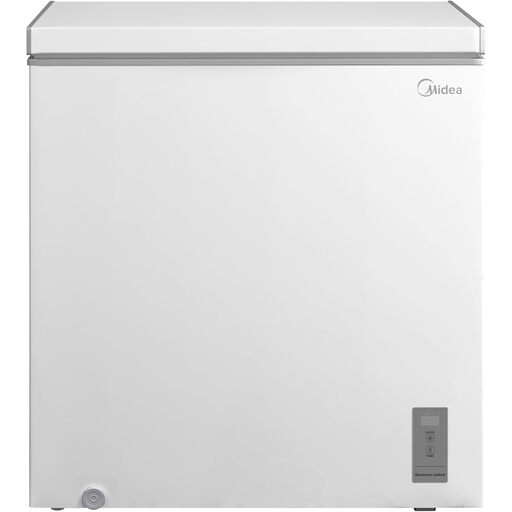
Why This Fits Their Persona: Suitable for households wanting substantial storage, garage flexibility and convenient electronic operation in one appliance.
It states garage suitability down to -18°C, helping address the risk of using an unsuitable appliance in a cold outbuilding.
198L capacity; E energy class; 37dB operation; convertible modes, fast freeze and counterbalanced lid.

Why This Fits Their Persona: Designed for large families, serious bulk-buyers and users storing batch-cooked meals, meat or seasonal produce in an outbuilding.
Its stated -15°C Winter Guard suitability addresses cold outbuilding use, while two baskets and electronic controls help with access and monitoring.
297L net capacity; 39dB noise level; up to 40 hours’ power-failure safe time; lockable handle.
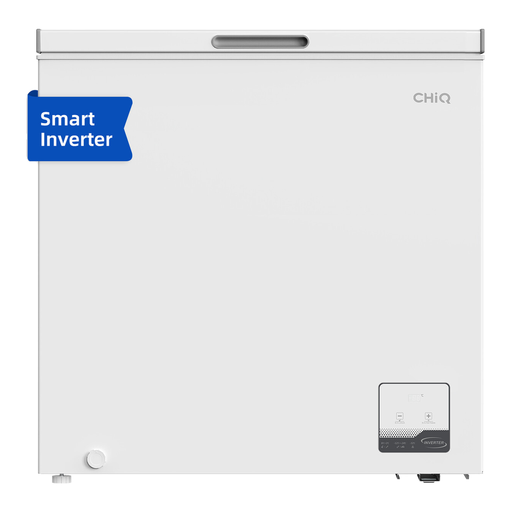
Why This Fits Their Persona: A practical match for families or small businesses that want freezer storage now and optional chilled storage for events or seasonal changes.
Convertible operation reduces the risk of buying a single-purpose appliance that becomes unsuitable when storage needs change.
199L capacity; digital controls; inverter compressor; -32°C freezing function; interior LED light.
We have compiled a complete, real-time list of products that fully satisfy these strict selection criteria and UK safety regulations.
Before switching on your appliance:
It can be, provided the model is specifically rated for the expected ambient temperature range. Check for garage-safe or outbuilding-safe details in the product specification. The garage should also be dry, ventilated and protected from direct sunlight.
Running cost depends on the appliance’s annual kWh figure and your electricity tariff. Multiply the stated annual consumption by your current price per kWh for an estimate. Actual use can vary with room temperature, loading, door opening and maintenance.
Lifespan varies according to construction, usage, ventilation and maintenance. Regular manual defrosting, keeping the lid seal clean and avoiding overloading can support reliable operation. Always follow the manufacturer’s care and safety instructions.