
24/7 Customer Support

Free returns

Same-day & Next-day Delivery

Quality Guaranteed

Unlock Your Welcome Offers: FREE Delivery | Up to 80% OFF | Free 30-day JoyPlus trial
Download the APP
A freezer can solve several household problems: storing bulk groceries, preserving batch-cooked meals and reducing trips to the supermarket. However, choosing between chest freezers, upright models and integrated appliances is not simply a matter of selecting the largest capacity.
Many UK buyers overlook three common traps:
The right choice depends on where the appliance will stand, how often you access it and whether you prefer open bulk storage or organised drawers.
A small chest freezer of around 85–100 litres may suit a flat, utility room or occasional extra storage. A 200-litre chest freezer is more appropriate for couples or families who batch-cook, while a 300-litre chest freezer can accommodate substantial quantities of meat, frozen vegetables and prepared meals.
Remember to measure more than the appliance footprint. Check:
Chest freezers often offer a large uninterrupted cavity, but items at the bottom can be difficult to reach. A freezer with baskets makes frequently used food easier to access, although baskets do not replace a complete storage system.
A freezer placed in a kitchen or heated utility room has different requirements from one installed in a garage. For an outbuilding, look for a clearly stated low-temperature operating range rather than assuming every model is a garage-safe freezer.
For example, the Hisense FC386D4AWLE is specified to operate in ambient temperatures down to -15°C, while several Midea convertible chest freezers list operation down to -18°C. These figures are product specifications, not a general guarantee for all chest freezers. The appliance should still be positioned on a level surface with suitable ventilation and protected from damp conditions.
An under-counter freezer or upright freezer may be more convenient for a kitchen because food is stored in drawers or on shelves. An integrated freezer is designed to sit behind a cabinet door, but it requires compatible housing dimensions, ventilation and appropriate door fittings.
The UK energy label uses an A to G scale, with A being the highest efficiency class. Many current models in this selection are E-rated freezers. Compare the stated annual energy consumption in kWh rather than relying on the letter alone, particularly when comparing appliances of different capacities.
A 4-star freezer is designed for freezing fresh food and storing frozen items over the longer term, subject to the manufacturer’s instructions. Fast Freeze or Super Freeze can be useful after adding a large quantity of fresh food.
Defrosting is another important distinction:
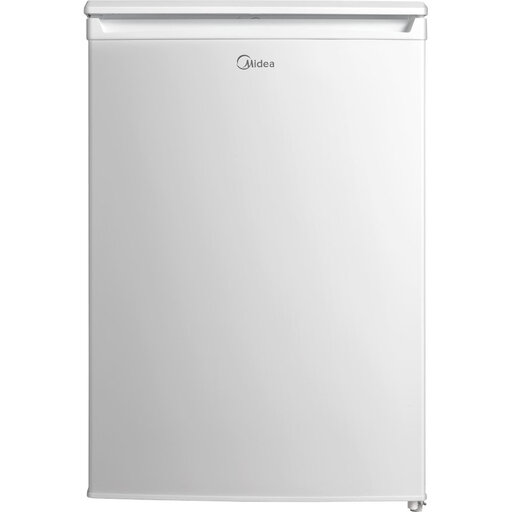
Why This Fits Their Persona: Its compact 86-litre capacity and 84.5 cm height suit smaller kitchens, flats and utility rooms where floor space is limited.
The three transparent drawers avoid the difficult rummaging associated with deep chest storage, while the reversible door helps with awkward kitchen layouts.
E energy rating, 39 dB noise level, three drawers and reversible door.
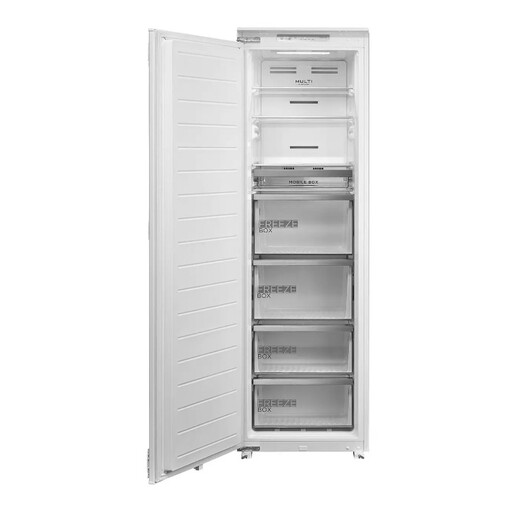
Why This Fits Their Persona: It is designed for homeowners planning a coordinated fitted kitchen and wanting organised 197-litre storage behind cabinetry.
Total No Frost avoids the routine ice removal required by many manual defrost models. Check housing and ventilation measurements before installation.
197-litre capacity, E rating, electronic controls and Total No Frost cooling.

Why This Fits Their Persona: Its near-300-litre capacity and stated low-temperature operation suit large families, bulk buyers and garage storage.
The Winter Guard specification addresses cold outbuilding use, while two baskets reduce the need to search through the full cavity.
297-litre capacity, E rating, two baskets, lockable handle and up to 40 hours’ stated safe time during a power failure.
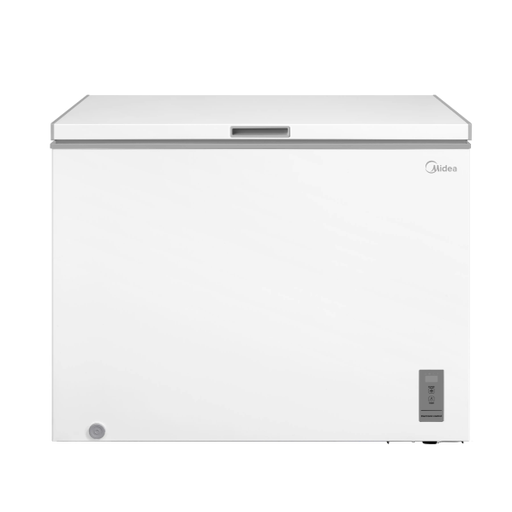
Why This Fits Their Persona: The convertible design gives households, landlords and small businesses the option to switch between refrigerator and freezer modes.
Its listed -18°C ambient suitability is more useful for cold garages than an unspecified model. Confirm ventilation and placement requirements before switching on.
293-litre capacity, E rating, electronic display, fast freeze and lockable counterbalanced lid.
We have compiled a complete, real-time list of products that fully satisfy these strict selection criteria and UK safety regulations.
Allow the appliance to stand for the period stated in its manual after delivery or relocation. Position it on a firm, level surface and keep ventilation openings clear. Avoid placing a standard freezer in a damp shed or unheated garage unless its specifications confirm suitability.
For manual defrost models, unplug the appliance before cleaning and allow ice to melt naturally. Do not use sharp tools or direct heat to remove ice. Keep an inventory of stored food, grouping items by type and date so that the deep cavity remains usable.
Running cost depends on the energy rating, capacity, room temperature, condition and usage. Compare the appliance’s annual kWh figure on its energy label. A larger E-rated freezer may use more electricity overall than a compact model, but it can provide storage that better suits bulk buying.
Lifespan varies with build quality, installation, usage and maintenance. Keeping ventilation clear, avoiding unnecessary lid opening and defrosting when ice builds up can support efficient operation. Always follow the manufacturer’s care instructions.
An upright freezer normally offers drawers or shelves, making everyday access simpler. Chest freezers provide broad open storage for large items and can offer considerable capacity for their footprint, but baskets and a clear inventory are useful for avoiding food being forgotten at the bottom.