
24/7 Customer Support

Free returns

Same-day & Next-day Delivery

Quality Guaranteed

Unlock Your Welcome Offers: FREE Delivery | Up to 80% OFF | Free 30-day JoyPlus trial
Download the APP
A chest freezer can make bulk buying, batch cooking and seasonal food storage much easier for UK households. However, choosing one based only on litre capacity or a low headline price can lead to frustrating compromises.
The most common pitfalls include:
Capacity should reflect how you shop and where the appliance will stand. A small chest freezer of around 95–99L may suit a flat, utility room or supplementary storage for a couple. A 99L chest freezer is also useful for meal-prepping without taking over a room.
For larger households, a 198L chest freezer offers a practical middle ground for frozen meals, meat and supermarket promotions. A 300L chest freezer or similarly sized unit is more appropriate for bulk-buyers, large families, small cafés and convenience stores, but it requires considerable floor space.
Measure:
Remember that internal capacity is not the same as usable, organised space. Wire baskets help keep frequently used items near the top, while large uninterrupted cavities are useful for bulky food.
An energy-efficient chest freezer should be assessed using its energy class and annual consumption. For example, the AUCMA 141L model is listed as Class E with annual consumption of 179 kWh, while the Midea 99L model is listed at 169 kWh per year.
To estimate annual electricity cost, multiply the stated kWh figure by your electricity tariff. Actual costs vary according to room temperature, usage, ventilation, frost build-up and tariff changes, so the label is a guide rather than a guarantee.
A manual-defrost model can remain practical and economical, but ice accumulation reduces available space and may affect efficiency. Defrost the appliance when ice becomes noticeably thick, following the manufacturer’s instructions. Never use knives or sharp tools to remove ice.
Noise is particularly important if the freezer will sit near a kitchen, living area or home office. Several listed models operate between 37 dB and 42 dB, although perceived sound can vary depending on flooring and surrounding surfaces.
A quiet chest freezer with a counterbalanced lid is easier to live with. The lid stays open while you load groceries, reducing the need to hold it with one hand. Adjustable thermostats are straightforward, while electronic controls may provide clearer temperature settings, LED displays and functions such as fast freeze.
For a garage chest freezer, look for a clearly stated outbuilding or winter-security specification. The Midea convertible models are specified for operation down to -18°C, while the Hisense FC386D4AWLE is stated to operate down to -15°C. Always follow the installation manual, including clearance and ventilation requirements.
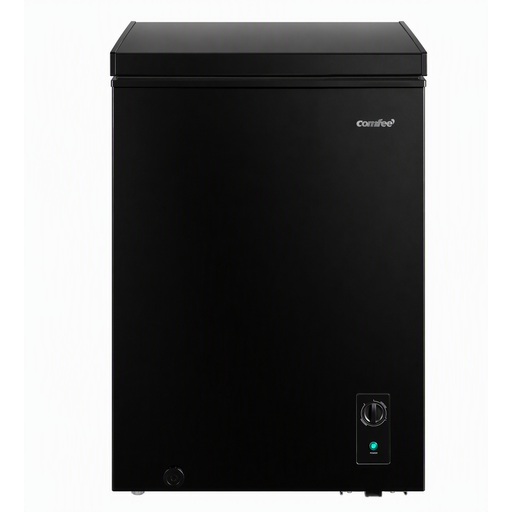
Why This Fits Their Persona: Its 99L format provides additional frozen storage for smaller UK homes, flats and utility rooms without the footprint of a large chest freezer.
The compact capacity helps avoid paying for unused space, while its 4-star freezer rating is specified for long-term frozen storage.
Compact 99L capacity and black finish; suitable for supplementary household storage.
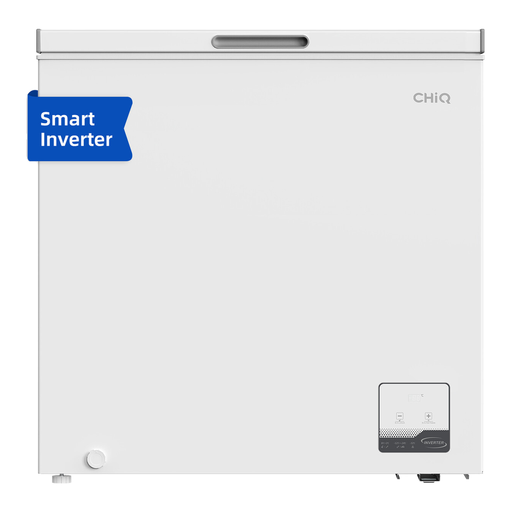
Why This Fits Their Persona: It suits households wanting flexible storage, digital controls and a cleaner, more organised user experience in a kitchen, utility room or garage.
The counterbalanced lid, interior light and removable basket address common access and organisation problems.
199L capacity, E energy rating, digital control, inverter compressor and fridge-to-freezer conversion.

Why This Fits Their Persona: Its large capacity and stated outbuilding suitability make it appropriate for large households, bulk-buyers and homeowners with an unheated garage.
The stated winter operating range helps address the risk of placing a standard deep freezer in a cold outbuilding.
297L capacity, two wire baskets, lockable handle, E rating and stated operation down to -15°C.
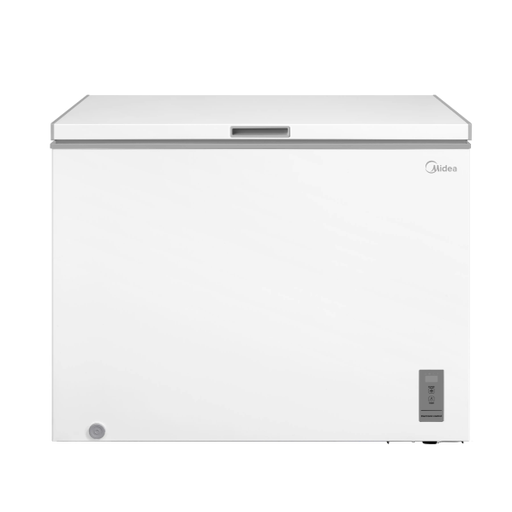
Why This Fits Their Persona: This suits families and small food businesses that need substantial storage but may occasionally require extra refrigerator space.
Its convertible function avoids buying separate appliances for occasional chilled storage, while garage suitability is clearly specified.
293L capacity, fridge/freezer switching, fast freeze, lockable counterbalanced lid and 41dB noise rating.
We have compiled a complete, real-time list of products that fully satisfy these strict selection criteria and UK safety regulations.
It can be, but only when the model’s specifications support the expected ambient temperature. Look for a stated garage-safe or winter-security feature, then follow the required clearance and ventilation guidance.
Running cost depends on annual kWh consumption and your electricity tariff. Multiply the appliance’s stated annual kWh figure by your price per kWh for an estimate. Real-world use varies with room temperature, loading and defrosting.
Lifespan depends on build quality, installation, usage and maintenance. Keeping ventilation clear, avoiding damage to the lid seal and defrosting safely can help maintain performance. Check the warranty and support details before purchase, particularly for a large chest freezer intended for frequent commercial-style use.