Solo bread and batch-cooking users
If you also freeze portions of home-cooked food or other groceries, you have a use for space beyond a few loaves. A chest freezer is worth considering when your existing freezer cannot hold those extras.


A chest freezer makes more sense if sliced bread will share the space with batch-cooked meals or other frozen food; for bread alone, check whether your existing freezer has enough room before committing floor space to another appliance. If you do need more storage, compare how easily you can retrieve loaves, the installation space and the exact model's energy information. Garage placement needs a separate check of the model's stated temperature suitability.
If you also freeze portions of home-cooked food or other groceries, you have a use for space beyond a few loaves. A chest freezer is worth considering when your existing freezer cannot hold those extras.
If you take out slices or loaves regularly, measure the appliance location and lid-opening space, then consider how you will keep bread near the top rather than beneath other food.
If the freezer will stand outside a heated kitchen, check the exact model's stated ambient-temperature range and outbuilding suitability against the intended location.
Decide how much food you will freeze besides bread before choosing an appliance. If frequent access matters more than open storage space, compare a chest freezer's top-access layout with an under-counter upright's compartments.
| Concern | What to check | Who this matters to |
|---|---|---|
| Capacity and space | List what else you will freeze; measure the intended location and compare it with an upright or your existing freezer. | If bread is my main frozen item, I do not want to give floor space to capacity I will rarely use. Around 36% of consumers put avoiding excess capacity first. |
| Access to bread | Check basket provision and whether the storage layout lets you keep labelled loaves near the top. | When I take bread out frequently, I want to find the current loaf without digging beneath other food. For around 29% of consumers, easy retrieval is the primary need. |
| Energy and upkeep | Compare the exact models' annual energy consumption in kWh and check whether defrosting is manual. | Since I would run another appliance continuously, its electricity use and defrosting effort matter to me. Around 21% of consumers prioritise this ongoing commitment. |
| Installation location | Match the model's operating-temperature range and outbuilding guidance to the location; check ventilation and lid clearance. | If the kitchen has no room, I need a freezer rated for the conditions where it will stand. Suitable placement comes first for around 14% of consumers. |
The compact models considered here hold roughly 95–99 litres, leaving substantial space beyond a few loaves.
Write down what else you would freeze. If the list is short, check your existing freezer space and compare an under-counter upright before adding a chest freezer.
Outbuilding suitability differs by model: the Fridgemaster MCF95E1 is listed for garage or outbuilding use, while the Bush BECFE99LW is listed as unsuitable for outbuildings.
Check the exact model's temperature range and installation guidance against the conditions in your garage or shed.
Annual electricity consumption is model-specific, and manual defrost adds upkeep to the compact chest freezers considered here.
Compare the exact models' annual kWh figures and defrost methods alongside their capacities.
A manual-defrost model also requires time to remove frost.
Deep, top-access storage can make individual loaves harder to find when other food is stacked above them.
Label and date bread bags, keep the loaf in use near the top and rotate older packs forward.
The MCF95E1 is a compact chest-freezer example for buyers considering garage or outbuilding placement.
The L95CFW23 is a 96-litre chest freezer to consider where a removable basket would help organise bread.
The BECFE99LW is a 99-litre chest freezer with a fridge/freezer conversion mode.
This compact chest-freezer option is relevant if bread will share the space with other frozen food. Check its installation requirements before deciding where it will stand.
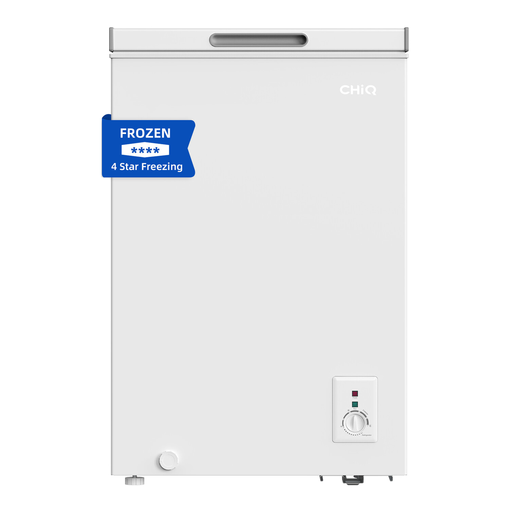 No image available
Consider this 99-litre chest freezer if you will store other frozen food alongside sliced bread; for bread alone, check whether you need that much space.
Compare its annual energy consumption and defrost method, and check lid, ventilation and temperature requirements for your intended location.
Check your existing freezer space first if bread is the only extra food you plan to store. A chest freezer becomes more relevant when you also need overflow space for batch-cooked meals or other frozen groceries; an under-counter upright is another option if separate compartments would make bread easier to retrieve.
Keep the freezer at around −18°C, in line with GOV.UK food-freezing guidance, and follow any storage instructions on the bread packaging. Freezing does not replace sensible food handling.
Only choose a model whose stated outbuilding suitability and operating-temperature range fit that location. The Fridgemaster MCF95E1 is listed for garage or outbuilding use, whereas the Bush BECFE99LW is listed as unsuitable for outbuildings and has a specified 10°C minimum operating temperature.
Allow for opening the lid and for the ventilation space specified in that model's installation instructions. Do not transfer another freezer's clearance measurements to the appliance you intend to buy.
Compare the exact models' energy labels, product information sheets and annual consumption in kWh, rather than relying on an energy-class letter alone. UK government guidance says an accurate energy label and product information sheet are required for in-scope products, including display of the label at the point of sale online.