
24/7 Customer Support

Free returns

Same-day & Next-day Delivery

Quality Guaranteed

Unlock Your Welcome Offers: FREE Delivery | Up to 80% OFF | Free 30-day JoyPlus trial
Download the APP
A chest of drawers can solve everyday clutter, but choosing the wrong one may create new problems. A unit that looks spacious online can have shallow drawers, a bulky footprint or a frame that feels unsuitable for regular clothing storage. Flat-packed furniture also varies considerably in assembly time, stability and load limits.
Before buying bedroom drawers, focus on how the furniture will work in your home rather than relying on appearance alone. The following guide explains the main buying traps, specifications and styles to consider, followed by product options matched to different UK households.
A tall or wide dresser may appear to offer considerable capacity, but drawer dimensions can vary. Check the internal drawer measurements, not only the external height and width. A drawer storage unit with several narrow compartments may suit accessories but be less practical for jumpers, towels or folded bedding.
Also measure skirting boards, doorways and walking space. A chest of drawers should not obstruct wardrobe doors, radiators or bedroom entrances.
Product images rarely show how a drawer is built. MDF, particleboard, steel and fabric each offer different characteristics. Engineered wood with a paper veneer can provide a wipe-clean surface, while fabric drawers keep the overall unit lighter and may suit rented rooms or student accommodation.
Look for details such as smooth-glide runners, reinforced drawer bases and anti-bowing support. These features can make daily use more convenient, but they do not remove the need to observe the stated weight limits.
A freestanding bedroom furniture unit can become unstable if drawers are opened at the same time or if heavier items are stored high up. Families with young children should pay particular attention to wall-fixing guidance and anti-tip kits.
A chest of drawers should be assembled on a flat, level surface and secured as instructed. Never assume that a heavier unit is automatically safer, and do not overload either the drawers or tabletop.
Compare the product’s height, width and depth with the available space. A 4 drawer chest of drawers may work beside a bed or in a compact guest room, whereas a 5 drawer chest of drawers provides more vertical clothes storage but may require additional clearance.
For narrow hallways or small bedrooms, a shallower fabric dresser may be easier to position. For a main bedroom, a wider dresser can offer a more practical surface for lamps, mirrors or everyday items.
Check the stated capacity per drawer and for the tabletop. For example, some units specify 5 kg per drawer, while others provide a higher limit. The number of drawers alone does not indicate how much clothing the unit can safely hold.
Consider the type of items you plan to store:
MDF and particleboard are common choices for affordable bedroom storage furniture. A paper veneer finish is generally straightforward to wipe clean, but it should be protected from excessive moisture, heat and harsh cleaning products. Solid pine offers a different appearance and may show natural grain variation.
Fabric drawers are lightweight and practical, although they may not provide the same rigid structure as a fully engineered-wood drawer. Review the frame material, drawer fronts and stated weight limits together rather than judging the finish in isolation.
All products should be assembled according to their supplied instructions. Where a manufacturer recommends wall fixing, use the included hardware or suitable fixings for the wall type.
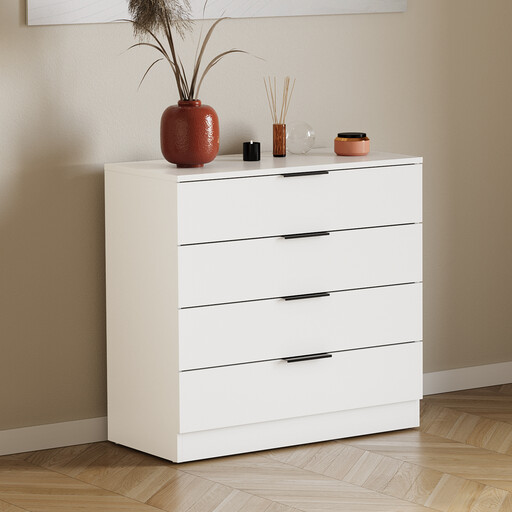
Why This Fits Their Persona: Its 74 x 66 x 36 cm footprint suits first homes, rented bedrooms, nurseries and compact flats where straightforward clothes storage is needed.
The listed 5 kg drawer capacity and 20 kg top-panel limit make capacity easier to assess before purchase, while the wall-fixing recommendation addresses stability.
Four drawers, smooth-glide runners, anti-bowing support and an easy-clean paper veneer finish.
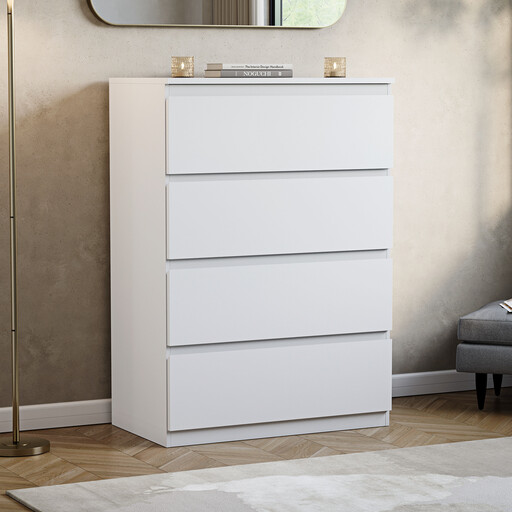
Why This Fits Their Persona: The 70 x 40.5 cm surface and four-drawer layout suit shoppers seeking a substantial bedside chest or versatile unit for a guest room.
Its stated 5 kg per-drawer and 30 kg tabletop limits help prevent assumptions about capacity, while assembly instructions and indoor-use guidance clarify setup.
Solid-pine construction is listed in the product features, with smooth-gliding drawers and a warm oak-stained appearance.
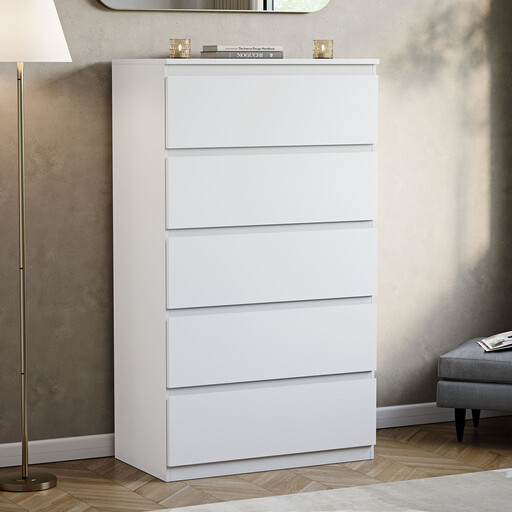
Why This Fits Their Persona: Five drawers and a 117 cm height provide a vertical clothes storage option for main bedrooms, dressing areas and households with more items to organise.
The listed 15 kg capacity per drawer gives a clear reference for heavier clothing, while wall fixing is recommended to help reduce tipping hazards.
Five handle-free drawers, a paper veneer surface and a design intended for bedrooms, guest rooms and flats.
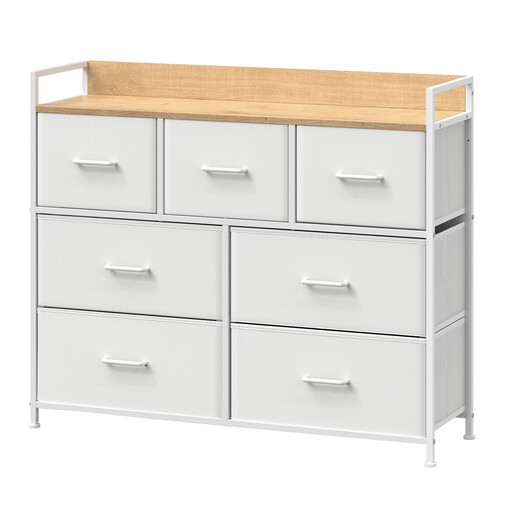
Why This Fits Their Persona: Seven mixed-size fabric drawers suit households organising clothing, accessories, toys or everyday items across bedrooms, hallways and living spaces.
Adjustable feet and an included anti-tip kit address stability, while the stated 3 kg per-drawer limit helps users avoid overloading the fabric compartments.
Metal frame, adjustable feet, seven drawers and a raised back edge for keeping items on the top surface.
We have compiled a complete, real-time list of products that fully satisfy these strict selection criteria and UK safety regulations.
Most listed units arrive flat-packed and include illustrated instructions. Assembly is easier with two people, particularly for taller or wider furniture. Use a flat surface, identify each labelled part before starting and check that the unit is level before fitting the drawers. Complete any recommended wall fixing after assembly.
Lifespan depends on materials, assembly quality, frequency of use and load. Avoid dragging drawers, exceeding their stated capacity or exposing the furniture to moisture and heat. Tighten fittings if they loosen and wipe surfaces with a soft, damp cloth rather than abrasive products.
A white finish can reflect light and coordinate with different décor, but colour does not determine the unit’s footprint. Measure the available area, door clearance and drawer-opening space first. For compact rooms, compare a shallow 4 drawer chest of drawers with taller designs to balance access and storage capacity.