Buyers with little floor space
If grated cheese needs its own overflow storage, start with the appliance’s width and depth. Allow for ventilation and a clear path for the top-opening lid before deciding where a chest freezer will stand.


A compact chest freezer can provide extra space for bags of grated cheese if you have a measured floor position and room to open its lid; spare worktop space alone does not establish that it will fit. If you retrieve small portions often, compare an under-counter upright freezer with drawers before choosing a chest model, and check the exact appliance’s installation requirements.
If grated cheese needs its own overflow storage, start with the appliance’s width and depth. Allow for ventilation and a clear path for the top-opening lid before deciding where a chest freezer will stand.
A chest freezer basket can keep regularly used bags near the top. If separating and finding individual portions is the priority, compare the drawer layout of an under-counter upright freezer.
If grated cheese shares space with batch-cooked meals or groceries, consider capacity alongside the larger floor position it may require. For an outbuilding, check the exact model against that space’s ambient temperatures.
Measure the installation position before comparing litres, then decide whether easy access to small portions matters more than an open chest cavity.
| Concern | What to check | Who this matters to |
|---|---|---|
| Installation fit | Measure the floor position, lid-opening space and the exact model’s ventilation clearances. | If floor space is tight, I need to know the freezer will fit before choosing its capacity. Roughly 36% of consumers put physical fit first. |
| Access to portions | Compare chest-freezer baskets and lid access with the drawers of an under-counter upright. | When I reach for small bags frequently, I want to find one without searching through the whole cavity. Around 29% of consumers prioritise access and organisation. |
| Storage capacity | Compare the exact model’s frozen-compartment volume and width-by-depth dimensions together. | If grated cheese shares the freezer with batch-cooked food, I need room for both without overlooking the appliance’s size. Approximately 21% of consumers put capacity first. |
| Running and placement | Read the model’s energy information and check any outbuilding claim against the expected ambient temperature. | For a freezer placed outside the kitchen, I need its stated operating conditions to suit that location. Roughly 14% of consumers prioritise placement or energy information. |
A chest freezer stands on the floor and opens upwards. Its width and depth alone do not account for ventilation or access to the lid.
Measure the intended position and compare it with the exact model’s installation instructions, including its required clearances.
Small bags can be awkward to locate at the bottom of a deep chest cavity, even when there is enough overall capacity.
Keep portions identifiable and use a basket for frequently retrieved bags. Compare an under-counter upright if drawer-by-drawer organisation matters more.
Outbuilding suitability depends on the model and the temperatures at its intended location. A general description of the freezer format is not enough.
Check the exact model’s stated operating conditions against the temperatures expected in that space.
The Logik L95CFW23 is listed as a manual-defrost model, so maintaining it involves defrosting rather than frost-free operation.
Check the defrost method of the model you are considering and whether that maintenance suits how you plan to use it.
Indesit UK lists chest models at notably different sizes: the OS 2A 100 2 UK 2 has a 99-litre frozen compartment and is 52.7 cm wide, while the OS 2A 250 H2 1 has 255 litres and is 101.0 cm wide.
The L95CFW23 is listed as a 96-litre chest freezer measuring 54.5 cm wide by 47.7 cm deep.
The HHCH142ELK is listed with 137 litres of capacity and dimensions of 69.5 cm wide by 55.5 cm deep.
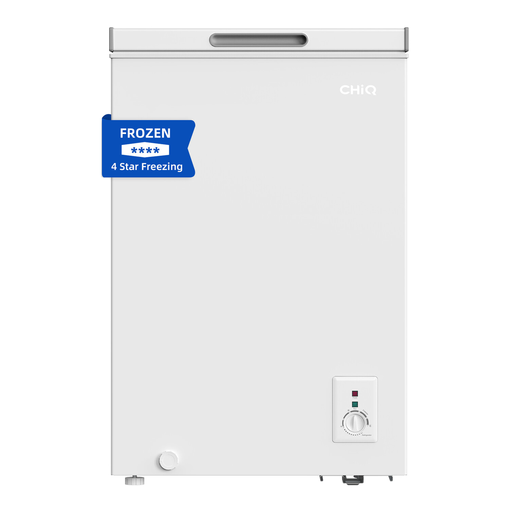
This compact chest freezer is a choice to consider if you want additional storage for grated cheese and have space for a top-opening floor appliance. Check installation clearances before deciding whether it fits.
 No image available
Consider this chest model for extra frozen storage when you have a suitable floor position for a top-opening appliance.
Its product title specifies 99 litres and an E energy rating. Confirm the installation and lid-opening clearances for your intended position.
No: a chest freezer needs a suitable floor position and room above for its lid to open. If you want to keep floor space clear or organise small cheese portions in drawers, compare an under-counter upright freezer instead.
Choose capacity according to what else you plan to freeze, not the cheese alone. Product information and listings include examples ranging from 96- and 99-litre compact chest models to 137- and 255-litre models; compare each model’s width and depth as well as its volume.
Only choose a model whose stated operating conditions suit the temperatures at that location. The Logik L95CFW23 is listed with a 10–43°C optimum ambient range, while the Hoover HHCH142ELK is described as suitable for operation in environments down to -15°C; neither statement applies to other models.
Check the energy label and product information sheet for the exact freezer. UK government guidance says that in-scope products must display an accurate energy label at the point of sale, including on a website, and be accompanied by a product information sheet.