Solo bread-roll batch freezer
You freeze rolls in labelled, small portions and want to reach them without searching through a large cavity. Floor space and lid access matter as much as stated capacity.


For one person freezing mainly bread rolls, choose a chest freezer only if its capacity and floor space make sense for the portions and other food you plan to store. Check ventilation and lid clearance before choosing a compact model; a basket can make small bags easier to reach, while fast-freeze matters more if you regularly add larger loads. For an unheated outbuilding, the exact model’s stated operating conditions matter more than its chest-freezer shape.
You freeze rolls in labelled, small portions and want to reach them without searching through a large cavity. Floor space and lid access matter as much as stated capacity.
You live alone but sometimes store bulk buys or batch-cooked food alongside bread rolls. Decide how much overflow space you will use before committing floor space to a chest freezer.
You want frozen storage outside the kitchen. Check the exact freezer’s stated ambient-temperature range against the planned location; general guidance notes that not all refrigeration appliances are designed for cold conditions.
Start with the space and the amount you normally freeze. Then consider access to small portions and, if the freezer will sit outside a heated room, its installation requirements.
| Concern | What to check | Who this matters to |
|---|---|---|
| Footprint and capacity | Measure the appliance space, ventilation gaps and full lid-opening path; decide whether you will use capacity beyond bread rolls. | If rolls are almost all I freeze, I need to know whether a chest freezer earns its floor space. Around 46% of consumers put footprint and right-sized capacity first. |
| Freezing and access | Look for a basket and supported lid; consider fast-freeze if you regularly add larger loads. | With several small bags to rotate, I want to find older rolls without digging through newer food. Easy access and freezing larger batches are the primary concern for around 36% of consumers. |
| Location and monitoring | Check the exact model’s ambient-temperature guidance and energy label; consider whether a temperature warning would be useful. | If the freezer is going in a garage or shed, I need its stated operating conditions to suit that location. Outbuilding suitability and monitoring come first for around 18% of consumers. |
A freezer may fit between walls yet leave too little room to open its lid or meet its ventilation instructions. Clearances of 50 mm at the sides, 300 mm above and 60 mm behind are listed for the Russell Hobbs RH99CF0E1W.
Measure the planned space against the exact model’s dimensions, clearances and lid-opening path before ordering.
Outbuilding suitability depends on the model and its operating environment. An optimum ambient range of 10–38°C is listed for the Russell Hobbs RH99CF0E1W, while general guidance notes that not all refrigeration appliances are designed for cold conditions.
Compare the exact model’s manual and stated ambient-temperature range with conditions at the installation site.
The Russell Hobbs RH99CF0E1W and Statesman CHF100 listings specify manual defrost. Ice build-up can make a cavity less convenient to organise, particularly when it holds small bags.
Allow for periodic defrosting and label portions so older rolls are easy to identify.
An energy label helps compare appliances, but the freezer still needs to fit the space and its intended installation conditions.
Compare the exact models’ displayed energy information alongside capacity, dimensions and placement instructions.
The MDRC154FZE01 is a compact chest-freezer example for comparing footprint and fast-freeze controls.
Its compact 99-litre chest-freezer listings illustrate chill-or-freeze flexibility and basket access.
The CHF100 is a compact model to consider when an outbuilding location and a visible temperature warning matter.
These 99-litre chest freezers are options to assess if you want space for bread rolls and some additional frozen food. Check the space each model needs before deciding whether a chest freezer is practical for your home.
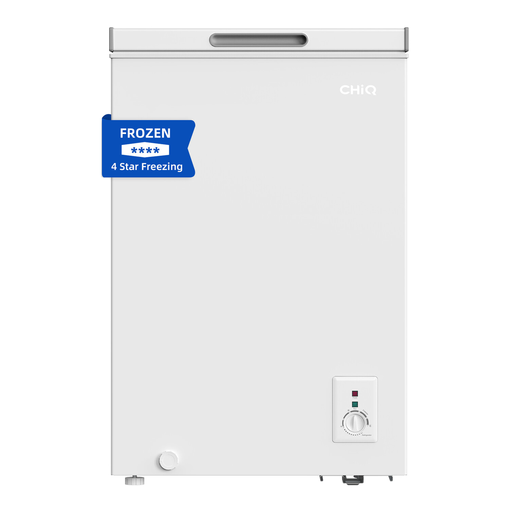 No image available
Consider this 99-litre model if you plan to freeze bread rolls alongside other food. Confirm its required clearances, lid access and defrost arrangements for your space, and compare the exact model’s energy label.
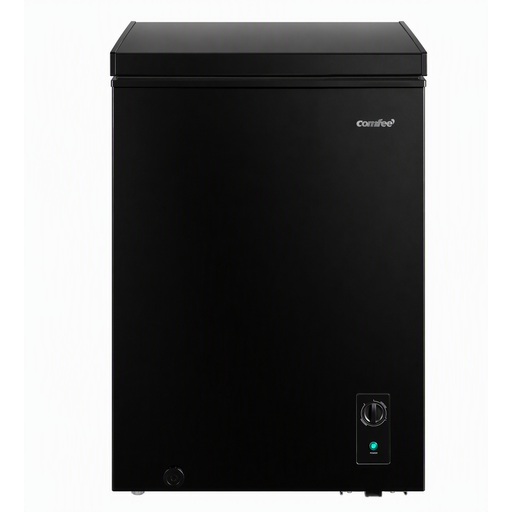 No image available
This 99-litre chest freezer is another option for rolls and occasional overflow food. Check its dimensions, installation clearances, small-item access and defrost arrangements before choosing it for your space.
Choose capacity for the portions and other food you actually plan to freeze, not household size alone. The 99-litre models discussed here are examples rather than a minimum; measure the appliance space, ventilation gaps and lid clearance before choosing one.
Fast-freeze is more worth considering if you regularly add larger batches than if you freeze only a small bag at a time. Compare that feature with how easily you can organise and retrieve the portions you use most often.
No: choose according to the exact model’s stated outbuilding suitability and ambient-temperature range. the general guidance is that not all refrigeration appliances are designed for cold conditions, so check the intended location against the model’s instructions.
Compare the energy information for the exact models you are considering, alongside their capacity and installation requirements. UK guidance from the Department for Energy Security and Net Zero and the Office for Product Safety and Standards says products within the energy-labelling rules must carry an accurate printed label and display an energy label at the point of sale.
Follow the food’s storage instructions and keep track of when it was frozen. Food Standards Agency guidance recorded in its research says pre-packed food can be frozen up to its use-by date and should be consumed within 24 hours after defrosting; follow more specific pack instructions where given.