Solo bakers short on floor space
You want to freeze portions of dough, but the freezer must fit a small indoor space. Its external dimensions, ventilation space and room to open the lid matter as much as its capacity.


A compact chest freezer around 99 litres makes sense for one person if repeated biscuit-dough batches or other frozen food will use the space; dough alone may not justify that capacity. Check the full installation space before choosing controls or frost-management features. For a garage or shed, choose only a model whose stated operating conditions suit that location.
You want to freeze portions of dough, but the freezer must fit a small indoor space. Its external dimensions, ventilation space and room to open the lid matter as much as its capacity.
Your existing freezer compartment is becoming difficult to organise. A basket and a labelling routine could help you find and rotate dough portions.
You plan to store dough away from the kitchen. Check the exact model’s stated operating conditions against the temperatures expected in that space.
Start with the space needed to install and open the freezer, then decide how much capacity you can use and which features will help you manage dough portions.
| Concern | What to check | Who this matters to |
|---|---|---|
| Footprint and capacity | Measure the space for the appliance, ventilation and open lid; compare that with the model’s dimensions and capacity. | When floor space is tight, I need enough room for my dough without choosing a freezer I cannot comfortably place or organise. Around 50% of consumers put fit and proportionate capacity first. |
| Access and maintenance | Check the basket and lid arrangement, defrost type and whether you would use a fast-freeze control. | If I freeze dough after regular baking sessions, I want to find older portions easily and manage ice build-up. For around 40% of consumers, that routine is the primary concern. |
| Unheated-location suitability | Compare the exact model’s stated ambient-temperature conditions with the planned location; review its energy information separately. | For a garage or shed, I need a freezer whose stated operating conditions suit the temperatures there. That location requirement comes first for around 10% of consumers. |
A compact freezer may still need room above the lid and around the cabinet. Its listed dimensions alone do not describe the full installation space.
Measure the available height, width and depth, then check the exact model’s ventilation and lid-opening guidance before ordering.
Location guidance differs by model. The Indesit OS 2A 100 2 UK 2 is explicitly noted as unsuitable for an unheated area, while the Fridgemaster MCF297E is described as suitable for operation down to -15°C.
Compare the temperatures expected in your space with the documentation for the specific freezer you plan to buy.
Low frost describes reduced ice build-up, not a promise that defrosting will never be needed. Small dough portions can also become difficult to find in an open compartment.
Check the stated defrost type and plan how you will label and arrange portions so older dough remains accessible.
A class letter does not by itself tell you how much energy a particular freezer is listed to use or whether its capacity suits your needs.
Read the energy label and product information alongside capacity, listed annual consumption, noise and the space the appliance will occupy.
The MDRC154FZE01 is a compact, convertible chest-freezer reference for buyers who might use both freezer and refrigerator modes.
The RH99CF0E1W provides a reference for a compact chest freezer with manual defrost.
The OS 2A 100 2 UK 2 is a 97-litre reference for buyers interested in low-frost and fast-freeze features.
The MCF297E is a larger reference for buyers whose planned location makes cold-weather operation a priority.
This 99-litre chest freezer is an option to consider for repeated biscuit-dough batches when you have room for the appliance and its required clearances.
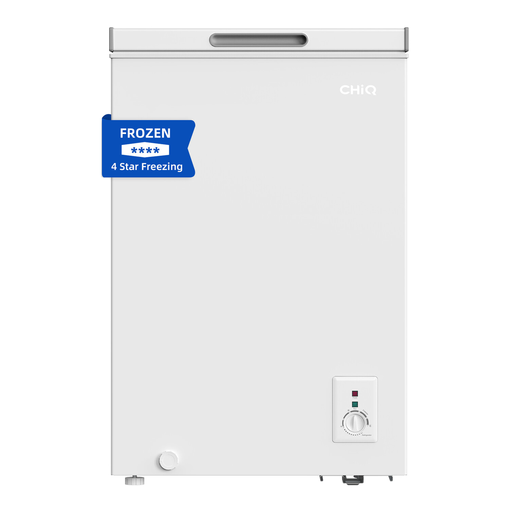 Image unavailable
Consider this model if you regularly freeze dough batches and can use the capacity.
The product name lists a 99L capacity and E energy rating. Before choosing it for your space, check the required clearances, defrost method and stated operating conditions.
It may be more capacity than dough alone requires. Consider that size if you make repeated batches or will store other frozen food, and check that you can organise the contents and accommodate the appliance.
Measure the intended space and allow for the exact model’s ventilation and lid-opening requirements. For example, the Russell Hobbs RH99CF0E1W is listed at 850 × 547 × 446 mm, with additional clearances of 50 mm at the sides, 300 mm above and 60 mm behind.
No; check the operating conditions of the individual model against the temperatures expected there. the Indesit OS 2A 100 2 UK 2 is noted as unsuitable for an unheated area, so chest-freezer shape alone cannot establish suitability.
Not necessarily. A dedicated fast-freeze control may be worth considering if you often add several fresh portions at once; if you freeze small amounts occasionally, fit, usable capacity and organisation may matter more to your choice.
Compare the energy label together with the listed annual consumption and capacity, rather than relying on the class letter alone. GOV.UK’s energy-information guidance states that products within its scope must display an energy label at the point of sale, including on a website.