Gym-goers with food already planned
Keep gum in a gym bag if you want a fresh-tasting option before or after exercise. University College London Hospitals NHS Foundation Trust describes a different role for a pre-workout food snack.


A chewing gum multipack can be useful for carrying a fresh-tasting option to the gym, but it cannot replace food when you need a pre-workout snack. University College London Hospitals NHS Foundation Trust describes pre-training snacks in terms of food containing carbohydrate and protein; choose gum for its pack format and flavour, while checking the ingredients and warnings on the exact product.
A gum multipack makes sense as something to carry or divide between places, rather than as the food part of a workout plan.
Keep gum in a gym bag if you want a fresh-tasting option before or after exercise. University College London Hospitals NHS Foundation Trust describes a different role for a pre-workout food snack.
Separate packs can be divided between a work bag, gym bag and desk. Tesco and Asda list Extra multipacks containing five individual packs of 10 pieces.
Buying several packs at once makes it worth checking the exact flavour’s sweeteners, allergen statement and warnings before choosing a format to share.
Consider it when: Food is already accounted for and you want separate packs to keep in different places.
Keep in mind: A multipack provides more gum to store or share, not a substitute for a food snack.
Consider it when: You need a snack before training rather than something to chew for flavour.
Keep in mind: University College London Hospitals NHS Foundation Trust says snack choice depends on the activity and its timing; gum can remain a separate, optional purchase.
| Priority | What to check | Your needs |
|---|---|---|
| Purpose before exercise | Decide whether you need food or simply want gum. University College London Hospitals NHS Foundation Trust describes a snack 60–90 minutes before training, when a meal was missed, as containing carbohydrate, protein, minimal fat, vitamins and minerals. | If I need a pre-workout snack, I am choosing food for that purpose, not relying on chewing gum. |
| Pack format | Compare the total number of pieces with the number of separate packs. Tesco and Asda list Extra formats with five packs of 10; Asda also lists a three-pack Bubblemint format. | I would rather split small packs between bags or people than carry one container everywhere. |
| Flavour and sugar-free status | Check the stated flavour and whether the exact product is labelled sugar-free. Do not treat that label as a statement about its suitability as workout food. | For a fresh-tasting option, I want a flavour I will use and a formulation that matches what I intended to buy. |
| Ingredients and warnings | Read the current ingredient and allergen statements. GOV.UK describes phenylalanine wording for aspartame and a laxative-effect warning for foods with more than 10% added polyols; check whether these appear on the pack. | Before stocking up, I want to know whether the ingredients and warnings matter for anyone who will use the gum. |
Fresh-tasting gum does not serve the same purpose as the food snack described by University College London Hospitals NHS Foundation Trust.
Decide whether you need food before selecting gum; keep the two purchases separate.
Some listed Extra multipacks carry an excessive-consumption warning. GOV.UK specifies a laxative-effect warning for foods containing more than 10% added polyols.
Read the ingredients and on-pack warning, particularly if several pieces might be chewed in a day.
NHS guidance says aspartame is unsuitable for people with phenylketonuria (PKU). Asda’s Extra Spearmint listing also identifies soya in its allergy advice.
Check the current label for the particular flavour and pack size, rather than assuming every gum from a brand has the same ingredients.
Three separate packs, five separate packs and a bottle offer different ways to store or divide gum.
Compare the piece count and separate-pack count with where the gum will actually be kept.
These are references for comparing flavours and pack formats; check the details of an individual product before buying.
Tesco, Sainsbury’s and Asda list Extra sugar-free gum in separately packed formats, including five-by-10-piece examples.
The Wrigley’s name appears alongside Extra on Asda listings for Spearmint and Bubblemint multipacks.
Sainsbury’s lists a Wrigley’s Airwaves sugar-free gum multipack with menthol and eucalyptus flavours.
This separately packed gum option is for carrying or sharing around a workout, not for replacing a pre-workout food snack.
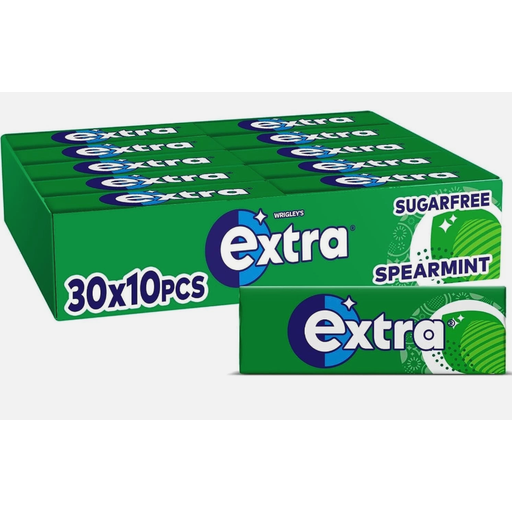 Image unavailable
The separate packs offer a way to keep gum in more than one bag. The product name states 30 packs of 10 pieces in spearmint flavour; check the current pack’s ingredients and warnings if you are buying for others.
No, not when the purpose is to have a food snack before training. University College London Hospitals NHS Foundation Trust describes pre-workout snacks using food components including carbohydrate and protein; use gum separately if you want something to chew for flavour.
Compare the number of separate packs, total pieces and flavour. Tesco and Asda list five-by-10-piece Extra formats that can be divided between bags; for a child’s lunchbox, also check whether chewing gum is appropriate for that child and permitted at school.
GOV.UK states that foods with more than 10% added polyols require this warning. Some listed Extra multipacks contain polyol sweeteners and carry an excessive-consumption warning, so read the wording on the exact pack.
People with phenylketonuria (PKU) need to check whether gum contains aspartame. The NHS says aspartame is unsuitable for people with PKU, and GOV.UK sets out the associated phenylalanine label wording.
No. The NHS mentions sugar-free gum among dry-mouth self-care options but still advises brushing teeth twice daily; gum is not a replacement for brushing.