For someone old enough to chew gum safely, a sugar-free multipack of separate small packs makes it easier to divide gum between half-term outings or lunchboxes than a single bottle. Check the exact pack for ingredients and warnings before sharing it. GOV.UK says chewing gum should not be given to babies and young children.
Who is this for?
Families packing snacks for older children
Separate packs may be useful for outings or lunchboxes when the recipient can chew gum safely. GOV.UK says chewing gum should not be given to babies and young children, so age comes before flavour or pack size.
Households choosing sugar-free gum
A clearly labelled sugar-free pack lets you distinguish it from a sugar-containing gum. It does not replace brushing with fluoride toothpaste or decisions about sugary snacks.
Households checking ingredients
Check the exact pack before sharing it if soya, a phenylalanine statement or a warning about excessive consumption matters to someone in the household. Ingredients and warnings can differ between products and formats.
What should you check?
Decide who the gum is for before comparing pack formats, then read the label of the particular product you plan to buy.
| Priority | What to check | Your needs |
|---|
| Age suitability |
Check who will receive the gum and whether it could end up in a shared snack bag. GOV.UK says not to give chewing gum to babies and young children. |
I need snacks for different ages and want to keep gum out of bags intended for younger children. |
| Sugar-free status |
Look for a sugar-free declaration on the exact variant. Do not assume every flavour or pack from a familiar range has the same label. |
For someone who can chew gum safely, I want to distinguish a sugar-free option from a sugar-containing one. |
| Ingredients and warnings |
Read the current ingredient and warning panel for soya, aspartame or a phenylalanine statement, and any excessive-consumption warning. GOV.UK explains the labelling requirements for aspartame and products containing more than 10% polyols. |
Before I share a pack, I need to know whether its ingredients or warnings matter to anyone who might take a piece. |
| Pack format |
Compare the number of separate packs, pieces per pack and net weight. A five-pack of small packs and a single bottle are different ways of storing and dividing gum. |
Separate packs would be easier for me to allocate across outings or bags; if the gum stays in one place, a bottle may also work. |
Common buying mistakes
-
Treating gum as an all-age snack
GOV.UK says chewing gum should not be given to babies and young children. A multipack in a shared snack bag could be offered to someone it was not intended for.
Keep gum out of bags intended for younger children and choose another age-appropriate snack for them.
-
Assuming sugar-free means suitable for everyone
The checked Extra and Wrigley’s Extra labels include ingredients or warnings that may matter to a particular household, including soya and phenylalanine statements.
Read the ingredient and warning panel on the exact pack before sharing it, including any warning about excessive consumption.
-
Choosing a bottle when you need separate packs
A single bottle does not provide the same ready-separated portions as a multipack of small packs, even if both contain sugar-free gum.
Compare the pack structure as well as piece count and weight when planning several outings or lunchboxes.
Relevant brand references
These examples show why the exact flavour and format matter more than a brand name alone.
Extra
ASDA lists an Extra Bubblemint five-pack weighing 70 g.
- Five separate packs provide a format for dividing gum between bags or outings.
- The listed Bubblemint multipack contains soya; check the current label before sharing it.
Wrigley’s Extra
Sainsbury’s lists an Extra White sugar-free multipack of 5 x 10 pieces.
- The five small packs can be allocated separately.
- The checked Extra White label warns that it contains a source of phenylalanine and that excessive consumption may produce laxative effects.
Mentos
The Mentos Pure Fresh Mint option listed by Joybuy is a 70 g bottle rather than five separate small packs.
- A single container may suit gum kept in one place.
- Its bottle format is not a direct substitute when individually packed portions are the reason for buying a multipack.
Joybuy product options
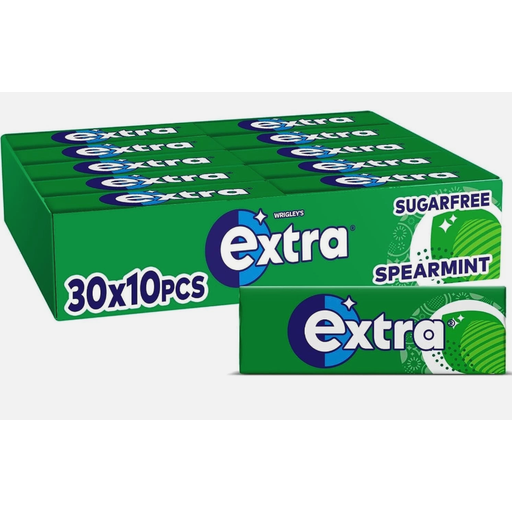
The option below is a sugar-free spearmint multipack for separating gum across outings or bags. Its 10 Pieces x30 format differs from the five-packs discussed above.
 No image available
Wrigley Extra Sugar Free Spearmint, 10 Pieces x30
The separately packed format is worth considering when gum needs to be allocated across outings rather than kept in one bottle. Check the current pack for soya, phenylalanine and excessive-consumption warnings before sharing it. Do not give chewing gum to babies or young children.
View on Joybuy
Questions about chewing-gum multipacks
Can chewing gum go in a young child’s snack bag?
No. GOV.UK choking-hazard guidance says not to give chewing gum to babies and young children. Choose an age-appropriate snack instead, including when a bag will be shared with older children.
Does sugar-free gum replace brushing teeth?
No. Sugar-free gum is not a substitute for brushing with fluoride toothpaste or limiting dietary sugars. The Department of Health and Social Care and NHS England identify dietary sugars as a cause of tooth decay.
Why might a sugar-free gum pack carry phenylalanine and laxative-effect warnings?
The warnings relate to particular ingredients, not simply to the words “sugar-free”. GOV.UK sets out a phenylalanine labelling requirement for aspartame and an excessive-consumption warning for foods containing more than 10% polyols. The checked Wrigley’s Extra White pack carries both warnings; read the wording on the pack you buy.
How should I check a multipack for soya?
Read the ingredient and allergen information on the exact current pack before sharing it. The Extra Bubblemint multipack listed by ASDA contains soya, but that does not establish the ingredients of every gum format or flavour.


