Families with babies or young children
GOV.UK early-years choking guidance says not to give chewing gum to babies and young children. Choose another age-appropriate holiday snack for them, regardless of how the gum is packed.


Do not buy chewing gum as a snack for babies or young children: GOV.UK early-years choking guidance says not to give it to them. For an older child, check the school’s rules before buying gum for lunchboxes. Where gum is suitable and permitted, separate sugar-free packs can be practical for family sharing, but check the exact pack label for ingredients and warnings.
GOV.UK early-years choking guidance says not to give chewing gum to babies and young children. Choose another age-appropriate holiday snack for them, regardless of how the gum is packed.
For an older child, check the individual school’s current rules before buying gum for a lunchbox. Riverside Primary School, for example, prohibits chewing gum on its site.
Separate packs can make it simpler to divide gum between people who can chew it safely. Compare the number of packs and pieces, flavour, and the ingredient statement for the exact product.
Decide who will chew the gum and where it will be used before comparing pack formats or flavours.
| Priority | What to check | Your needs |
|---|---|---|
| Age suitability | Check who will use the gum. GOV.UK early-years choking guidance says not to give it to babies or young children; a multipack does not change that advice. | I’m choosing a holiday snack for a young child, so I need something other than gum. |
| School rules | Read the school’s current packed-lunch or site policy. A product’s packaging cannot establish whether gum is allowed at school. | If this is intended for a school lunchbox, I need to know that child’s school rules before buying. |
| Ingredients | Read the label for the exact flavour and pack size, including allergens, sweeteners and any dietary warnings. Do not assume different variants have identical ingredients. | Someone sharing the pack may need to avoid a particular ingredient, so I need the declaration for the gum I’m actually buying. |
| Pack format | Compare the number of separate packs and pieces in each. A bottle keeps the supply together; a multipack divides it without decanting. | Separate packs would be useful if I’m dividing suitable gum between family members; a bottle may be simpler for shared storage at home. |
| Snack plans | Decide whether gum is an optional extra rather than the food planned for a break or lunch. | I’m planning holiday snacks, so I need food as well if gum is included for someone who can use it safely. |
Separating gum into portions does not address the choking concern for babies and young children identified in GOV.UK early-years guidance.
Choose another age-appropriate snack for a baby or young child rather than a different gum format.
School rules can determine whether gum may be brought onto the site. Riverside Primary School, for example, prohibits it.
Check the intended school’s current policy before setting aside packs for school days.
Sugar-free gum can still contain ingredients relevant to a person’s dietary restrictions. The product information for the Wrigley Extra Spearmint multipack below states that it contains soya and a source of phenylalanine.
Read the current label for the exact product and check its ingredients and warnings against the intended user’s requirements.
A bottle keeps pieces together, while a multipack provides portions that can be divided without decanting. Neither format establishes age suitability or school permission.
For suitable, permitted use, compare the number of separate packs with how you plan to share or store the gum.
Joybuy lists an Extra White Bubblemint five-pack containing 50 pieces, while Tesco lists an Extra Spearmint 5 × 10-piece pack. These are distinct products, so check the chosen variant rather than treating their labels as interchangeable.
This sugar-free multipack has separate portions for family sharing where chewing gum is suitable and permitted.
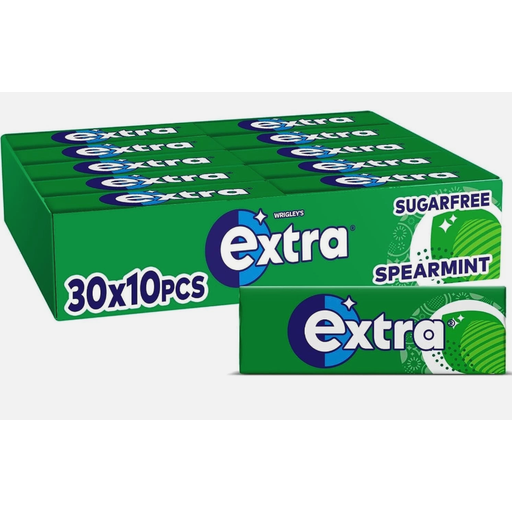 Image unavailable
Thirty separate packs of 10 pieces allow the gum to be divided for suitable family use. The product information describes it as sugar-free, states that it contains soya and a source of phenylalanine, and warns that excessive consumption may have laxative effects. Check the current pack label and, if buying for a lunchbox, the school’s rules.
No for babies and young children: GOV.UK early-years choking guidance says not to give them chewing gum. Choose another age-appropriate snack instead.
Check the individual school’s current policy before buying it for that purpose. The Department for Education’s school-food guidance addresses food and drink provided in state-funded schools in England; it does not establish permission for gum in a home-packed lunch. Riverside Primary School, for example, prohibits chewing gum on its site.
No. If you are planning food for a break or lunch, do not treat gum as the food portion. For someone who can chew it safely, consider it only as an optional extra where its use is permitted.
Check the exact pack’s ingredients, allergen declaration, sweeteners and warnings, as well as its pack and piece counts. The product information for the Wrigley Extra Spearmint 30-pack shown here states that it contains soya and a source of phenylalanine and warns about excessive consumption.