For pre-packed school-holiday snack bags, separate 10-piece packs let an adult allocate a pack to each outing; a bottle suits an adult who will dispense and store the pieces. A 10-piece pack is not a single-piece serving, and the exact gum label matters even when it says sugar-free. In England, the Requirements for School Food Regulations 2014 classify chewing gum as confectionery, so an organiser supplying food at a state-funded school should check the applicable school-food requirements.
Who is choosing the gum?
Parents packing for holiday outings
If you prepare separate bags before leaving home, an individual pack can be allocated without dispensing pieces from a bottle. Sainsbury’s lists an Extra multipack containing five separate 10-piece packs; each pack still holds more than one piece.
Families checking sugar-free ingredients
If you are choosing sugar-free gum, read the label for the exact flavour and format. The Extra products listed by Tesco, Sainsbury’s and Asda include sweeteners and soya and carry warnings about phenylalanine and excessive consumption.
School and holiday-activity food organisers in England
Food supplied by a state-funded school calls for a different check from a family’s personal snack. Department for Education guidance addresses food and drink provided in those schools, while the Requirements for School Food Regulations 2014 classify chewing gum as confectionery. Check the organisation’s policy for personal items.
What should you check before choosing?
Start with how the pieces will be allocated, then check the exact pack’s ingredients and any rules at the place where it will be used.
| Priority |
What to check |
Your needs |
| Pack format |
Check the number of separate packs as well as pieces per pack. Sainsbury’s lists five individual 10-piece Extra packs; Asda lists a 46-piece Extra bottle. Neither format makes one piece an automatic serving. |
I’m filling separate bags for days out, so allocating an unopened pack is simpler than dispensing pieces from a shared bottle. |
| Bottle storage |
Check the bottle’s piece count and whether an adult will dispense and store the pieces. A bottle does not provide separate packs for different outings. |
For a shared supply, I can keep the bottle with an adult and portion pieces when they are needed. |
| Ingredients and warnings |
Read the current label for sugar-free wording, sweeteners, soya and warnings. Tesco, Sainsbury’s and Asda list these details for the cited Extra products; do not assume every flavour has the same formulation. |
I’m looking for sugar-free gum, but I also need to check whether the exact ingredients and warnings suit the intended person. |
| Imported flavours |
Confirm the flavour, piece count, current label and seller details. Sweet Genie lists imported Trident sugar-free gum in 14-piece packs; availability can differ by flavour. |
If the family wants a particular Trident flavour, I’ll check that exact pack rather than substitute another flavour without reading its label. |
| School or club rules |
Check who is supplying the gum and the organisation’s current policy. In England, the Requirements for School Food Regulations 2014 classify chewing gum as confectionery; Department for Education school-food guidance concerns provision in state-funded schools. |
I need to know whether this is a personal item for an outing or food the school will provide, rather than assuming one rule covers both. |
Common pack and label mistakes
-
Assuming a bottle is already portioned
A 46-piece bottle puts the pieces in one container; it does not provide separate packs for children or outings.
For bags prepared in advance, consider individually packed gum. Choose a bottle when an adult can manage storage and dispensing.
-
Treating sugar-free as the only label check
The Extra packs cited by Tesco, Sainsbury’s and Asda contain sweeteners and soya. Their labels also warn that excessive consumption may produce laxative effects and that the gum contains a source of phenylalanine.
Read the current label for the exact flavour and pack size before buying, particularly when ingredients or warnings matter to the intended person.
-
Assuming one school rule covers every outing
The Department for Education’s England school-food guidance concerns food and drink provided in state-funded schools. It does not, by itself, settle the policy for a parent-packed item or every holiday activity.
Ask the school or activity organiser about personal items. If the school is supplying gum as food, check the applicable school-food requirements; the Requirements for School Food Regulations 2014 classify gum as confectionery.
-
Substituting an imported flavour without checking it
Sweet Genie lists Trident in several 14-piece flavours, but a different flavour should not be assumed to have the same ingredients or current availability.
Check the exact imported pack’s flavour, quantity, label and seller details before ordering.
Brand references
These references help distinguish the ranges and pack formats; they do not mean every product from a brand has the same ingredients.
Extra
The cited Tesco, Sainsbury’s and Asda listings include Extra 10-piece packs, a 5 × 10-piece multipack and a 46-piece bottle.
- Separate packs and a bottle offer different ways to allocate or store pieces.
- The cited products contain sweeteners and soya and carry phenylalanine and excessive-consumption warnings. Check the current label for the exact product.
Wrigley’s
Retailer naming can combine Wrigley’s and Extra: Asda lists a Wrigley’s Extra Bubblemint 46-piece bottle.
- Searching either name may help identify the particular Extra pack shown in a retailer listing.
- Shared branding does not establish that other Wrigley’s products have the same format or ingredients.
Trident
Sweet Genie describes Trident as originating from the USA and lists sugar-free gum in 14-piece packs across several flavours.
- A distinct flavour option for shoppers seeking a particular imported Trident pack.
- Check the exact flavour’s current availability and label rather than assuming another variant is interchangeable.
Joybuy gum options
These options cover separate spearmint packs for preparing outing bags and bottles that an adult can dispense from. Compare the stated piece counts and the current labels before choosing.
 No image available
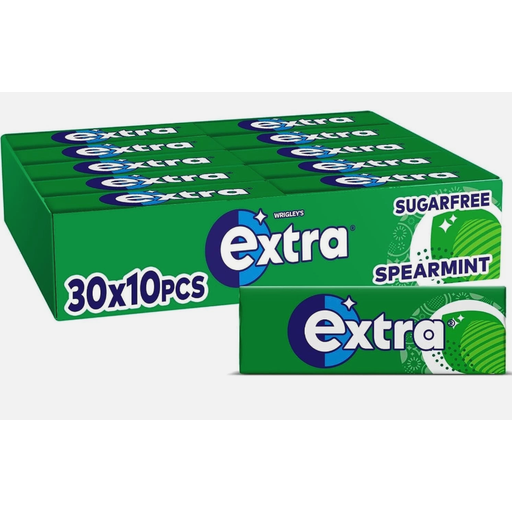
Wrigley Extra Sugar Free Spearmint Gum, 10 Pieces × 30
Thirty separate 10-piece packs allow an adult to allocate an unopened pack to an outing bag. Each pack still contains 10 pieces. Check the current label for ingredients and warnings, including soya and phenylalanine information.
Joybuy
 No image available
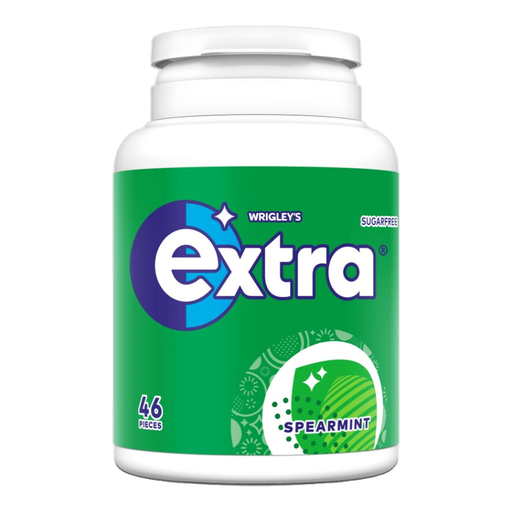
Extra Spearmint Chewing Gum, 46-Piece Bottle
The 46-piece bottle suits a shared supply when an adult can dispense pieces; it does not provide separate packs for outing bags. Read the current label for ingredients and warnings before use.
Joybuy
 No image available
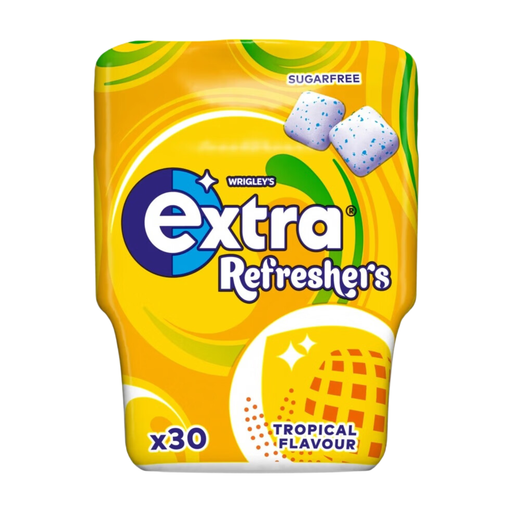
Extra Refreshers Tropical Sugarfree Gum, 30 Pieces, 67g
This 30-piece bottle is another option for an adult-managed supply, rather than separately packed snack bags. Its product information flags soya, a source of phenylalanine and a warning about excessive consumption; check these details on the current pack.
Joybuy
Frequently asked questions
Does “mini” mean one piece per pack?
No: choose by the stated piece count and pack structure, not the search term. The cited listings include individual 10-piece packs, a multipack of five such packs and a 46-piece bottle; an individual pack is not a single piece.
Is sugar-free gum suitable without further label checks?
No. The cited Extra products are labelled sugar-free or no sugar, but Tesco, Sainsbury’s and Asda also list sweeteners and soya, plus warnings about phenylalanine and excessive consumption. Read the current packaging for the exact flavour and format.
What should an England school check before supplying gum?
A state-funded school in England should check the school-food requirements applicable to what it provides: the Requirements for School Food Regulations 2014 classify chewing gum as confectionery, and Department for Education guidance addresses food and drink provided in those schools. For a parent-packed item or a holiday activity, check the organisation’s own policy rather than assuming the same provision rules settle the question.


