Who is this decision for?

Parents focused on online contact

If the child wants multiplayer games, the immediate question is who can contact them and whether chat and content shared by other players can be restricted. PlayStation and Nintendo describe controls for some of these interactions, but the particular game still needs checking.

Households wanting a bounded first setup

A dedicated gaming device may fit a household that wants online play centred on games. Xbox, PlayStation and Nintendo each have family-management options, with different child-account and control arrangements to set up before play.

Parents considering a portable, multi-use device

A tablet or phone brings games together with other apps and web access. For these households, Apple’s or Google’s family-account and device controls are part of the choice, alongside the settings in each game.

What matters when choosing?

Decide whether gaming belongs on a dedicated device or alongside wider app use, then check that the household can manage the child’s account and online interactions on that route.

Games console

Consider it: When the device will be used mainly for games and an adult can manage a separate child account.

Bear in mind: Console controls vary by platform, and a game’s own communication features may need separate attention.

Tablet

Consider it: When portable play and access to other apps both matter.

Bear in mind: The family must manage the wider app and web environment as well as the games.

Phone

Consider it: When the child also needs a personal connected device beyond gaming.

Bear in mind: Gaming becomes one part of a broader setup that may also include messaging, browsing and other apps.

Concern What to check Who this matters to
Online contact Check child-account communication settings and the intended game’s separate chat and privacy options. If my child wants to play with others, I need to understand who can contact them, not just whether multiplayer works. Around 36% of consumers put online contact first.
Household controls Confirm the child and adult account setup, and how to secure adult or guest profiles. When several people use the device, I want the child’s restrictions to apply to their own account rather than depend on whoever last signed in. Household controls are the primary concern for around 29% of consumers.
Device purpose Decide whether it is chiefly for games or also for other apps, and whether it will be shared or personal. I would choose differently if this were mainly a games device rather than the child’s route to a wider range of online activities. For around 21% of consumers, that distinction comes first.
Portable, multi-use access For a tablet or phone, check the relevant family-account, app, web and screen-time controls. If we want games to travel with the child, I also need to be comfortable managing everything else accessible on that device. Roughly 14% of consumers prioritise this portable, multi-use need.

What is easy to overlook?

  • Buying before planning the accounts

    Family controls generally depend on a child account and an adult who manages it; owning the device does not configure those controls automatically.

    Decide who will manage the family group and check the account and management-app requirements before choosing a route.

  • Relying on an age rating to manage online contact

    An age rating helps with game selection, but it does not replace a review of voice chat, messaging and content shared by other players. Nintendo says Switch 2 GameChat settings need separate management from some parental-control options.

    Check the intended game’s rating, then review its communication, friend, privacy and reporting settings before online play.

  • Leaving an unrestricted profile available

    Restrictions on a child account may not apply when the child can enter an adult or guest profile instead. PlayStation advises protecting adult accounts and controlling new-user and guest access.

    Use separate accounts, secure adult profiles and restrict guest or new-user access where the platform allows it.

  • Managing a tablet or phone as though it only runs games

    Games can sit alongside browsing and other apps, so settings inside a game address only part of the device’s use.

    Review app approvals, web and communication controls, and screen-time settings for the whole device as well as for each intended game.

Relevant brands and ecosystems

Xbox / Microsoft

A console ecosystem for households prepared to manage online play through Microsoft child accounts and an adult-led Xbox family group.

  • Xbox Support describes family settings for privacy and online safety.
  • Xbox Support says a child below the local age of majority must be linked to an adult account to participate in Xbox services; account and age requirements depend on the applicable region.

PlayStation / Sony

A console ecosystem with separate child accounts and family controls for online play.

  • PlayStation describes controls for communication, content created by other users and playtime.
  • Each child needs a separate child account for PlayStation online services; parents also need to secure adult accounts and review guest access.

Nintendo

Nintendo Switch and Switch 2 consoles offer parental controls through a linked smart-device app, with some restrictions available on the console.

  • Nintendo describes tools for checking gameplay, setting time limits and restricting some communication features.
  • Nintendo says Switch 2 GameChat settings need separate attention and children under 16 need parent or guardian approval in the app to use GameChat.

Apple

An iPhone or iPad route for households prepared to use Family Sharing and a separate Child Account.

  • Apple describes Screen Time controls for apps, websites, communication and device-use timing.
  • Set up Family Sharing and the child’s own account, and check which controls are available on the intended Apple device.

Google / Android

A tablet or phone route for households considering Family Link or compatible on-device controls.

  • Google describes screen-time, app, app-store and web controls for supported setups.
  • For Google’s on-device controls, check its Android 17-or-later requirement and its restriction on devices with multiple profiles; Family Link is a separate setup route.

Tablet choices on Joybuy

This tablet is relevant if you want portable gaming alongside other apps. Before choosing it for online play, check the child-account controls available to your household and whether it runs the games your child intends to use.
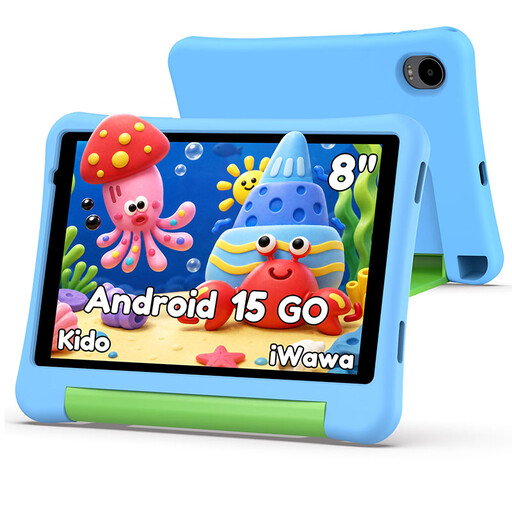
Alldocube Kido children’s tablet with blue protective case

Alldocube Kido children’s tablet with blue protective case

A tablet option for a household considering a portable device for a child’s games and other apps; check the intended games’ compatibility before buying.

The listing names an 8-inch display, Android 15, 3GB+32GB, a 5000mAh battery and a Child Lock. Check what the Child Lock actually restricts, including whether it covers accounts, apps or communication; those functions should not be assumed from its name.

No adapter is included, so check whether you already have a suitable one.

Joybuy

Common questions

Does a game’s age rating cover its online chat?

No. Use the age rating when deciding whether a game is suitable, but check its communication and content-sharing settings separately before a child plays online.

Should my child use my adult account to play online?

Use a separate child account if you want child-specific controls. PlayStation says each child needs one for its online services, while Apple advises giving the child their own Apple Account; Xbox Support describes linking a child’s account to an adult account for Xbox services.

Do parental controls automatically block chat with strangers?

No; the available restrictions depend on the platform and the game. PlayStation describes child-account communication controls, and Nintendo says Switch 2 GameChat needs separate settings, so review the intended game’s own chat options too.

What should I set up before my child first plays online?

Create the child and adult family-management accounts, configure the available communication and content controls, and secure adult profiles. Then check the intended game’s online settings; for a tablet or phone, also confirm that the device supports the control method you plan to use.