
24/7 Customer Support

Free returns

Same-day & Next-day Delivery

Quality Guaranteed

Unlock Your Welcome Offers: FREE Delivery | Up to 80% OFF | Free 30-day JoyPlus trial
Download the APP
A children’s mini trampoline with handle can provide an engaging way for young children to practise balance and controlled movement at home. However, choosing one based only on colourful photos or a low price can lead to disappointment. A frame that moves across the floor, exposed springs or an unsuitable weight limit may make the trampoline difficult to use safely.
For UK homes, especially where indoor space is limited, the right choice should balance stability, protective padding, rebound design, storage and age suitability. This guide explains the practical details to check before buying and compares suitable options for different family needs.
A handlebar is useful only when it is firmly attached and positioned at a suitable height. Some product listings use “safety handle” as a headline feature without clearly explaining whether it is adjustable, padded or securely fixed to the frame.
Look for an adjustable T-shaped handlebar or similar design that can be set to suit the child. Before each use, check that the handle is properly secured and does not wobble excessively.
A 36-inch children’s trampoline may fit neatly in a playroom, but it still requires adequate clear space around and above it. Placing it beside a sofa, radiator, table or low light fitting creates avoidable hazards.
The trampoline should sit on a level, stable surface, away from walls and furniture. A compact design helps with room planning, but it does not remove the need for supervision and clearance.
Traditional steel springs can provide a responsive bounce, but they need complete protection from a properly fitted safety pad. A springless resistance band trampoline uses elastic bands instead, which may offer a quieter bouncing experience and can be more convenient for indoor use.
Neither system removes the need for inspection. Check the jumping mat, frame, springs or elastic bands and protective padding regularly. Do not use the product if any part is damaged.
For a toddler trampoline or an indoor mini trampoline for children, the listed maximum user weight is a key purchasing filter. The SPORTSOUL models featured here have a 25kg weight capacity, making them intended for children and lighter users within that limit.
Weight capacity is not a suggested target. Select a product according to the child’s current weight, the manufacturer’s instructions and the stated age suitability. Only one child should use the trampoline at a time, and children should remain under continuous adult supervision.
A 36-inch trampoline has an overall diameter of approximately 916mm, so measure the intended area before ordering. Also consider the height of the handlebar and the available overhead clearance.
A foldable mini trampoline can be practical for UK flats, bedrooms and shared play spaces. Check how it folds, where it can be stored and whether it must be fully unfolded and secured before use. A product that is easy to put away is more likely to be stored indoors and protected from damp conditions.
A foam safety pad or full-coverage spring pad should cover the relevant contact points around the jumping surface. Inspect whether the padding stays in place and whether its condition can be checked easily.
The resistance-band models below use 24 elastic resistance bands and an integrated foam pad. The spring model uses 24 steel springs with a full-coverage spring safety pad. These are objective design differences that may help families choose between a quieter rebound system and a conventional spring setup.
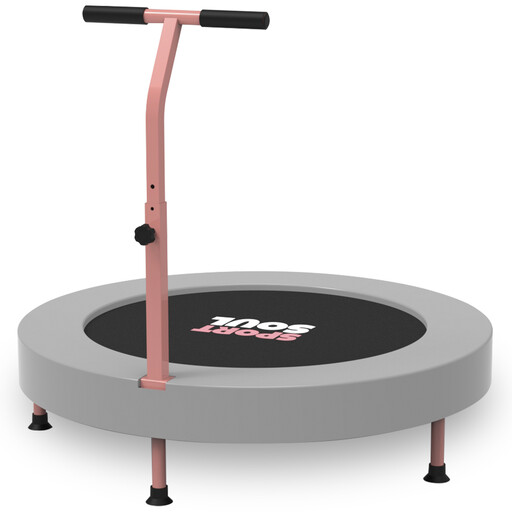
Why This Fits Their Persona: A compact option for families introducing a young child to supervised bouncing in a playroom or other limited indoor space.
The springless design uses 24 elastic resistance bands rather than exposed steel springs, with an integrated foam pad and adjustable handlebar.
Foldable construction, 4.77kg net weight, 25kg capacity and a stated 916mm by 916mm footprint.
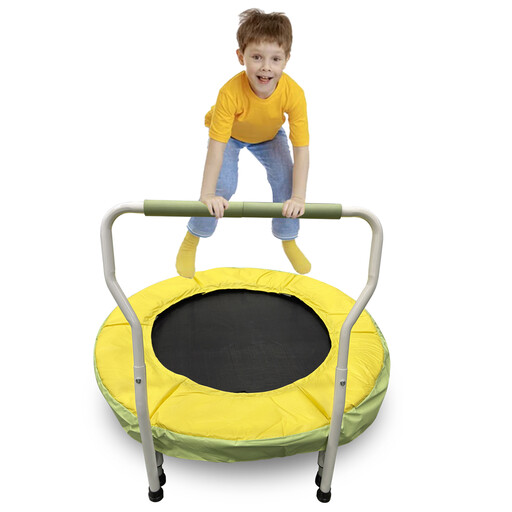
Why This Fits Their Persona: Suits carers who prioritise visible spring coverage and a padded handle for supervised indoor or outdoor use.
All 24 steel springs are covered by a full-coverage safety pad, helping address the common problem of exposed rebound components.
Adjustable handle height, polypropylene jumping mat, 25kg capacity and a 7kg steel-frame construction.
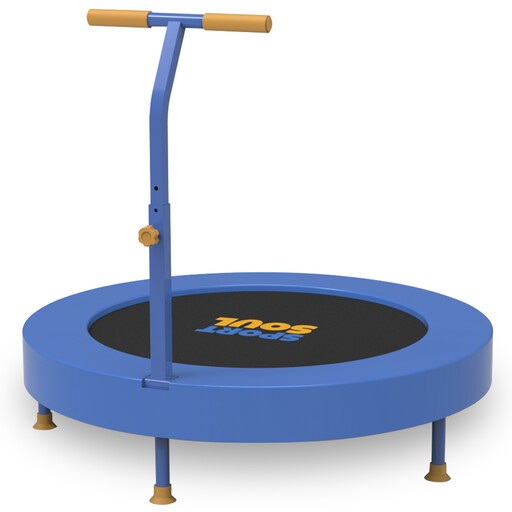
Why This Fits Their Persona: Appropriate for families wanting frequent supervised use, provided the child remains within the 25kg limit and the trampoline is inspected regularly.
The band-based rebound system is designed for quieter use, while the handle can be adjusted as the child’s height changes.
Steel frame with powder-coated finish, polypropylene mat, 24 elastic bands and pre-assembled core components.
We have compiled a complete, real-time list of products that fully satisfy these strict selection criteria and UK safety regulations.
Before a child uses an indoor mini trampoline for children:
It may be suitable if the individual product specifies an appropriate age range, the child is within the 25kg weight capacity and an adult provides continuous supervision. A handle can support balance, but it does not prevent falls. Follow the manufacturer’s instructions rather than relying on the product title alone.
They are designed to produce less noise than comparable steel-spring systems because elastic bands replace metal springs. Actual sound levels will also depend on the floor, room and how the trampoline is used. A carpeted, stable surface may help reduce movement and noise, but the product must remain level and secure.
Lifespan depends on frequency of use, storage conditions, the child’s weight and maintenance. Regularly inspect the frame, jumping mat, padding and rebound components. Replace or stop using the trampoline if damage, excessive stretching, loose fittings or deterioration appears. Product packaging, instructions and current retailer information should also be checked for warranty and replacement-part details.