
24/7 Customer Support

Free returns

Same-day & Next-day Delivery

Quality Guaranteed

Unlock Your Welcome Offers: FREE Delivery | Up to 80% OFF | Free 30-day JoyPlus trial
Download the APP
A children's mini trampoline can provide active play without taking over a UK home or garden. However, product listings often make similar models appear interchangeable. The important differences are usually hidden in the rebound system, handlebar design, padding, weight limit and storage requirements.
Before buying, look beyond colourful photographs and broad age claims. A compact trampoline still needs enough room around it, a stable base and close adult supervision every time it is used.
A 36-inch children's trampoline measures approximately 91.6 cm across the outside frame. The actual jumping mat is smaller, while the surrounding frame and safety padding take up additional space. Measure the available floor area before ordering and leave clear space around the trampoline, away from furniture, walls and hard edges.
Also check the height. A low frame may suit younger children, but the handlebar can still affect overhead clearance in a room with low ceilings.
A springless children's trampoline normally uses elastic resistance bands rather than metal springs. This can reduce the metallic noise associated with spring movement, although no trampoline is completely silent. A model with steel springs may provide a different rebound feel and can be suitable when the springs are fully covered by a properly fitted pad.
The key point is to check what creates the rebound. Product names such as “silent”, “soft” or “low impact” should not replace clear information about the construction.
A toddler trampoline with handle can offer a handhold for balance, but it does not prevent falls. The bar must be securely fixed and adjusted to a suitable height. Children should use the trampoline one at a time, without somersaults or high-impact movements, and remain under direct adult supervision.
A foam-covered handlebar and full spring padding can reduce contact with hard components, but they do not remove the need for safe positioning and supervision.
For indoor use, consider whether a mini rebounder trampoline with elastic bands is more suitable than a spring model. The SPORTSOUL springless design uses 24 elastic resistance bands, which may be preferable where reducing mechanical noise is a priority. Elastic bands can also offer a gentler-feeling rebound, although the child’s movement and the floor surface will affect the sound.
A steel-spring model uses 24 springs and should have a full-coverage spring pad. Inspect the pad regularly, as exposed or damaged springs are a clear reason to stop using the product.
A 25kg capacity trampoline is intended for children or lighter users within that limit. The maximum weight is not a suggested target; it is a boundary that should never be exceeded. Check the child’s current weight, clothing and footwear, and allow for only one user at a time.
Do not choose a small trampoline for older children simply because the diameter fits the room. A compact frame, mat and handlebar need to match the intended user and activity level.
Look for a steel frame, a securely attached polypropylene jumping mat and padding that covers hard or moving components. The SPORTSOUL models described here use a powder-coated steel frame, polypropylene mat and foam safety components.
A foldable children's trampoline can be useful in flats, playrooms or homes where equipment needs to be stored after use. Folding does not mean it can be left assembled in an unsafe location: place it on a level, stable surface before each session and check the frame, mat, bands or springs and padding for wear.
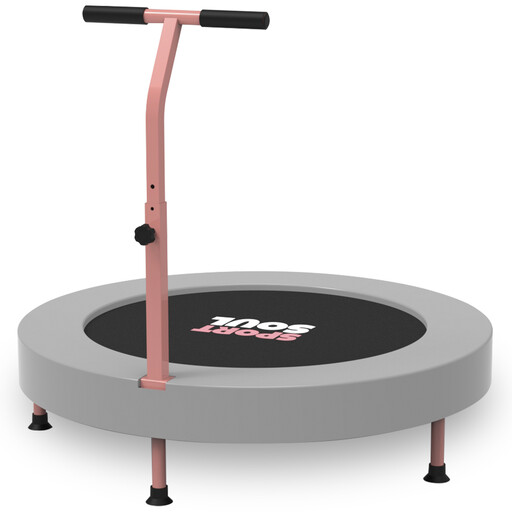
Why This Fits Their Persona: A compact option for families introducing a young child to supervised indoor or outdoor bouncing, with storage-friendly dimensions and minimal assembly.
The springless construction uses 24 elastic bands, while the foam pad helps cover the frame. The 25kg limit and one-user guidance make suitability easier to assess.
36-inch footprint; adjustable T-shaped bar; foldable design; pre-assembled elastic bands, mat and foam pad.
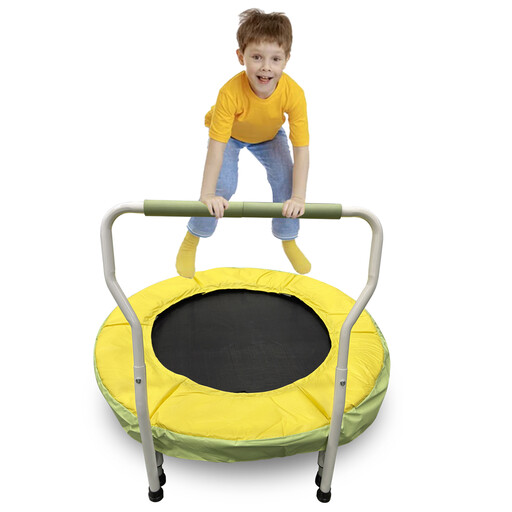
Why This Fits Their Persona: Suitable for buyers prioritising a padded handlebar and full spring coverage for a younger child’s supervised play routine.
The model does not rely on uncovered springs: its 24 steel springs are covered by a full-coverage safety pad. The handlebar is adjustable and includes foam padding.
36-inch frame; 25kg maximum user weight; adjustable bar; no-gap spring cover listed in the product description.
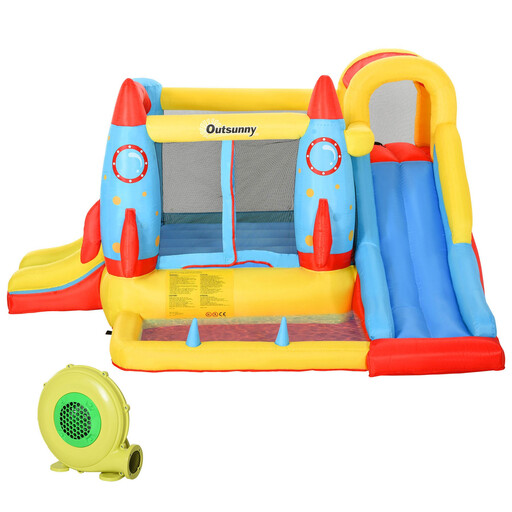
Why This Fits Their Persona: A garden-focused alternative for families wanting a larger play structure for parties or playdates rather than a compact indoor trampoline.
Its specifications state a 120kg total maximum capacity, five ground stakes and included repair patches. It is not a substitute for a 36-inch mini trampoline and needs substantially more space.
Includes a blower, slides, climbing wall and pool; listed dimensions are 330 x 265 x 185 cm; EN71-1, EN71-2, EN71-3, EMC, LVD and RoHS certifications are listed by the product description.
We have compiled a complete, real-time list of products that fully satisfy these strict selection criteria and UK safety regulations.
Some models are designed for indoor and outdoor use, but indoor placement requires adequate clearance and a non-slip, level surface. Keep the trampoline away from radiators, furniture, windows and doorways. Check the product dimensions, including handlebar height, before setting it up.
Lifespan depends on frequency of use, storage, weight limits and inspection. Elastic bands, springs, padding and the jumping mat are wear components. Stop using the trampoline if any part is stretched, torn, loose, cracked or damaged, and follow the seller’s replacement guidance where available.
A standard mini trampoline does not require electricity. Unlike an inflatable play structure, it has no blower and therefore has no operating power cost. The main practical costs are purchase, storage and replacing worn components when necessary.