
24/7 Customer Support

Free returns

Same-day & Next-day Delivery

Quality Guaranteed

Unlock Your Welcome Offers: FREE Delivery | Up to 80% OFF | Free 30-day JoyPlus trial
Download the APP
A children's rocking horse can become a favourite playroom toy, but the wrong design may quickly become awkward, unsafe or unsuitable. Parents and gift buyers often focus on appearance while overlooking the details that affect everyday use.
Three common buying traps are worth avoiding:
The right choice depends on the child’s development, available floor space, preferred play style and how long you expect the toy to remain useful.
A toddler rocking horse should offer a stable seat, accessible handles and a rocking motion that is easy to control. Plush animal rockers often include higher sides, a backrest, footrests and a seat belt, which can provide additional support for younger riders.
However, a belt is not a substitute for supervision. Check whether the child can sit upright independently and whether the seat height is appropriate. Some products are described as suitable from 12 or 18 months, while their warnings may state that they are not suitable for children under three because of small parts. Follow the manufacturer’s complete instructions rather than relying on one line of the listing.
The rocking base should sit evenly on the floor, with smooth edges and no visible movement between the frame and seat. A wooden rocking horse may use solid wood, plywood or a combination of wood and metal reinforcement. These materials can offer different balances of weight, stability and portability.
For example, the Le Toy Van Classic Wooden Rocking Horse has an assembled size of approximately 24 x 65 x 53 cm and a stated maximum weight capacity of 50 kg. The HOMCOM penguin rocker measures approximately 60 x 33 x 50 cm, with a 40 kg capacity. These figures help with room planning, but the child’s age and physical control remain equally important.
Also check whether assembly is required. A product that arrives ready to use may be convenient for gifting, while a larger wooden model may need careful assembly and tightening before the first ride.
Look for clearly stated materials and safety information. The products below list features such as EN71, EN62115 and EMC compliance or testing information. These references relate to toy safety and, where applicable, electrical toy requirements. Buyers should still inspect the product on arrival and follow the supplied instructions.
A sustainable children's toy may appeal to families trying to reduce disposable purchases. The Le Toy Van wooden models use FSC-certified rubberwood, and the Classic model also uses plywood. Both are described as decorated with child-safe, non-toxic or water-based paints. A durable frame and repairable or reusable design may make a toy more suitable for passing between siblings.
For musical or electronic products, check battery type, access to the battery compartment and cleaning instructions. A plush rocker may only be surface washable, while battery-operated toys should have their batteries removed before cleaning if the instructions require it.
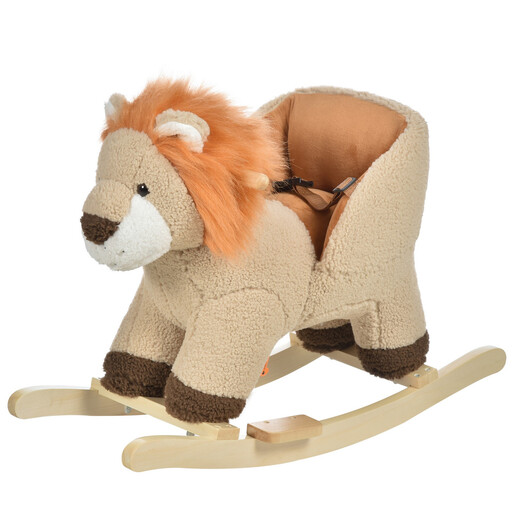
Why This Fits Their Persona: A practical option for families introducing rocking play to children aged 18–36 months, with a compact footprint suitable for many UK playrooms.
It specifies a seat belt, high sides, back support and a front handlebar rather than relying on appearance alone. Adult supervision and assembly remain necessary.
Plush padded seat, curved wooden base, sound button and stated 40 kg maximum load.
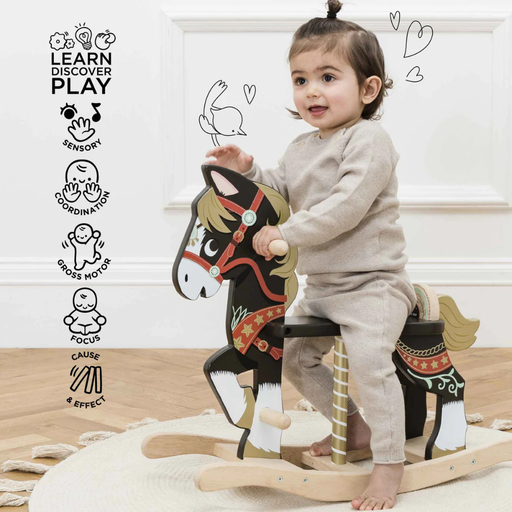
Why This Fits Their Persona: Suits gift buyers seeking a traditional nursery or playroom piece with no batteries and a design intended for continued family use.
Its solid wooden handles and shaped seat provide defined contact points, while the product details specify FSC-certified rubberwood and child-safe paints.
Traditional wooden construction, 50 kg stated capacity and no batteries required.
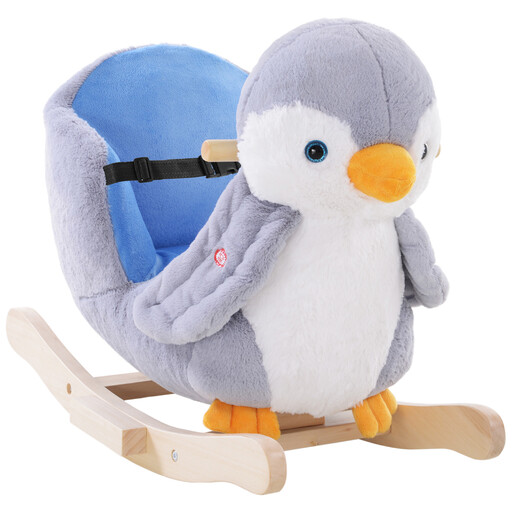
Why This Fits Their Persona: Designed for toddlers aged 18 months and over who enjoy a softer seat and interactive play during regular indoor use.
The listing identifies the frame materials, seat belt, footrests, dimensions and stated safety standards, making the specification easier to check.
Wide padded seat, reinforced steel and poplar wood frame, 32 songs and 40 kg stated capacity.
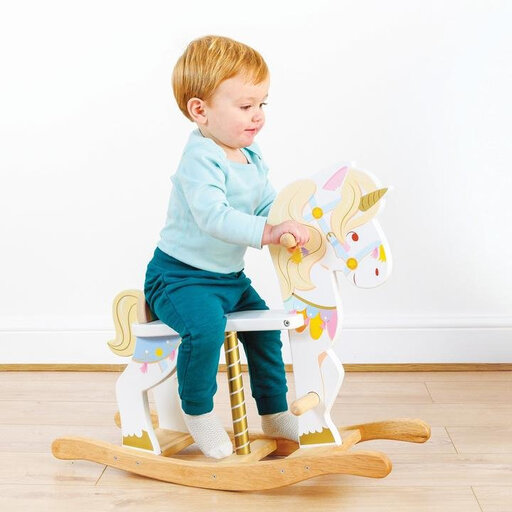
Why This Fits Their Persona: A decorative rocking unicorn for families buying a memorable present that can support storytelling as well as gentle rocking play.
The product information states its FSC-certified rubberwood, water-based paints, shaped rockers and required adult supervision.
Pastel carousel styling, wooden handles, no batteries and 50 kg stated maximum capacity.
Before giving any ride-on toy for toddlers, use this checklist:
We have compiled a complete, real-time list of products that fully satisfy these strict selection criteria and UK safety regulations.
Some models are listed as suitable from 12 months, but readiness varies. The child should be able to sit steadily, hold the handles and remain balanced during gentle movement. Always follow the product’s age guidance, warnings and supervision instructions. A listing may include a small-parts warning that changes how the toy should be used.
Allow the full length and width of the rocker, plus additional clearance at both ends for movement. The HOMCOM lion measures approximately 68 x 35 x 50 cm, while the Le Toy Van Classic model measures approximately 65 x 24 x 53 cm when assembled. Place the toy on a stable, level indoor surface rather than close to stairs or hard corners.
Traditional wooden models such as the Le Toy Van Classic and Magical Rocking Unicorn do not require batteries. Interactive animal rockers may use button batteries for sounds, while the walking plush pony uses four AA batteries. Choose a battery-free design for simpler maintenance, or an interactive model if sound and movement match the child’s interests and your household’s preferences.