
24/7 Customer Support

Free returns

Same-day & Next-day Delivery

Quality Guaranteed

Unlock Your Welcome Offers: FREE Delivery | Up to 80% OFF | Free 30-day JoyPlus trial
Download the APP
A children's rocking horse can become a much-loved playroom companion, but the wrong design may be uncomfortable, difficult to supervise or quickly outgrown. Parents and gift buyers often focus on appearance first, while practical details such as seat height, restraint design and battery requirements receive less attention.
Before choosing a baby rocking horse or toddler rocking horse, watch for these common buying pitfalls:
For younger children, a rocking horse for toddlers should allow them to sit securely without stretching excessively to reach the handle. Seat height varies considerably. Some models designed for 18–36 months have seats around 20–28cm from the floor, while larger designs for children aged approximately 2–5 years can have a seat height of around 35cm.
Check whether your child can:
The Le Toy Van model is listed as suitable from 12 months, but its product warning states that it is not suitable for children under 3 years because of small parts and recommends direct adult supervision. This is an important example of why the complete product information should be read before purchase.
A wooden rocking horse with a broad, smoothly curved base should rock in a controlled forward-and-back movement. Inspect the base dimensions and look for a stable frame rather than relying on photographs alone.
Common materials include:
Paint and finish also matter. The Le Toy Van Classic Wooden Rocking Horse is described as using FSC-certified sustainable rubberwood and plywood, with child-safe, non-toxic paints. It requires self-assembly, so check all fixings carefully before use.
A rocking horse with seat belt may offer additional support for younger toddlers, but a belt should never replace adult supervision. Check that it closes correctly, sits across the child’s lap as intended and does not leave excessive slack.
Look for clearly stated safety information, including references to EN71 toy safety standards and EN62115 for electrical toys where applicable. These references are useful indicators of the standards the product information says it meets, but the toy should still be checked for loose parts, damaged stitching, sharp edges and secure fixings after assembly.
Sound-enabled models also need battery safety. Keep button batteries away from children, ensure the compartment is secured and remove batteries if the toy will be stored for a long period.
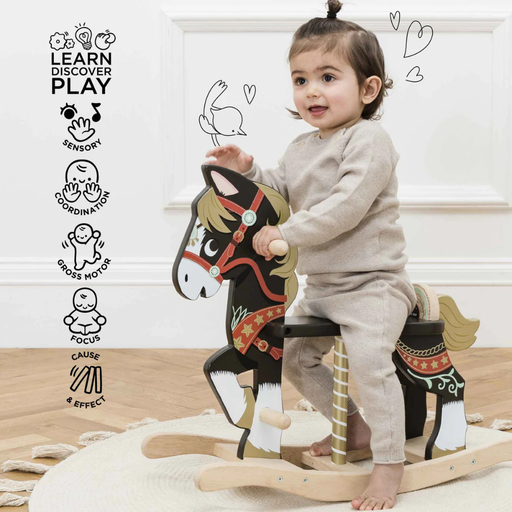
Why This Fits Their Persona: A traditional choice for families who value a painted wooden design that can suit a playroom and remain appealing beyond the novelty stage.
It provides stated material and paint details rather than relying only on decorative styling. Buyers should still follow its specific age warning and supervise use.
FSC-certified rubberwood and plywood are specified; maximum weight capacity is 50kg; no batteries are required.
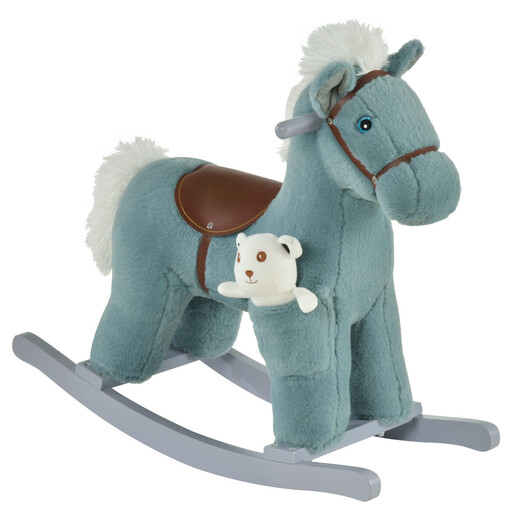
Why This Fits Their Persona: A straightforward plush ride-on rocking toy for families seeking a compact design with interactive play within a specified 18–36-month age range.
The listing gives clear dimensions, age guidance and a 30kg maximum load, helping avoid choosing solely by appearance.
It has a curved wooden base, padded plush covering, handles and two AA batteries included.
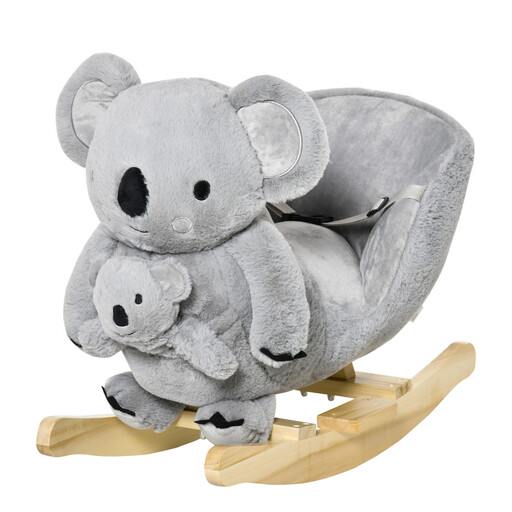
Why This Fits Their Persona: A practical option for households wanting a spacious, supported seat for supervised everyday play.
The design combines a seat belt, back handlebars and a solid wooden base, rather than depending on a soft exterior for support.
It has a 45kg stated weight capacity, a spacious 26cm seat height and an animal-sound button.
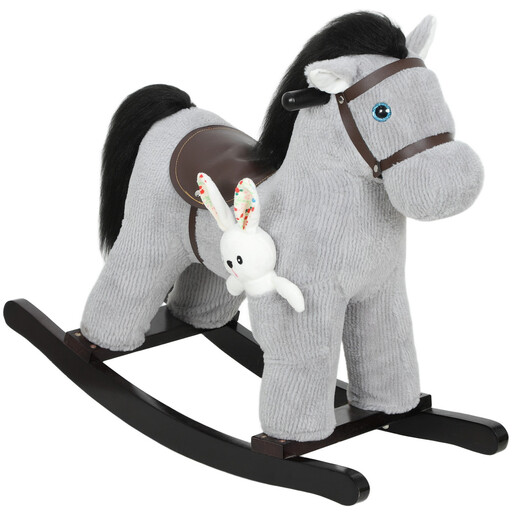
Why This Fits Their Persona: Its stated 2–5 years recommendation suits buyers looking for a larger plush rocking toy with longer age coverage.
The listing distinguishes between recommended age and approved age, so buyers can compare suitability more carefully.
The steel and poplar wood construction supports up to 40kg; it includes a soft toy and sound feature.
We have compiled a complete, real-time list of products that fully satisfy these strict selection criteria and UK safety regulations.
Place the toy on a flat, clear floor away from stairs, furniture corners and radiators. Assemble it exactly according to the instructions, then check screws, rails, handles and seat attachments before the first ride. Recheck them periodically, particularly if the toy is used frequently.
For plush models, follow the care instructions and inspect seams, ears, footrests and belts. For wooden models, look for chipped paint, splinters or loosened joints. Sound functions typically use LR44 or AA batteries, so factor replacement batteries into ongoing ownership and keep all battery compartments secured.
Many plush toddler models in this selection are listed for 18–36 months, while the AIYAPLAY model states a recommendation of 2–5 years. Age guidance must be considered alongside seat height, the child’s physical fit and all product warnings. Adult supervision is essential.
A seat belt can provide additional positioning support, especially on a baby rocking horse with raised sides and a high back. It does not make unsupervised play appropriate. The belt must be fastened correctly, and the child should remain within the stated age and weight limits.