
24/7 Customer Support

Free returns

Same-day & Next-day Delivery

Quality Guaranteed

Unlock Your Welcome Offers: FREE Delivery | Up to 80% OFF | Free 30-day JoyPlus trial
Download the APP
A rocking horse can become a favourite playroom toy, but choosing one involves more than picking a colour or animal design. Parents and gift buyers need to consider age guidance, seat height, construction, movement, cleaning and battery features before ordering.
Several common marketing traps can lead to an unsuitable purchase:
Start with the manufacturer’s recommended age range, not only the maximum weight. A baby rocking horse designed for younger toddlers usually needs a lower seat, raised sides or a seat belt to help the child remain positioned during movement.
For example, products described as a rocking horse for ages 18-36 months may have a seat height around 26cm. Designs for a toddler rocking horse for ages 2-5 can have a higher seat, such as 35cm, which may be more suitable as a child grows.
Check:
A maximum load is a product limit, not a recommendation to use the toy with an older or larger child than the stated age range.
The rocking motion should be gentle and predictable. Look for a solid curved base, a well-supported frame and a seat that does not feel narrow or unstable. Plush upper sections commonly use a metal frame with PP cotton filling, while a wooden rocking horse may use rubberwood, plywood or another timber construction.
Check the listed dimensions, particularly the base length and width. A longer base can affect how much floor space is required, while a wider base may be useful for stability. Always place the toy on a level surface with clear space around it, away from stairs, sharp furniture and hard obstacles.
The EN71-1-2-3 references shown on several listed products relate to European toy safety requirements covering areas such as mechanical and physical properties, flammability and migration of certain elements. EN62115 is associated with the safety of electrically operated toys. These markings are useful checks, but buyers should still follow the product instructions and age warnings.
Plush designs offer a soft surface for sitting and cuddling, but check whether the cover can be wiped clean and whether the toy includes removable accessories. Wooden designs may be easier to inspect for surface damage, although painted finishes and decorative details still need regular checks.
For a rocking horse with sounds, confirm:
A sound function can support pretend play, but a quiet traditional design may be more appropriate for bedrooms, shared homes or children sensitive to noise.
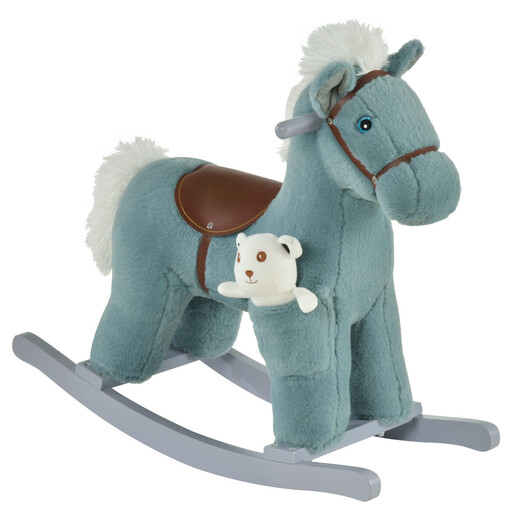
Why This Fits Their Persona: This blue plush ride-on suits gift buyers seeking a straightforward toddler rocker for indoor play, with a compact 65 x 26 x 55cm footprint and batteries included.
The listing states an 18-36 month recommendation, 30kg maximum load, handlebars and a curved wooden base, rather than relying on sound effects alone.
Plush padding, removable bear accessory, neighing and galloping sounds, and 2 AA batteries included.
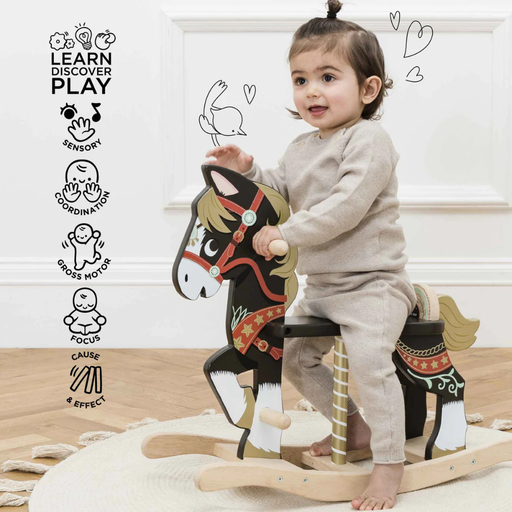
Why This Fits Their Persona: A traditional choice for a playroom, nursery or special occasion where a decorative wooden toy is expected to remain in use beyond a single season.
The product details specify a 50kg maximum weight, wooden handles and a solid rubberwood and plywood construction. Buyers should note the small-parts warning and follow the stated safety guidance.
FSC-certified rubberwood and plywood are listed, with no batteries required and assembled dimensions of 24 x 65 x 53cm.
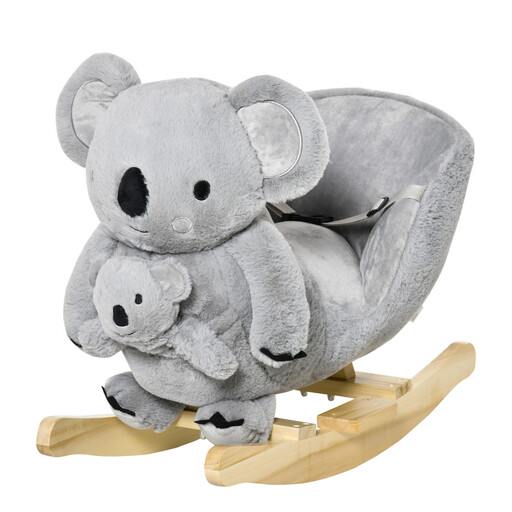
Why This Fits Their Persona: The koala design is aimed at children aged 18-36 months and offers a more enclosed seating arrangement for supervised early riding.
It lists a seat belt, two back handles, a 26cm seat height and a wooden base with curved rails. Adult supervision remains necessary.
45kg maximum load, animal sounds activated by pressing the ear, and a removable baby koala puppet.
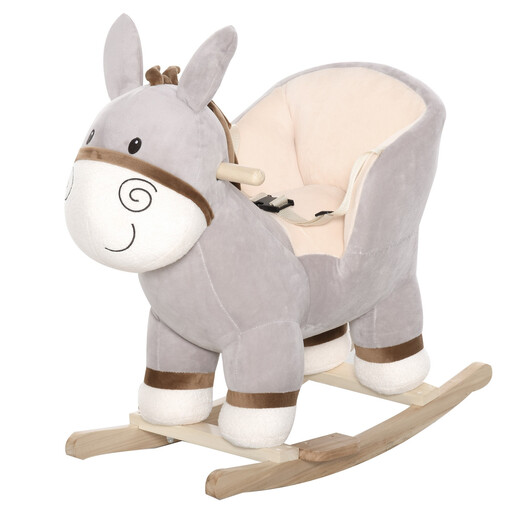
Why This Fits Their Persona: This grey donkey rocker may suit families looking for a toddler ride-on with a high back, raised sides and a seat belt for supervised everyday play.
The listing gives a clear 18-36 month age range, 40kg load limit, seat belt, handlebars and a curved wooden rocking base.
Soft padded seating, high backrest, footrests, realistic sounds and 3 LR44 batteries listed as included.
We have compiled a complete, real-time list of products that fully satisfy these strict selection criteria and UK safety regulations.
Some products are approved from 12 months, while others are recommended from 18 months or 2 years. A traditional plush toy may be suitable as a cuddly companion but not as a ride-on. Always follow the individual product’s age warning, seating guidance and supervision requirements.
Lifespan depends on construction, frequency of use, storage and the child remaining within the stated age and load limits. Inspect handles, rails, stitching, paint, fasteners and battery compartments regularly. Tighten assembly points when required and stop use if any part becomes loose or damaged.
Non-interactive wooden designs do not need batteries. A rocking horse with sounds uses replaceable batteries, commonly AA or LR44 cells, so ongoing cost depends on how often the sound button is pressed. Remove batteries during long-term storage and follow the manufacturer’s battery instructions.