People carrying a snack to training
An individually wrapped bar is convenient to carry. Compare the nutrition per bar with when you plan to exercise, rather than assuming that portability makes chocolate suitable for every session.


A chocolate-bar multipack can provide a portable, occasional snack before exercise if a bar suits your timing and you know you tolerate it, but it need not replace a meal. The British Dietetic Association advises a low-fat, high-carbohydrate snack or light meal two to three hours before exercise. Among the four conventional multipacks compared here, Mars Caramel lists the most carbohydrate and least fat per bar; that label comparison does not establish which snack will suit every workout.
An individually wrapped bar is convenient to carry. Compare the nutrition per bar with when you plan to exercise, rather than assuming that portability makes chocolate suitable for every session.
A multipack makes each wrapped portion clear, but bars of different sizes supply different amounts. Check the weight and nutrition of one bar before comparing packs.
A snack bought for home is a different decision from food supplied by a school. If the bars are intended for school-provided food, check the rules for the relevant nation and school setting; England’s state-funded school-food framework should not be treated as a single UK-wide rule.
Start with the time before your workout, then compare what one wrapped bar supplies. A four-bar pack does not necessarily mean four equal-sized alternatives across brands.
| Priority | What to check | Your needs |
|---|---|---|
| Carbohydrate per bar | Compare the carbohydrate in one wrapped portion, not just per 100 g. Mars lists 28 g per 40 g bar; Snickers and Galaxy each list 23 g per bar, at 40 g and 42 g respectively; Ocado lists 19 g per 33.5 g Cadbury Dairy Milk bar. | I want to know what one bar supplies without treating a multipack as my whole plan for eating before training. |
| Timing and fat | The British Dietetic Association advises a low-fat, high-carbohydrate snack or light meal two to three hours before exercise. Check fat per bar and allow for how you tolerate food before movement: the listed figures range from 6.4 g in Mars Caramel to 14 g in Galaxy Smooth Milk. | If I am eating close to a workout, I would rather choose something I already know suits me than assume any chocolate bar will feel comfortable. |
| Portion and pack format | Check the number of wrapped portions and the weight of each. The compared four-bar packs contain bars weighing 33.5 g, 40 g or 42 g; a mixed funsize bag uses a different portion format. | One wrapped portion is easier for me to plan around than an unspecified amount from a sharing bar. |
| Ingredients and allergens | Read the ingredient list, declared allergens and any precautionary wording on the exact pack. A peanut bar, a plain milk-chocolate bar and a biscuit-containing bar should not be treated as interchangeable. | Anyone I am buying for needs the actual pack to fit their ingredient and allergen requirements. |
| School setting | Separate a household purchase from school-provided food. Department for Education guidance covers food in state-funded schools in England, while the Requirements for School Food Regulations 2014 define chocolate as confectionery within that framework. | If these bars are intended for food supplied by a school, I need to check the applicable school-food standards rather than assume one rule covers every UK setting. |
A bar’s carbohydrate figure does not settle what to eat for every type or length of workout. The British Dietetic Association’s advice for two to three hours before exercise is a low-fat, high-carbohydrate snack or light meal.
Use a bar as an occasional convenience option if it suits you; plan regular meals and other carbohydrate-containing foods around your wider training needs.
The four conventional multipacks discussed here have individual bars weighing 33.5 g, 40 g or 42 g. A per-100-g figure alone does not tell you what one wrapped bar supplies.
Compare carbohydrate, fat and sugars per bar, alongside the portion weight, before deciding between packs.
Recipes and precautionary allergen statements can differ, including between bars from the same manufacturer. Snickers Peanut, for example, is not interchangeable with a plain milk-chocolate bar for someone avoiding peanuts.
Read the exact pack each time, including its ingredient list and precautionary wording.
Department for Education school-food guidance concerns state-funded schools in England. It does not, by itself, establish the rules for every UK nation or for food packed at home.
For school-provided food, identify the nation and school setting, then check the standards that apply there before choosing a product.
These product references illustrate different portions and formats; they are not a claim that every brand has a comparable multipack or that its products suit every workout.
Mars Caramel is a four-bar multipack with 40 g bars.
Snickers Peanut is another four-bar multipack with 40 g bars.
Galaxy Smooth Milk comes as four 42 g bars.
The Cadbury Dairy Milk multipack listed by Ocado contains four 33.5 g bars.
Twix is a biscuit-and-caramel option that can appear in mixed funsize packs as well as twin-bar multipacks.
KitKat 4 Finger Milk is a wafer-based bar; the Nestlé product information describes an individual 41.5 g bar.
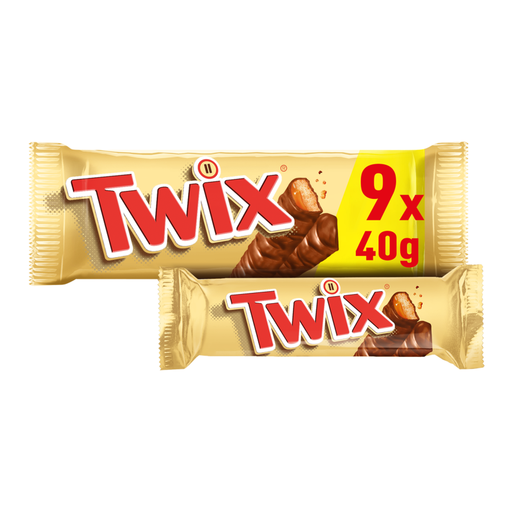
The Twix twin-bar pack below offers wrapped portions to carry before training. Its format differs from the four-bar Mars, Snickers, Galaxy and Cadbury packs discussed above, so compare the nutrition for its own 40 g twin pack rather than applying another bar’s figures.
 No image available
Nine individually wrapped 40 g twin packs give you a portion to carry before training. Check the carbohydrate and fat figures for one twin pack against your workout timing; the product information identifies milk, soya and wheat ingredients and also gives precautionary allergen wording, so read the exact pack before buying.
It can be an occasional portable option if the portion and timing suit you, but it need not replace a meal. The British Dietetic Association advises a low-fat, high-carbohydrate snack or light meal two to three hours before exercise; check a bar’s fat and carbohydrate per portion rather than relying on its sugar content alone.
Mars Caramel lists 28 g carbohydrate and 6.4 g fat in each 40 g bar, the most carbohydrate and least fat per bar among the four conventional multipacks compared here. Manufacturer listings give Snickers 23 g carbohydrate and 9.9 g fat per 40 g bar, and Galaxy 23 g and 14 g per 42 g bar; Ocado lists 19 g and 10 g per 33.5 g Cadbury Dairy Milk bar. These are label figures for different portion sizes, not measures of workout performance.
Read the ingredient and precautionary allergen statements on the exact pack before buying or eating it. Do not assume that another flavour, pack format or chocolate brand has the same ingredients; Snickers Peanut, for example, is explicitly a peanut bar.
Do not assume they do. Department for Education guidance addresses food provided in state-funded schools in England, and the Requirements for School Food Regulations 2014 define chocolate as confectionery within that framework. If buying food for a school to supply, check the standards for its nation and setting; those England-specific materials do not establish a single rule for all UK schools or home-packed lunchboxes.