Households sharing a biscuit break
A shared packet can cover several mid-morning breaks. Compare its weight and biscuit count, then consider how you will store it after opening.


For recurring household mid-morning snacks, choose a shared packet if several people will eat from it and you can store the remainder airtight; choose separately portioned bars when handing out individual snacks matters more. Check the exact pack weight or bar count, ingredients and nutrition for the portions you intend to serve. Household snack choices should not be treated as guidance for food provision in English schools.
A shared packet can cover several mid-morning breaks. Compare its weight and biscuit count, then consider how you will store it after opening.
Bars offer separate portions rather than a communal packet. Check the count and nutrition for the particular multipack you choose.
Look at the exact product label when chocolate style, listed allergens or the amount in one biscuit or bar affects your choice.
Choose it when: Several people will take biscuits from a packet over repeated breaks.
Bear in mind: Plan for airtight storage once the packet is open; a twin pack lets you leave the second packet sealed until needed.
Choose them when: You want to divide snacks between people without serving from one open packet.
Bear in mind: A bar is a different product and portion from a digestive biscuit, so compare the amounts you would actually serve.
| Priority | What to check | Your needs |
|---|---|---|
| Pack configuration | Check the total weight and stated biscuit or bar count for the exact variant. Distinguish one large packet from two smaller packets. | Will we finish an opened packet across our usual breaks, or would separate portions be easier to divide? |
| Chocolate style | Check whether the biscuit is coated, contains chocolate chips or is a filled bar. The descriptions refer to different constructions. | I would choose the style people want to eat, rather than assume a chocolate-chip digestive is coated. |
| Portions and ingredients | Read nutrition per biscuit or bar, and use per 100g figures for a weight-based comparison. Check the selected pack’s ingredients and allergen information. | If portions or ingredients matter in our household, I want to compare what each person would actually have. |
| Storage | Read the packet’s storage directions and check what to do after opening. Tesco’s listing for McVitie’s 400g Milk Chocolate Digestives and Sainsbury’s chocolate-chip digestives advise airtight storage after opening. | A shared packet may stay open between our mid-morning breaks, so I need somewhere suitable to keep it. |
McVitie’s lists several weights for its Milk Chocolate Digestives, including twin packs. Weight alone does not tell you how many biscuits you would serve at each break.
Check the count for the selected variant where it is stated, and plan how you will store an opened packet.
McVitie’s lists 83kcal per Milk Chocolate Digestive and 130kcal per Penguin Original bar. Those figures describe different products and serving units.
Compare the amounts you intend to serve; consult per 100g figures if you need a weight-based comparison.
Sainsbury’s describes dark chocolate chips within its 400g digestives, whereas McVitie’s Milk Chocolate Digestives have chocolate on the biscuit.
Check the construction and ingredients of the specific variant if that distinction affects your choice.
Gateshead Council’s explanation of the English school-food standards restricts mid-morning snacks and chocolate or chocolate-coated products in school food. Household shopping and school provision are separate decisions.
Use the applicable school-food requirements when choosing food for an English school, rather than treating these household options as approved for that setting.
McVitie’s Milk Chocolate Digestives are a coated biscuit available in several single-packet and twin-pack weights listed by the maker.
McVitie’s Penguin Original is a biscuit-and-cream bar with a chocolate-flavoured coating. Its maker lists 172g and 344g sizes.
McVitie’s Club Orange is an orange-flavoured biscuit bar with a chocolate-flavoured coating.
Its 400g chocolate-chip digestives offer a shared packet with chocolate pieces in the biscuit rather than a chocolate coating.
Tesco’s chocolate-digestive listings include own-label milk chocolate Digestives in a 300g packet and chocolate-chip Digestives in a 400g packet.
These options include shared chocolate biscuit packets and bar multipacks for household mid-morning breaks. Compare each pack’s stated quantity and format with the way your household will use it.
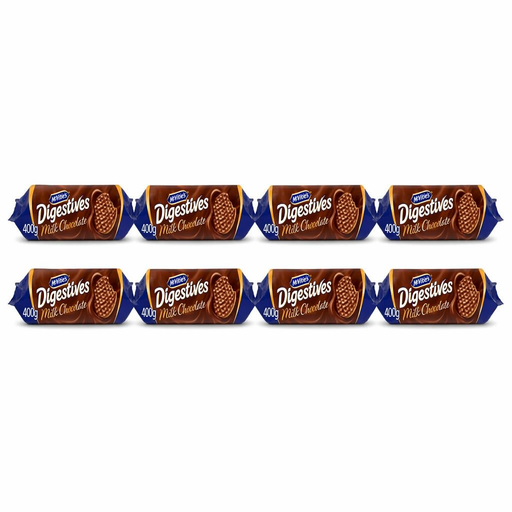 No image available
A 400g shared packet for serving biscuits over more than one break. Follow the pack’s directions for storage after opening; Tesco’s listing for this 400g product advises an airtight container.
 No image available
An eight-pack of milk chocolate caramel wafers for households considering bars rather than digestive biscuits. Check the selected pack’s wrapping, ingredients and per-bar information if you plan to hand out separate snacks.
 No image available
A 14-bar pack to consider when dividing mid-morning snacks. Penguin is a biscuit-and-cream bar rather than a digestive; use the selected pack’s per-bar nutrition when comparing the portions you would serve.
 No image available
Two 262g packets offer a way to open one shared packet at a time. Hobnobs are oat biscuits rather than wheat-based digestives; check the pack’s ingredients and directions for storing the opened packet.
 No image available
Two 266g packets suit a household choosing dark chocolate digestives and opening one packet at a time. Check the selected pack’s storage directions once a packet is open.
Follow the directions on the exact packet. Tesco’s listing for McVitie’s 400g Milk Chocolate Digestives specifies a cool, dry place and an airtight container after opening; Sainsbury’s gives airtight-storage advice for its 400g chocolate-chip digestives.
The UK government’s consumer guidance says a seller must offer a full refund for goods that are faulty or not as described. That is distinct from a change-of-mind return, for which different rules and exceptions may apply.
Do not use household biscuit choices as approval for school provision. Gateshead Council’s explanation of the English school-food standards says school snacks are restricted and that chocolate or chocolate-coated products are not permitted across the school day. The Department for Education described proposed further standards for September 2027 as subject to Parliamentary approval; check the applicable requirements for the school decision.
No general prohibition on household purchases follows from that warning. Department of Health and Social Care guidance addresses specified high-fat, sugar or salt product promotions and placement by businesses operating in and selling to England; school-food requirements have a separate scope. A particular biscuit’s classification needs to be assessed under the applicable rules, not assumed from its category name.